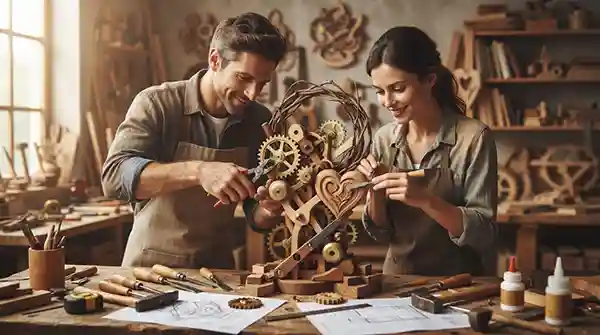
Stop Finding Love, Start Building It: The 4 Skills That Actually Last
Most Americans are taught to treat love as a discovery. You meet the right person. The chemistry clicks. The rest takes care of itself. That is the story we tell in movies, in songs, in the endless scroll of dating apps. It is also the reason so many relationships collapse. The story is not wrong about the feeling. It is wrong about the work. Love is not a lottery ticket. It is a craft. And crafts are not found. They are practiced.
I call the capacity to practice this craft love literacy: the learned ability to understand, give, and sustain care for another person as an ongoing discipline rather than a passive emotion. Love literacy is not about being nice. It is not about compatibility quizzes or shared hobbies. It is about knowing how to listen when you are tired, how to repair after a fight, how to stay when your instinct says run. It is a skill set. And like every skill set, it can be taught, learned, and improved.
The psychologist Erich Fromm made this argument in 1956 in The Art of Loving. He said love is an art. It requires knowledge. It requires effort. It requires practice. He also said that most people never learn it because they confuse the problem of loving with the problem of being loved. That confusion is still with us. Maybe more than ever.
Why we mistake being loved for loving
Watch an hour of American television. Count how many storylines are about being chosen. The makeover. The grand gesture. The moment someone finally sees you. We are obsessed with being picked. We are not obsessed with picking well, or staying well, or loving well after the picking is done.
Fromm called this the “passive” conception of love. The question is not “How do I love?” It is “How do I become lovable?” Men are taught to become successful. Women are taught to become attractive. Both are taught that these qualities will earn love the way a vending machine earns a snack. Put in the right coins. Get the reward. That is not love. That is commerce.
The research on attachment has shown something different. The capacity to love is not a fixed trait. It is a set of behaviors that can be learned. A 2025 study published in Journal of Social and Personal Relationships examined the relationship between emotional skills and relationship satisfaction across 2,400 adults. The findings showed that emotional skills—specifically the ability to identify, express, and regulate emotions—predicted relationship satisfaction more strongly than compatibility or shared interests. The skills were not innate. They were learned. And they could be improved with practice.
What the research on lasting couples actually shows
John Gottman at the University of Washington spent four decades studying couples. He could predict divorce with over 90 percent accuracy after watching a fifteen-minute interaction. He was not reading tea leaves. He was watching for specific behaviors. He called them the Four Horsemen: criticism, contempt, defensiveness, and stonewalling. These are not feelings. They are habits. They are learned responses to conflict. And they can be unlearned.
Gottman also found that the most important predictor of relationship stability was not the absence of conflict. It was the presence of repair. The couples who stayed together were not the ones who never fought. They were the ones who knew how to come back after the fight. They knew how to say sorry. They knew how to listen. They knew how to de-escalate. Those are skills. They are not personality traits. They are practices.
Sue Johnson at the University of Ottawa developed emotionally focused therapy, one of the most researched couples interventions in the world. Her work focuses on what she calls “attachment injuries”—moments when one partner fails to respond to the other’s need for connection. The healing does not come from insight alone. It comes from new experiences of responsiveness. The partner learns to turn toward instead of turning away. That turning is a skill. It can be taught.
Four practices that turn affection into a craft
Love literacy is not a single skill. It is a set of practices. The first is attention. Not the kind of attention that scrolls through a phone while nodding. The kind that notices. The research on “bids for connection,” a term Gottman coined, shows that couples who respond to each other’s small bids—a sigh, a question, a look—are more likely to stay together. The bids are not dramatic. They are small. The response is the practice.
The second is repair. Every relationship has ruptures. The question is not whether you will rupture. It is whether you will repair. Repair requires three things: acknowledging the specific behavior, recognizing its impact, and expressing a commitment to change. Those are not feelings. They are sentences. They can be learned.
The third is regulation. The research on emotional flooding, developed by Gottman and others, shows that when heart rates rise above 100 beats per minute, the ability to listen and empathize shuts down. The person becomes defensive, aggressive, or withdrawn. The skill is not to stop the flooding. It is to recognize it and take a break. A twenty-minute pause. A walk around the block. A glass of water. The break is the skill.
The fourth is generosity. Not the grand gesture kind. The small kind. Assuming good intent. Giving the benefit of the doubt. Noticing what is going right instead of what is going wrong. The research on gratitude and relationships has shown that couples who express appreciation regularly report higher satisfaction and lower conflict. The appreciation is not a feeling. It is a choice. And it is a practice.
How American dating culture trains the wrong muscles
Dating apps have made it easier to meet people. They have also made it easier to treat people as options. The research on choice overload has shown that too many options reduce satisfaction and commitment. The person who always has another match waiting is less likely to invest in the match in front of them. The apps do not train love literacy. They train comparison shopping.
The culture of “no strings attached” has also trained a specific kind of avoidance. The research on attachment styles has shown that avoidant attachment—the tendency to pull away when things get close—is associated with lower relationship satisfaction. The avoidant person is not incapable of love. They are unpracticed. They have learned to protect themselves by leaving before they can be left. The learning can be unlearned. But it takes work.
The American obsession with independence has also made interdependence feel like weakness. The research on interdependence, conducted by researchers including Eli Finkel at Northwestern University, has shown that the healthiest relationships are not the ones where two independent people happen to live together. They are the ones where two people rely on each other. The reliance is not a burden. It is a bond. The bond is the point.
When love becomes a transaction
The source of much relationship suffering is not the absence of love. It is the presence of a transaction. I will give you this if you give me that. I will be loving if you are loving first. I will stay if you make it worth my while. That is not love. That is a contract. And contracts are broken all the time.
The research on equity theory in relationships has shown that people who keep score are less satisfied than people who do not. The scorekeeping creates resentment. The resentment creates distance. The distance creates more scorekeeping. The cycle is a trap. The exit is not to keep better score. It is to stop keeping score at all.
Fromm said that love is the active concern for the life and growth of the person you love. Active. Concern. Growth. Those are not feelings. They are actions. They are choices. They are practices. The person who practices them does not ask what they are getting. They ask what they are giving. And paradoxically, they get more.
Building love literacy in an age of instant gratification
The good news is that love literacy can be learned. The research on relationship education has shown that couples who participate in skills-based programs report higher satisfaction and lower divorce rates. The skills are not complicated. They are things like active listening, conflict de-escalation, and emotional expression. They are not taught in most American schools. They should be.
The first step is to stop treating love as a feeling that happens to you. It is a practice that you do. The second step is to start small. You do not need to overhaul your entire relationship in a day. You need to change one thing. One conversation. One repair. One moment of attention. The small change is the beginning. The beginning is the practice. The practice is the life.
The third step is to get feedback. You cannot see your own patterns. You need someone who will tell you the truth. A therapist. A coach. A trusted friend who is not afraid to hurt your feelings. The feedback is the mirror. The mirror is the tool. The tool is the teacher.
When the problem is not a skill deficit
There is a limit to what love literacy can fix. Some relationships are not struggling because of missing skills. They are struggling because of abuse, addiction, untreated mental illness, or fundamental incompatibility. The research on intimate partner violence and coercive control has shown that these patterns are not communication problems. They are safety problems. No amount of active listening will fix them.
If you are in a relationship where you feel unsafe, where you are being controlled, where you are afraid to speak or leave, the appropriate response is not to practice better communication. It is to seek help from a qualified professional who can assess what is happening and help you create a safety plan. The research on domestic violence and trauma is robust. Support is available. You are not to blame.
If you are experiencing persistent sadness, anxiety, or distress related to your relationship, if it interferes with sleep, appetite, work, or daily functioning, the appropriate response is not to try harder to fix it alone. It is to speak with a mental health professional who can help you assess what is happening and develop strategies for moving forward. Love literacy is a skill. It is not a substitute for safety.
The art you practice every single day
Fromm ended The Art of Loving with a simple observation. Love is not a state of being. It is a practice. It is not something you fall into. It is something you do. The doing is not glamorous. It is not cinematic. It is a thousand small choices, repeated daily, that say to another person: I see you. I am here. I choose you again.
The feeling may come and go. The practice remains. The practice is the thing that lasts. The practice is the thing that builds. The practice is the art. And the art is yours to learn.