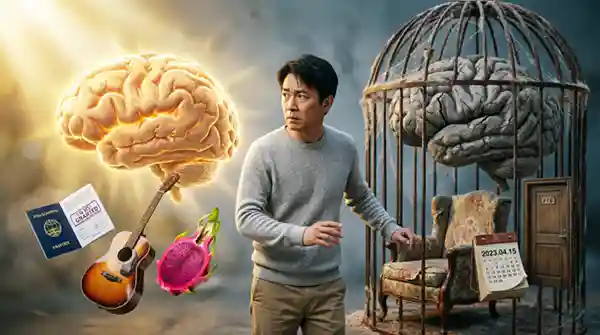
The Familiarity Trap
The research is unambiguous, and it has been for decades. Fear of the unfamiliar does not protect you. It ages you.
A 2003 study published in the Proceedings of the National Academy of Sciences found that infant rats identified as neophobic—hesitant to explore new environments—had a 60 percent higher mortality rate than their more exploratory brothers. The fearful rats lived shorter lives. Not because they were killed by predators. Because their stress response was chronically activated, and the chronic activation wore them down. The study’s authors concluded that an emotional trait present in infancy predicted an early death, and that the mechanism was neuroendocrine. The body, flooded with stress hormones every time it encountered something new, simply wore out faster. The same pattern has been documented in humans. The trait that keeps you safe in the short term is the trait that kills you in the long term.
What Neophobia Actually Is (And Why It Gets Worse With Age)
Neophobia is not a simple preference for routine. It is not the comfortable feeling of returning to a familiar restaurant or the mild hesitation before trying an unfamiliar cuisine. Neophobia is a persistent, irrational fear of anything new or unfamiliar. It is an exaggerated protective mechanism, an evolutionary impulse gone awry.
The term comes from the Greek neos, meaning new, and phobos, meaning fear. The condition exists on a spectrum. At its mildest, it is a reluctance to deviate from established patterns. At its most severe, it is a clinically diagnosable specific phobia that triggers panic, elevated heart rate, sweating, dizziness, and muscle tension in response to novelty that poses no actual threat.
The research on age-related changes in exploratory behavior is consistent. A 2026 paper published in Scilit proposed what the authors call the Neuroplasticity-Fear Axis Hypothesis. The framework integrates findings on age-related decline in brain plasticity, amygdala-driven threat processing, and the developmental neurobiology of risk-taking. The argument is that the decline in synaptic plasticity that accompanies aging—particularly in the prefrontal cortex and hippocampal regions—shifts the balance of cognitive-emotional processing toward amygdala-mediated fear responses. The aging brain becomes more reactive to threat and less capable of flexible adaptation.
But the same paper contains a crucial caveat. The trajectory is not deterministic. Individuals who maintain high levels of cognitive engagement through lifelong learning, professional intellectual activity, and continuous adaptation to technological and social change demonstrate preserved neuroplasticity and correspondingly greater openness to experience. The decline is real. But it is not inevitable.
Why Your Brain Treats a New Smartphone Like a Predator
The brain does not distinguish between a genuine threat and an unfamiliar interface. The amygdala, the almond-shaped structure deep in the temporal lobe that has been scanning for danger for hundreds of millions of years, responds to novelty the same way it responds to a snake on the hiking trail. Heart rate climbs. Palms sweat. Muscles tense. The prefrontal cortex, the part of the brain responsible for reasoning and flexible thinking, goes partially offline.
A study published by the Association for Psychological Science examined why older adults are reluctant to adopt new technology. The findings showed that attitudes and abilities are among the most powerful predictors of technology use. The reluctance is not a character flaw. It is a documented psychological response to novelty that has been reinforced by a lifetime of experiences in which new things were, in fact, sometimes dangerous.
The reinforcement is the problem. Every time you avoid something new, you teach your brain that the avoidance was justified. Every time you stick with the familiar, you strengthen the neural pathways that favor the known over the unknown. The pattern becomes self-perpetuating. The world narrows. The comfort zone shrinks. And the shrinking is not neutral. It is active. It is a process of cognitive narrowing that accelerates the very decline it is trying to prevent.
The Science of Why New Experiences Protect Your Brain
The research on novelty and brain health is extensive and consistent. A 2026 article by Dr. Steve Allder, a consultant neurologist at Re:Cognition Health, synthesized the evidence into a clear picture of what happens when the brain encounters something new.
Every time you try something unfamiliar—learning a language, picking up a musical instrument, taking a different route to work—you challenge your brain to process information in new ways. This stimulation encourages the formation of new neural connections and strengthens the pathways that allow brain cells to communicate effectively. A brain with a rich and varied network is more adaptable and better able to cope with stress and age-related changes.
Novel experiences also capture attention, which is a key ingredient for forming lasting memories. The brain treats new experiences as important, activating memory centers like the hippocampus. This is why first-time experiences—travelling to a new city, trying a new sport—are often remembered vividly. Regularly exposing yourself to new situations, even on a smaller scale, gives your memory systems a workout. Over time, this improves the ability to store and retrieve information.
Experiencing something new triggers the release of dopamine, a neurotransmitter linked to motivation, pleasure, and reward. This chemical response makes exploration enjoyable and encourages curiosity, engagement, and positive behavior. By trying a new hobby or social activity, you not only boost your mood but also increase energy, self-confidence, and a sense of achievement.
Routines are comforting, but repeating the same activities day after day allows some brain circuits to dominate while others weaken. Introducing new experiences activates multiple brain regions, creating a stronger and more resilient network. Activities that combine mental, physical, and social engagement—joining a dance class, attending a workshop, travelling—are particularly protective, helping slow age-related cognitive decline and keeping the brain agile.
The Openness Advantage: What the Research Says About Successful Aging
A 2025 study published in Innovation in Aging examined the roles of growth mindset and openness to experience in successful aging among adults aged 60 to 80. The findings supported the hypothesis that higher levels of openness and a growth mindset were associated with better aging outcomes, including improved emotion regulation and attention regulation.
Openness reflects a person’s willingness to consider new ideas and experiences. Individuals high in openness are more likely to engage in a diverse range of activities, which helps build cognitive reserve—the brain’s ability to withstand damage by recruiting alternative neural pathways. The cognitive reserve is not a fixed quantity. It is built through engagement. And it can be depleted through disengagement.
The study also found that openness mediated the relationship between years of education and growth mindset, and that growth mindset mediated the relationship between openness and successful aging. The two traits work together. Openness provides the raw material. Growth mindset provides the belief that the material is worth using.
How to Break the Familiarity Trap
The way out of the trap is not to force yourself to do things you hate. It is not to become a different person. It is to recognize that the discomfort of novelty is not a signal of danger. It is a signal of growth. The nervous system is firing because it is encountering something it has not encountered before. The firing is not a warning. It is a workout.
The first practice is to start small. The research on habit formation is clear. Small behaviors, repeated consistently, become identity. You do not need to move to a new country or change your career. You need to take a different route to the grocery store. You need to order something you have never ordered at a restaurant you have been to a hundred times. You need to read a book about a subject you know nothing about. The novelty does not have to be dramatic. It just has to be real.
The second practice is to name the fear. When the resistance arrives—and it will—notice it. Name it. Say to yourself: “This is the neophobia. This is the alarm misfire.” The naming creates a gap between the stimulus and the response. And in that gap, choice becomes possible.
The third practice is to tolerate the discomfort. The research on exposure therapy is unambiguous. The way to reduce fear is to approach the feared thing, not to avoid it. The first time is uncomfortable. The second time is less so. By the tenth time, the fear has lost its grip. The nervous system has learned that the novelty is not dangerous. The learning is not intellectual. It is physiological. And it is the most durable kind of learning there is.
When the Fear Is More Than a Habit
There is a limit to what self-directed strategies can accomplish. If the fear of novelty is accompanied by persistent anxiety, depression, or a sense of hopelessness that does not lift, the appropriate response is not to try harder to embrace change. It is to speak with a mental health professional who can assess what is happening.
The research on anxiety disorders and specific phobias is robust. Cognitive behavioral therapy, particularly exposure and response prevention, has strong evidence for treating phobic responses. Medication can also be effective for severe anxiety. These treatments work. But they work best when delivered by someone trained to deliver them.
This is not a disclaimer. It is the same logic that runs through everything else in this piece. You do not try to fix a broken bone with positive thinking. You go to a doctor. You do not try to fix a severe phobia with a few new hobbies. You get help.
The Choice That Determines How You Age
The research on neophobia and aging points toward a single conclusion. The fear of the new is not a protective mechanism. It is a degenerative one. The brain that avoids novelty is the brain that atrophies. The brain that engages with it is the brain that stays young.
The woman who refuses to learn the new software at work is not protecting herself. She is narrowing her world. The man who only eats at the same five restaurants is not being prudent. He is depriving his brain of the stimulation it needs to stay sharp. The retiree who fills her days with the same routines is not enjoying her freedom. She is accelerating her decline.
The alternative is not to become reckless. It is to become curious. To treat the unfamiliar not as a threat but as an invitation. To recognize that the discomfort of novelty is the feeling of a brain that is growing rather than shrinking. To choose, every day, in small ways, to move toward the new instead of away from it.
The brain you save may be your own. And the life you build will be larger, richer, and more resilient than the one you would have had if you had stayed in the familiar place. The rest is not complicated. The rest is showing up. The rest is saying yes when the easy answer is no.