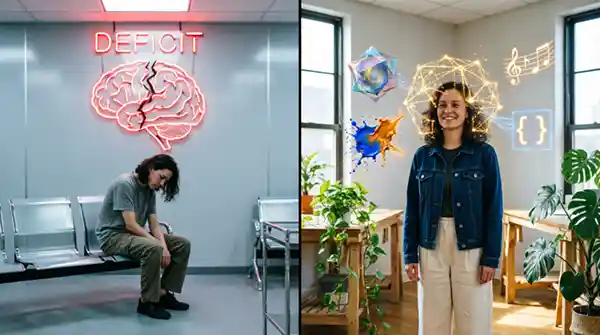
The productive deviation: why atypical brains build what normal ones cannot
I have been called difficult. Intense. Too much. For most of my life I treated these as insults. Then I understood they were descriptions. Not of a flaw. Of an operating system. I call it productive deviation: the capacity to convert non-normative cognitive and emotional patterns into output that the normal- brained world cannot generate. It is not a superpower. It is a trade- off. And it comes with a manual nobody hands you.
The mistake most people make is treating normality as the goal. It is not. It is a baseline. It is the factory setting. And factory settings are rarely optimal for anything except fitting in. The people who change things are almost never in the middle of the distribution. They are on the edges. They are the outliers. They are the ones the middle calls weird. The question is not whether your brain is strange. The question is whether you are going to let the strangeness run the show or put it to work.
Why normality is a statistical category
Normal describes the center of a bell curve. It does not describe excellence. It does not describe creativity. It does not describe anything particularly useful. It describes the average. And the average is, by definition, unremarkable. The person who is normal is the person who is indistinguishable from the crowd. That is not an insult. It is a description. But it is also not a life goal.
David Weeks, a neuropsychologist at the Royal Edinburgh Hospital, spent years studying eccentrics. He found they were not miserable. They were healthier than average. They visited doctors less. They reported higher levels of happiness. The stereotype of the tortured oddball is not wrong, exactly, but it is incomplete. Many eccentrics are having a better time than the normies. They simply do not care what you think about their wardrobe. The deviation is not the problem. The problem is the world’s reaction to it.
What research on eccentricity actually shows
The research on creativity and psychopathology has been consistent for decades. Dean Keith Simonton at the University of California, Davis, synthesized the evidence and found that eminent creators are roughly twice as likely to experience some form of mental disorder as the general population. Depression is the most common. Alcoholism and suicide are elevated. The rate is higher among artists than scientists. Poets are the most afflicted. In one study, eighty- seven percent of famous poets showed signs of psychopathology.
But here is the crucial distinction. The pathology is not the source of the creativity. It is a correlate. It is a side effect of the same underlying architecture that produces the work. The genes that build a brain capable of seeing connections others miss are the same genes that build a brain vulnerable to mood dysregulation. The two come as a package. The productive version is the one where the intensity is channeled. The destructive version is the one where the intensity runs the show.
Neuroscience of divergent processing
Your brain is not a computer. I know everyone says it is. They are wrong. A computer runs the same program and gets the same result every time. A brain is a wet, electrical, chemical mess that is constantly rewiring itself based on what happened five seconds ago and what happened twenty years ago. It is not designed for accuracy. It is designed for survival. And survival, in a complex environment, sometimes rewards strange.
There is a trait called sensory processing sensitivity. About fifteen to twenty percent of the population has it. Highly sensitive people process information more deeply. They notice subtleties others miss. They are more affected by art, music, and the emotional states of people around them. They also get overwhelmed more easily. Research by Bianca Acevedo and Elaine Aron has found that this trait is associated with greater activation in brain regions involved in empathy, awareness, and integration of complex information. It is not a disorder. It is a temperament. And it comes with both costs and benefits. The cost is obvious. The world is loud. Crowds are exhausting. Criticism cuts deep. The benefit is less obvious until you see the output. The sensitive person who survives the overwhelm often produces work that is richer, more nuanced, and more emotionally resonant than the person who feels nothing at all.
When intensity becomes liability
There is a difference between productive intensity and self- destructive spiral. The writer who turns existential dread into a novel is channeling. The writer who cannot write because they are too depressed is drowning. The musician who transmutes heartbreak into a song is channeling. The musician who self- destructs before the album is finished is drowning. The scientist who harnesses obsessive attention into a decade of research is channeling. The scientist who burns out before the breakthrough is drowning.
The difference is not the intensity. It is the structure. It is whether the person has built a container for the chaos. The research on grit and deliberate practice supports this framing. Angela Duckworth at the University of Pennsylvania found that perseverance and passion for long- term goals predict success beyond intelligence. The eccentric brain is not an excuse for lack of output. It is a different route to output. But the route requires a vehicle. The vehicle is routine, support, and a sense of mission larger than your own comfort.
Difference between burden and gift
The distinction is not moral. It is practical. It depends on output. Are you producing something? Are you creating, building, solving, contributing? If the answer is yes, your deviation is likely productive. If the answer is no, if the deviation is consuming all your energy and leaving nothing for the work, then the deviation is just a burden. The same wiring can produce either. The wiring does not decide. You do.
A 2025 study published in the Journal of Personality and Social Psychology found that individuals with high levels of openness to experience and intellect were more likely to engage in creative behavior. Neuroticism was not a predictor. The trait that mattered was openness. Openness is not the same as neuroticism. Openness is the engine. Neuroticism is sometimes the exhaust. The engine can run without the exhaust. The exhaust without the engine is just pollution.
How to tell if your deviation is productive
Ask three questions. First: does the deviation produce something that did not exist before? A sentence. A solution. A connection. A piece of code. A conversation that changes someone’s mind. Second: does the deviation interfere with your ability to function? Sleep. Appetite. Relationships. Work. If the answer to the first is yes and the answer to the second is no, you are in the productive range. If the answer to the second is yes, the deviation is winning. Third: do you have a container? A routine. A therapist. A friend who tells you the truth. A practice that grounds you. The container is not optional. The container is what separates the burden from the gift.
Ones who changed everything
Newton was paranoid, insomniac, and depressed. He also invented calculus and described gravity. Tesla had obsessive rituals and probably OCD. He also electrified the world. Churchill had bipolar disorder, or something close to it. He also held the line against fascism. Van Gogh cut off his ear and painted Starry Night. The pattern is not that the suffering caused the genius. The pattern is that the same brain that was capable of the genius was also prone to the suffering. The brain did not choose one. It came with both.
The productive ones were not the ones who suffered more. They were the ones who found a way to work despite the suffering. They had routines. They had support. They had a sense of mission that was larger than their own comfort. They had something to do. The work was the container. The container held the chaos.
What research says about treatment and creativity
There is a persistent fear that treating mental health problems will kill the creative gift. The research does not support this fear. A 2025 review in the Journal of Creative Behavior found that treatment for depression and anxiety often improves creative output, not diminishes it. The reason is simple. Depression and anxiety consume cognitive resources. They narrow attention. They reduce the capacity for divergent thinking. Treating them frees the resources. The gift is not in the symptom. The gift is in the brain. The symptom is an obstacle. Removing the obstacle lets the gift move.
If you are experiencing persistent sadness, anxiety, or distress that interferes with sleep, appetite, work, or relationships, the appropriate response is not to try harder to channel it into art. It is to speak with a mental health professional who can assess what is happening and recommend an appropriate course of care. The research on psychotherapy and medication for these conditions is robust. Support is not a sign that you have failed to be productive. It is a recognition that some containers need professional construction.
A note on seeking help
The cultural myth of the mad genius is dangerous because it romanticizes the suffering. It suggests the pain is the price of the gift. That is a lie. The pain is not the gift. The pain is the tax. And the tax is not always worth paying. The goal is not to suffer. The goal is to produce. If the suffering interferes with the production, the suffering is the problem, not the muse. The muse does not require your destruction. The muse requires your attention. Attention is easier when you are not drowning.
Choice you make every day
You are not a broken version of a normal person. You are a different version of a person. The question is not whether your brain is weird. The question is whether you are going to let the weirdness run the show or put it to work. The choice is not a single decision. It is a daily practice. It is the decision to channel the intensity into the work. It is the decision to build a life that can hold the chaos. It is the decision to stop apologizing for the way your brain works and start using it.
The malfunction is not the enemy. The malfunction is the material. The work is the thing you build with it. And if the work is not happening, if the malfunction is winning, the answer is not to try harder. The answer is to get help. A therapist. A doctor. A community. The research is clear that treatment does not kill the gift. It clears the ground so the gift can grow.
I know which one I am choosing. Most days. The days I do not choose it, I try again. That is the practice. That is the life. That is the productive deviation.