Stand Like You Mean It (Because Your Brain Is Watching)
Two minutes.
That’s all it takes. Two minutes in a bathroom stall with your arms raised over your head like you just won the Super Bowl. Two minutes of taking up space you would never take up in public. Two minutes of pretending, before the real thing starts, that you are not afraid.
That was the promise. And for a while, millions of people believed it.
Amy Cuddy stood on a stage in 2012 and told the world that your body could change your mind. Strike a power pose. Hold it. Walk into the room. The hormones shift. The confidence arrives. Fake it until you make it.
The talk went viral. It became a shorthand for a generation of self-help. And then the scientists came for it.
When the data said no
The original studies were small. Eighteen people. Forty-two people. Sample sizes that would never pass peer review today. And when researchers tried to replicate the hormone findings with larger groups, the effects vanished. Testosterone didn’t climb. Cortisol didn’t drop. The magic was not in the blood.
Cuddy eventually backed off the hormonal claims. She said the science had moved. She said she was following it. She didn’t disappear. She didn’t apologize for the talk. She just stopped talking about the hormones.
But here’s the thing nobody noticed.
The pose still worked.
What the follow-up studies found
A team of researchers tested power posing on 54 undergraduate students before a five-minute presentation. The students who practiced expansive poses didn’t show hormonal changes. They showed something more useful. Their presentation performance improved. Their self-efficacy scores climbed. Their perceived stress dropped.
The effect wasn’t in their blood. It was in their behavior.
The conclusion was not that power posing is fake. It was that the mechanism is different than we thought. The body doesn’t change the hormones. The body changes the mind.
You already know this if you’ve ever paid attention to your own posture. When you’re sad, you slump. When you’re scared, you curl inward. When you’re confident, you open up. The relationship runs in both directions. Your emotional state shapes your posture. Your posture shapes your emotional state.
The pose is not a trick. It’s a signal. You’re telling your own nervous system what kind of situation this is. And your nervous system is listening.
The failure mode that nobody talks about
The original power pose advice had a flaw that had nothing to do with hormones. It was the isolation.
Find a private space. Contort your body. Hold it for two minutes. Then walk into the high-stakes situation like nothing can touch you.
The pose was a secret ritual. A private hack. A way to trick your nervous system before the performance began.
But confidence is not a state you generate in a bathroom stall and carry into a room like a battery. It’s a quality of attention. A way of being present. A relationship with the people in front of you.
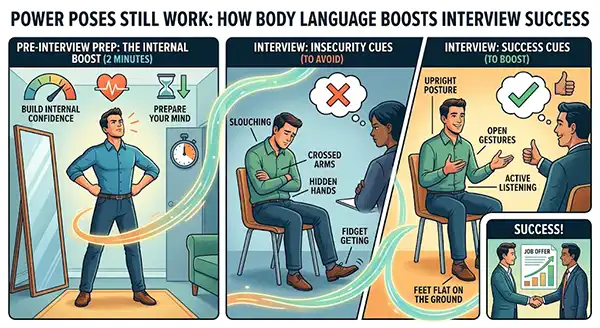
The Harvard study that tested power posing before a job interview found something interesting. The high-power posers performed better and were more likely to be hired. But the effect was mediated entirely by presentation quality — how captivating and confident they appeared — not by speech quality. The pose didn’t make them smarter. It made them more present.
The pose is not the point
You can stand like a superhero for two minutes and still walk into the room and fall apart. The pose doesn’t do the work. The pose creates the conditions for the work.
What work?
The work of paying attention. To the other person. To the conversation. To the room. To the signals your body is sending and the signals you’re receiving.
The research on embodied cognition has been clear for decades. Your body and your mind are not separate systems. They are one system. And the signals run in both directions.
When you sit up straight, you trust your own thoughts more. When you lean forward, you’re more engaged. When you uncross your arms, you’re more open to persuasion. These aren’t metaphors. They’re measurable effects.
A 2009 study found that participants who sat in a confident posture — chest out, back straight — were more confident in their own judgments than participants who slouched. The posture affected metacognition. It changed how much people trusted themselves.
The trick that works better than the pose
There’s a technique that shows up in every serious book on performance. It’s not a pose. It’s not a mantra. It’s a question.
Before you walk into the room, ask yourself: what would I do if I weren’t afraid?
Not “how would I feel.” Not “what would I look like.” What would I do.
The question shifts the focus from the internal state to the external action. It moves attention away from the anxiety and toward the behavior. And behavior, unlike emotion, is something you can control.
The answer is usually simple. I would speak up. I would ask the question. I would say the thing I’ve been holding back. I would stop performing and start participating.
The pose is a preamble. The question is the practice.
What to do with your hands
The most common piece of advice for nervous speakers is to do something with your hands. Put them in your pockets. Hold a pen. Gesture.
The research on gesture and cognition suggests this is backward. Gesturing isn’t a distraction. It’s a cognitive tool. It helps you think. It helps you remember. It helps you organize your thoughts in real time.
A 2025 study published in Psychological Science found that people who gestured while speaking were perceived as more competent and more confident than people who kept their hands still. The effect was not about the gesture itself. It was about what the gesture communicated. The gesturers were more engaged. More alive. More present.
The lesson is not to wave your hands around like a windmill. It’s to let your body participate in the conversation instead of trying to suppress it. The body is not an obstacle to communication. It is part of communication.
The problem with faking it
“Fake it until you make it” is the most quoted line from the original talk. It’s also the most misunderstood.
The instruction is not to become a fraud. It’s not to pretend to be someone you’re not. It’s to act as if the outcome you want is already true. To behave as if the confidence you’re seeking is already present.
The research on self-perception theory, developed by Daryl Bem at Cornell, explains why this works. We infer our own attitudes and emotions from our behavior. We don’t feel confident and then act confident. We act confident and then feel confident. The behavior comes first. The feeling follows.
So the pose is not a lie. It’s a rehearsal. You are practicing the version of yourself you want to become. And with enough practice, the version becomes real.
When the fear is more than a pose can fix
There’s a limit to what posture and self-talk can accomplish.
If the fear of public speaking is persistent, if it interferes with your career, your relationships, or your ability to function, if it produces physical symptoms like panic attacks, nausea, or a racing heart that doesn’t slow down — that’s not a posture problem. That’s a clinical condition. And it requires a clinical response.
Talk to a mental health professional. The research on social anxiety disorder and performance anxiety is robust. Cognitive behavioral therapy, acceptance and commitment therapy, and other evidence-based interventions have been shown to reduce symptoms and improve functioning.
This is not a disclaimer. It’s the same logic that runs through everything else in this piece. You don’t try to fix a broken bone with a power pose. You go to a doctor. You don’t try to fix a broken emotional system with a bathroom ritual. You get help.
The only pose that matters
The pose is not the point.
The point is what happens when you walk into the room. The attention you bring. The curiosity you carry. The willingness to be present with the people in front of you instead of retreating into your own private spiral of self-monitoring.
The original power pose research was flawed. The hormones don’t change. The science didn’t replicate. But the underlying insight was correct. The body and the mind are not separate. They are one system. And you can use the body to influence the mind.
So stand up straight. Take up space. Let your hands gesture. Breathe.
Not because a pose will change your hormones. Not because faking it will make it real. Because the body is the first language you speak. And sometimes, the simplest way to change your mind is to change the way you carry it.