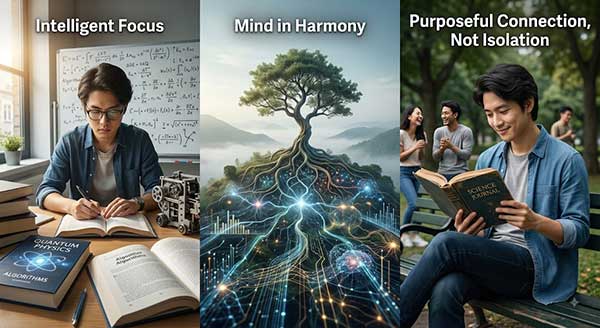
THE SOLITUDE OF THE LUCID: WHY THE BRILLIANT CHOOSE FEWER COMPANIONS
We often measure a life well-lived by the warmth of a crowded room. A chorus of voices, a constellation of friends, an endless stream of shared laughter—these are the traditional markers we use to anchor our happiness. Yet, if you peer closely at the inner worlds of exceptionally bright minds, you might notice a quiet contrast. They move through life with a sparse, deliberate circle. Why do exceptionally intelligent people so often cultivate fewer friendships? Let’s look at what science has to say about this quiet, intentional choice.
THE SAVANNA PARADOX: WHEN CROWDS BREED DISCONTENT
In a landmark study published in the British Journal of Psychology, evolutionary psychologists Satoshi Kanazawa and Norman Li analyzed data from 15,000 individuals aged 18 to 28. Their findings uncovered a fascinating dual reality: generally speaking, high population density reduces life satisfaction, and frequent interaction with close friends increases daily happiness.
Except for one striking exception: individuals at the higher end of the intelligence spectrum. For highly intelligent minds, frequent socialization actually correlated with a decrease in overall life satisfaction.
[ ANCESTRAL SAVANNA: Tribal Survival ] ──► [ MODERN DENSITY: Evolutionary Novelty ] ──► [ HIGH INTELLECT: Accelerated Adaptation ]
Our brains evolved to navigate low-density hunter-gatherer clans where daily tribal cooperation was a literal matter of survival. Highly intelligent individuals tend to adapt more fluidly to modern evolutionary novelties, navigating abstract challenges with such ease that they feel less bound to the ancestral instinct equating physical isolation with mortal danger.
THE ARCHITECTURE OF LONG-TERM FOCUS
Brilliance is rarely passive; it is an active engine seeking to build, decode, or transform. While a crowded Friday night offers comforting community, a deeply focused mind often experiences excessive socialization as a cognitive distraction.
This is never about cold misanthropy. When an individual is consumed by a grand vision—building an enterprise, mastering a discipline, or birthing a creative work—every hour spent in casual small talk carries an invisible friction. They trade the transient noise of broad social circles for the deep, quiet sanctuary of unbroken momentum. To them, goals are sacred commitments that demand protected time.
THE SELECTIVE GEOMETRY OF CONNECTION
To say intelligent people have fewer friends is not to say they lack warmth or devalue human connection. Rather, their currency is time, and their relationship architecture is built on profound depth rather than wide breadth.
They do not need a crowded gallery to feel anchored; they prefer a quiet harbor shared with minds that mirror their own hunger for depth. When they love, they love with intention. And when they step back into solitude, they are simply returning home to the work that calls their name.
EMPIRICAL REFERENCE
- Kanazawa, S., & Li, N. P. (2016). The savanna theory of happiness: Why modern life makes us unhappy. British Journal of Psychology, 107(4), 679–701.