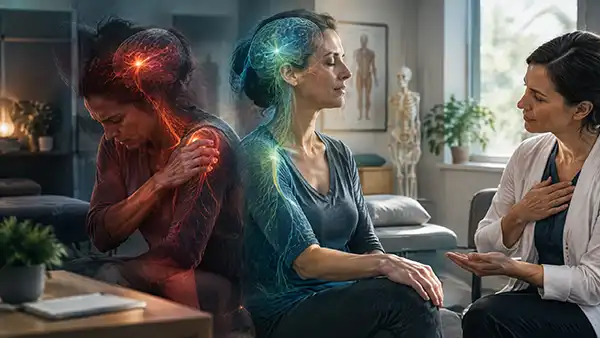
The body that believes: a spiral through the mind-body conversation
The mind and the body are not separate. They are in constant dialogue. The dialogue is chemical. It is electrical. It is measurable. Thoughts, expectations, and meanings influence physical processes in ways that science is only beginning to map. But the influence is not unlimited. It does not cure cancer. It does not replace medicine. It modulates. It supports. It shapes the conditions under which healing either happens or does not. This is the spiral I want to trace: the three turns of the mind-body conversation, each one deeper than the last.
The hand that touches the wound
The first turn is the most basic. It is touch.
A blindfolded volunteer sits with three fingers submerged in three separate water baths. The index and ring fingers rest in warm water. The middle finger rests in cool water. The arrangement produces a well-documented sensory illusion: the middle finger feels as if it is burning. The volunteer reports pain.
The researchers, led by Marjolein Kammers at the University College London Institute of Cognitive Neuroscience, then ask the volunteer to withdraw the hand and press the affected fingers together. The pain drops by 64 percent. When the volunteer presses the same fingers against the experimenter’s hand, nothing happens.
The finding, published in Current Biology, was not about the magic of touch. It was about the brain’s map of the body. Kammers proposed that self-contact provides the brain with multiple streams of sensory data—temperature, position, identity—that allow it to update a coherent representation of the physical self. The pain did not disappear because the tissue healed. It disappeared because the brain revised its interpretation of the signal.
A follow-up study found something stranger. When the volunteers placed their own hand on the affected area, the pain decreased. When the experimenter’s hand was placed on the same area, the pain increased. The difference was not the pressure. The difference was the ownership. The brain knows which hand belongs to it. The map is not just a map. It is a map with a signature.
The gate-control theory of pain, proposed by Ronald Melzack and Patrick Wall in 1965, had finally found direct electrophysiological evidence in humans. When a painful laser pulse is delivered to the skin, the brain generates a characteristic response. When the same skin is simultaneously touched, the response is suppressed at the subcortical level, in the brainstem, before the signal reaches the cortex. The touch is not just a distraction. It is a gate. It closes before the pain can fully arrive.
Why expectation changes the immune response
The second turn is deeper. It is expectation.
The placebo effect was once dismissed as a nuisance variable, something to be controlled for in clinical trials. The research of the past two decades has reversed that judgment. The brain can self-medicate, and the list of conditions that are placebo-responsive is longer than most physicians were trained to believe. Parkinson’s disease, chronic pain, irritable bowel syndrome, depression, anxiety, certain types of asthma, and autoimmune deficiencies all show measurable responses to belief alone. Cancer does not.
The distinction matters. The mind is not a substitute for medicine. It is a modulator of medicine. A 2026 review in Pain examined the relationship between treatment expectations and outcomes in chronic low back pain. The findings showed that positive expectations were associated with better treatment outcomes, but the effect was moderated by depression. The patients who were both optimistic and not depressed had the best outcomes. The patients who were pessimistic and depressed had the worst.
A separate 2026 study examined negative expectancies specifically. The researchers found that negative expectancies predicted worsening pain outcomes over a ten-year period in older adults. Positive expectancies did not predict improvement. The absence of negative expectation was the protective factor.
This is a subtle but crucial point. The goal is not to force yourself into a state of relentless positivity. The goal is to stop rehearsing the worst. The brain that is constantly preparing for disaster is a brain that is constantly releasing stress hormones. The stress hormones suppress the immune system. The suppressed immune system struggles to do its job.
The nocebo effect is the shadow of the placebo effect. When a patient expects a treatment to cause side effects, the side effects are more likely to occur. When a patient expects pain, the pain is more intense. The expectation is not just a thought. It is a physiological instruction. A 2025 study in Journal of Psychosomatic Research examined the nocebo effect in patients receiving beta-blockers. The patients who were told about the potential side effects of fatigue and sexual dysfunction were significantly more likely to report those side effects than patients who were not told. The pharmacological effect was the same. The expectation was different. The difference was the symptom.
Psychoneuroimmunology is the study of how psychological states influence the nervous, endocrine, and immune systems. The mechanisms are specific. Immune cells have receptors for neuropeptides, the chemical messengers produced by the brain in response to emotional states. When you feel fear, you release one set of chemicals. When you feel safety, you release another. The immune cells are listening. They adjust their behavior accordingly.
A 2025 study in Nature Reviews Immunology examined the role of the vagus nerve in immune regulation. The vagus nerve is the main highway of the parasympathetic nervous system. It connects the brainstem to the heart, lungs, gut, and immune organs. The study found that stimulating the vagus nerve reduced inflammatory cytokine production in animal models of sepsis. The finding has led to clinical trials of vagus nerve stimulation for inflammatory conditions. The mind is not just talking to the immune system. It is talking through a specific telephone line.
When meaning makes healing possible
The third turn is the deepest. It is meaning.
Viktor Frankl, the Austrian psychiatrist who survived Auschwitz, wrote that the last of human freedoms is the ability to choose one’s attitude in any given set of circumstances. The claim is not inspirational. It is clinical. The research on meaning in life has consistently found that the presence of meaning predicts better mental health, better physical health, and longer life. The person who has a reason to live is the person who is more likely to live.
A 2025 study in Journal of Contextual Behavioral Science examined the relationship between psychological flexibility, existential resources, and meaning in life among older adults. The findings showed that psychological flexibility predicted the deployment of existential resources, including freedom and responsibility. Those resources were associated with meaning in life. Meaning in life predicted lower psychological distress and higher life satisfaction.
The research on social support and health outcomes has consistently found that people with strong social connections recover faster from illness, manage chronic conditions better, and live longer. A 2025 study in The Lancet Public Health found that social isolation was associated with a significantly increased risk of dementia, independent of other risk factors including depression, hypertension, and diabetes. The isolation was not just a psychological state. It was a physiological stressor.
The research on loneliness has shown that it activates the same inflammatory pathways as physical threat. The lonely person is not just sad. They are inflamed. The inflammation is chronic. The chronic inflammation damages tissue. The damage accumulates.
Reiki is a Japanese energy healing practice in which practitioners channel energy through their hands into the patient’s body. A 2024 study on knee osteoarthritis compared reiki, mindfulness, and a sham treatment. Clinically meaningful reductions in symptoms were reported by 55 percent of participants in the reiki and mindfulness groups, compared to 20 percent in the sham group and 13 percent in the waitlist group. The retention rate was 96 percent. The blinding was successful. The researchers concluded that both reiki and mindfulness may offer effective, well-tolerated alternatives for managing osteoarthritis pain.
The study does not prove that reiki energy is real. It does prove that the ritual of receiving attention, touch, and the expectation of relief produces measurable changes in how people experience pain. The mechanism may be the brain’s body map updated by the sensory input of another person’s hands. Or the mechanism may be the placebo effect. Or the mechanism may be the relaxation response. The research does not fully disentangle these possibilities. What it does show is that the experience of being touched with intention changes something in the body.
What the spiral reveals
The three turns are not separate. They are layers of the same conversation. The hand that touches the wound is sending a signal. The expectation that shapes the immune response is interpreting the signal. The meaning that makes healing possible is deciding what the signal is for.
The conversation is not a monologue. The body talks back. The racing heart. The tight chest. The stomach that clenches before a difficult conversation. These are not symptoms to be suppressed. They are messages to be read. The person who can read them has more information. The person who has more information has more choices.
A 2025 study in Biological Psychology found that individual differences in interoceptive accuracy—the ability to detect bodily signals—predicted emotion regulation ability. People who were better at detecting their own heartbeat were better at identifying and managing their emotions. The body is not just a vessel for the mind. It is a source of information that the mind needs.
The research on interoception has also shown that the sense is trainable. A 2024 study in Frontiers in Psychology examined the effects of a four-week interoceptive awareness training program on stress and well-being. The participants who completed the program showed significant reductions in perceived stress and significant increases in emotional clarity. The training was not complicated. It involved paying attention to bodily sensations without trying to change them.
If the spiral tightens
There is a danger in the mind-body conversation. The danger is that it becomes a form of blame. The patient who does not recover is told they did not think positively enough. The patient who is sick is told they manifested their illness. The narrative is not supported by the evidence. It is also cruel.
The research on the nocebo effect shows that negative expectations can harm. It does not show that positive expectations can cure. The difference matters. The difference is the line between empowerment and blame.
If you are experiencing persistent pain, chronic illness, or a health condition that is interfering with sleep, appetite, work, or relationships, the appropriate response is not to try harder to think positive thoughts. It is to speak with a physician or a mental health professional who can assess what is happening and recommend an appropriate course of care. The research on psychoneuroimmunology is robust. It is also not a substitute for medical treatment.
The spiral you are already in
The conversation between mind and body is not optional. It is happening right now. The question is not whether you will participate. The question is whether you will participate consciously.
The practice is not to think positive thoughts. It is to stop rehearsing the worst. It is to notice when your mind is preparing for a disaster that has not arrived and to ask whether the preparation is serving you. The answer is usually no. And the noticing is the beginning of the change.
The volunteer in the London laboratory felt the pain disappear when the fingers touched. The amputee in the rehabilitation clinic felt the phantom hand unclench when the mirror showed it moving. The cancer patient in Houston received psychological care before the chemotherapy began. The woman who was told she would die went to India, came back pregnant, and lived.
The stories are not proof that thought alone heals. They are proof that the body is not a machine. It is a conversation. And the conversation continues whether you are paying attention or not.
The body is listening. The question is what you are saying.