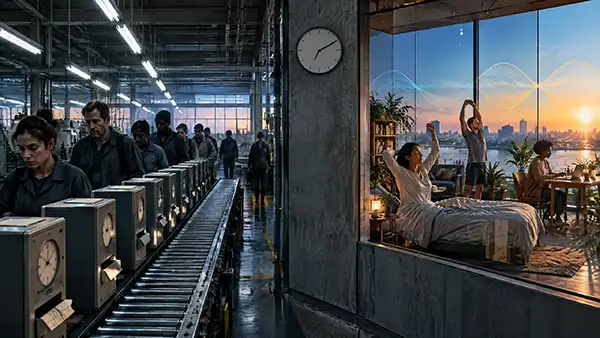
An obituary for the schedule that never fit anyone
The nine-to-five workday died on a Tuesday afternoon, surrounded by calendars that had never understood it. It was born in the factories of the nineteenth century, where the assembly line did not care whether the worker was a lark or an owl. It survived the office, the cubicle, the open-plan floor, and the remote-work revolution. It survived because it was convenient for managers, not because it was compatible with human biology. It is survived by the alarm clock, the afternoon slump, and a growing body of research that has been trying to kill it for decades. The cause of death was not rebellion. It was circadian science. The nine-to-five is not a neutral container for work. It is a biological mismatch for a large portion of the population. The cost of that mismatch is what I call circadian drag: the measurable loss of cognitive performance, emotional regulation, and long-term health that occurs when a person’s daily schedule is misaligned with their internal clock. Circadian drag is not laziness. It is not a lack of discipline. It is a physiological tax that most people pay without knowing they are paying it.
Born in the factory, buried in the lab
The nine-to-five was not designed for human flourishing. It was designed for steam engines and shift schedules. When factories needed workers to arrive at the same time, the schedule was a coordination tool. When offices inherited the factory model, the schedule became a cultural norm. The norm was reinforced by the Protestant work ethic, by the school system, and by the assumption that early rising is a moral virtue. The assumption was never tested against the biology. It was tested against the clock. The clock won because the clock was on the wall. The biology was inside the body, and the body could not argue.
Nathaniel Kleitman, a physiologist at the University of Chicago, conducted one of the first experiments that should have ended the argument. In the 1930s, he and his assistant Bruce Richardson lived in the total darkness of Mammoth Cave in Kentucky for thirty-two days. They wanted to know whether the human body kept time without sunlight. It did. Their body temperatures continued to rise and fall on a roughly twenty-four-hour cycle. Kleitman concluded that performance was best between noon and 6 p.m., just before body temperature reached its peak, and worst between 4 and 6 a.m., when temperature was at its lowest. The finding was not a suggestion. It was a description of a mechanism. The mechanism did not care about the factory whistle.
What the temperature curve actually controls
The body temperature curve is not a minor variable. It is a master signal. When core temperature rises, the brain becomes more alert, reaction times shorten, and working memory expands. When core temperature falls, the opposite happens. The average person’s temperature fluctuates by about one degree Celsius across the day. That one degree is the difference between a sharp morning and a foggy one. It is the difference between a productive afternoon and a wasted one. It is the difference between a good decision and a bad one.
The research on sleep inertia has confirmed what Kleitman observed. When you wake from deep sleep, the prefrontal cortex—the region responsible for planning, decision-making, and impulse control—takes time to come online. A 2025 study published in Sleep used high-density EEG to map the transition. The default mode network, the system associated with mind-wandering, becomes active before the executive control network. The thought arrives before the capacity to question it. The grogginess lasts between fifteen and thirty minutes, and sometimes longer if the person is sleep-deprived. The person who schedules a complex analysis at 8 a.m. is asking the brain to sprint while it is still stretching. The brain will comply, but it will not perform at its peak.
The temperature curve is also tied to the cortisol awakening response. Cortisol rises sharply in the first thirty to forty-five minutes after waking. The rise is not a stress response. It is a mobilization signal. It prepares the body for the day. But the signal is calibrated to the person’s chronotype. A morning type will have an earlier, sharper cortisol peak. An evening type will have a later, flatter one. When an evening type is forced into an early schedule, the cortisol rhythm is flattened and delayed. The result is a body that is awake but not ready. The result is circadian drag.
The synchrony effect and the myth of the early bird
The cultural myth says that morning is the best time for everyone. The research says that morning is the best time for morning types. Cynthia May at the College of Charleston co-authored a meta-analysis published in Perspectives on Psychological Science in 2023 titled “For Whom (and When) the Time Bell Tolls.” The paper reviewed decades of research on chronotypes and cognitive performance. The conclusion was unambiguous. Optimal outcomes occur when performance times align with peaks in circadian arousal. The finding is called the synchrony effect. It is one of the most robust in the field.
The synchrony effect is not a small adjustment. It is a large one. Morning chronotypes perform best on analytical tasks in the late morning. Evening chronotypes perform best on the same tasks in the late afternoon or evening. The person who is tested at the wrong time of day can perform as much as a full standard deviation below their actual ability. The error is not in the person. It is in the timing. The person who is labeled “slow” in the morning may be a high performer in the evening. The label is a schedule problem disguised as a character problem.
A 2025 study published in Sleep Medicine examined working memory performance in college students across morning and evening sessions. The findings were surprising. Both chronotypes performed better in the evening on a working memory task. But the definitely evening types outperformed the definitely morning types in the evening session. The study concluded that evening hours may be the optimal time for working memory regardless of chronotype, but that evening types show a particular advantage. The finding does not mean that everyone should work at night. It means that the assumption that morning is universally superior is not supported by the data.
When the afternoon dip is not a failure
The afternoon dip is real. Between roughly 1 and 3 p.m., body temperature is still rising, but homeostatic sleep pressure from the morning has accumulated. The result is a trough in alertness. The trough is not a moral failing. It is a physiological event. The research on circadian rhythms of attention has found that all components of attention reach their lowest levels during the night and early morning, improve around noon, and reach even higher levels during the afternoon and evening. The afternoon dip is a transition, not a verdict.
The person who pushes through the dip—with a walk, with a change in task, with a glass of water—often finds a second wind. The second wind is the second peak. The second peak is the time when body temperature is at its highest and circadian arousal is stable. For evening chronotypes, the second peak is the main event. They are not lazy. They are not undisciplined. They are biologically calibrated to perform best when the sun is setting. The person who forces them into a 9 a.m. meeting is not just inconveniencing them. They are wasting their cognitive potential.
The health cost of ignoring the body clock
Circadian drag is not just a productivity problem. It is a health problem. The research on social jetlag—the mismatch between biological time and social time—has linked chronic misalignment to metabolic disorders, cardiovascular disease, and mood disturbances. A 2025 study published in Sleep Health examined the relationship between chronotype and work ability in a general working population. The findings were stark. Evening chronotypes had significantly higher odds of poor work ability and greater health-related productivity loss compared to morning types. The adjusted odds ratio for poor work ability was 2.291. The mean difference in productivity loss was 5.362 percent. The study concluded that chronotype significantly influences work ability and that evening types experience the poorest outcomes due to circadian misalignment.
The misalignment is not just about work. It is about life. The person who lives against their chronotype is more likely to experience depression, anxiety, and chronic fatigue. The person who is forced to wake before their body is ready is more likely to rely on caffeine, sugar, and willpower to function. The reliance is not sustainable. The body eventually collects the debt. The collection is called burnout. The collection is called disease. The collection is called a life lived at half capacity.
What alignment looks like in practice
Alignment does not require a radical overhaul. It requires attention. The first step is to identify your chronotype. You can do this by paying attention to your energy patterns for two to three weeks. When do you wake naturally? When do you feel most alert? When do you crash? The answers will point toward a pattern. The pattern is your biology.
The second step is to protect your peak windows. If you are a morning type, schedule your most demanding cognitive work before noon. If you are an evening type, schedule it for the late afternoon. If you are a “always ready” type, you have more flexibility, but you still have a peak. Find it. Use it.
The third step is to negotiate your schedule. If you work in an office, talk to your manager about flexible hours. If you work remotely, set your own hours. If you cannot change your hours, change your tasks. Do routine work during your low-energy periods. Do creative work during your high-energy periods. The task matters less than the match.
The fourth step is to protect your sleep. Sleep is the foundation of circadian health. The research on sleep hygiene is consistent. Keep a regular sleep schedule. Avoid screens before bed. Keep the bedroom cool and dark. Avoid caffeine after noon. These are not new recommendations. They are simply ignored.
When the problem is clinical
There is a limit to what self-directed scheduling can accomplish. Some people have clinical circadian rhythm sleep disorders. These include delayed sleep phase disorder, advanced sleep phase disorder, and irregular sleep-wake rhythm disorder. These are not lifestyle problems. They are medical conditions. They require professional assessment and treatment. If you have persistent difficulty falling asleep, staying asleep, or waking up, if your sleep schedule is significantly different from the social norm and causes distress or impairment, the appropriate response is not to try harder to force yourself into a schedule that does not fit. It is to speak with a sleep specialist or a physician who can assess what is happening and recommend an appropriate course of care. The research on circadian rhythm sleep disorders is robust. Effective treatments exist. Support is not a sign that you have failed to manage your time. It is a recognition that the body has a schedule, and sometimes the schedule needs a doctor.
A closing note from the graveyard
The nine-to-five is dead. It died because it was never alive in the first place. It was a convention, not a biological fact. The people who thrived under it were the people whose chronotypes happened to match it. The people who suffered were the people who did not. The suffering was invisible because it was attributed to personal failure. The research has made the suffering visible. The visibility is the beginning. The beginning is the choice. You can keep living against your clock, or you can start living with it. The choice is yours. The clock is waiting.