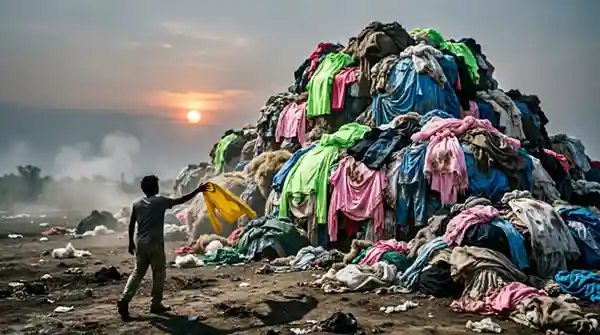
The average household contains 300,000 items. Not a typo. Three hundred thousand. From the paperclips in the junk drawer to the Christmas decorations in the attic to the single sock that has been sitting in the back of the closet since 2019, waiting for a partner that is never coming back. We are drowning in stuff. And yet, the moment something breaks, fades, or simply falls out of fashion, our first instinct is not to fix it, repurpose it, or reimagine it. Our first instinct is to throw it away.
I call this the discard reflex — the automatic, pre-conscious response that categorizes anything slightly damaged, outdated, or inconvenient as garbage. The reflex is not a character flaw. It is a learned behavior, reinforced by a culture that equates new with better and old with worthless. And it is costing us more than we realize.
The Environmental Cost of Throwing Away 17 Million Tons of Textiles a Year
The numbers are staggering. According to the most recent federal estimates, 17 million tons of textiles are discarded annually in the United States. Of that, 11.3 million tons end up in landfills. The recycling rate for clothing and footwear specifically is just 13 percent, against 14.7 percent for textiles overall. These figures are from 2018. The last full estimate. The problem has almost certainly gotten worse.
Globally, the picture is even bleaker. Every year, 92 million tonnes of textile waste is produced worldwide. Production doubled from 2000 to 2015, while the duration of garment use decreased by 36 percent. The equivalent of one garbage truck full of clothes is burned or dumped in a landfill every second. Less than 1 percent of material used to produce clothing is recycled into new clothing.
We are not just throwing away clothes. We are throwing away resources, labor, water, and carbon. The fashion industry consumes 215 trillion liters of water annually — the equivalent of 86 million Olympic-sized swimming pools. It is responsible for 2 to 8 percent of global carbon emissions. And it is the second-biggest consumer of water on the planet.
The discard reflex is not just a personal habit. It is an environmental crisis.
The Psychology Behind Why You Throw Things Away
Why do we do it? Why do we toss a shirt with a tiny stain, a chair with a wobbly leg, a phone with a cracked screen? The answer is not laziness. It is cognitive.
Researchers at the University of Alberta have identified a phenomenon called “form distortion.” The less an item resembles its original form, the less useful we perceive it to be. A torn piece of paper is seen as trash. A shirt with a missing button is seen as garbage. The brain, which relies on pattern recognition to categorize the world, uses visual cues to determine value. If it looks broken, it is broken. If it looks old, it is worthless.
The finding was published in the Journal of Consumer Research and has been replicated multiple times. When a product is sufficiently distorted or changed in size or form, consumers perceive it as less useful. And when they perceive it as less useful, they are more likely to throw it in the garbage, as opposed to recycle it.
This is why the discard reflex is so powerful. It operates below the level of conscious thought. You do not decide to throw something away. You just do it. The decision was made before you were aware of making it.
The Throwaway Culture That Was Built for You
The discard reflex did not emerge from nowhere. It was engineered.
Historian Susan Strasser, in her book Waste and Want, documents how the shift from a reuse-and-repair economy to a throwaway economy was neither inevitable nor accidental. It resulted from the convergence of four forces: a body of ideas saying the earth is ours for the taking, the rise of modern capitalism, technological cleverness, and the extraordinary bounty of North America.
More directly, our consumptive behavior is the result of seductive advertising, entrapment by easy credit, ignorance about the hazardous content of much of what we consume, the breakdown of community, a disregard for the future, political corruption, and the atrophy of alternative means by which we might provision ourselves.
In other words, we were not born to throw things away. We were trained to.
The training worked. Americans now buy 60 percent more garments than they did in 2000, but they keep them for only half as long. The average American woman owns 103 items of clothing but wears only about 40 percent of them regularly. The rest sit in closets, waiting for an occasion that never comes, until they are finally discarded, often with tags still attached.
The Upcycling Market That Is Growing Because We Are Finally Paying Attention
There is a counter-trend. And it is growing faster than anyone predicted.
The global upcycled consumer goods market was valued at $9.5 billion in 2025 and is expected to reach $20.3 billion by 2032, growing at a compound annual growth rate of 11.5 percent. The DIY upcycling market in the United States alone is valued at $3.5 billion, with a projected CAGR of 9 percent through 2033.
Secondhand clothing sales increased 28 percent year over year in 2025, compared to 8 percent growth in clothing stores. In the United States, upcycled clothing accounted for 27.4 percent of online luxury spending in 2024. By the end of 2025, that figure is projected to reach 28.8 percent.
The shift is being driven by younger consumers. Over 60 percent of both Gen Z and Millennials express an increased willingness to pay a premium for sustainable products. Among consumers under 30, 61 percent say they prefer to spend their money on environmentally friendly products rather than reducing the number of products they buy.
These are not just numbers. They are a signal. The discard reflex is not inevitable. It is a habit. And habits, unlike fates, can be rewritten.
How to Break the Discard Reflex in Your Own Home
The work of breaking the discard reflex is not complicated. It is just unfamiliar. The goal is not to become a hoarder. The goal is to create a pause — a moment of awareness between the impulse and the action.
The first practice is to ask a different question. Instead of “Is this trash?” ask “What else could this be?” A torn t-shirt becomes a cleaning rag. A stained button-down becomes fabric for a quilt. A broken chair becomes firewood or a garden trellis. The question does not require an answer. It requires a pause.
The second practice is to learn from the people who have been doing this for generations. The DIY upcycling market is full of tutorials, videos, and communities dedicated to turning trash into treasure. Upcycled denim can become insulation. Old tires can become shoes. Worn wool sweaters can become mittens. The internet has made this knowledge free and accessible. The only barrier is the willingness to look.
The third practice is to repair before you replace. A 2025 Mastercard report found that 71 percent of consumers say they would prefer to repair products they already own rather than buying new ones. The intention is there. The infrastructure is not. But the infrastructure is growing. Repair cafes, fix-it clinics, and online repair communities are emerging across the country. The shift is happening. The question is whether you will be part of it.
The Limits of Individual Action
There is a limit to what individual behavior can accomplish. The discard reflex is not just a personal habit. It is a systemic feature of an economy built on planned obsolescence, disposable products, and the relentless promotion of consumption.
The Ellen MacArthur Foundation estimates that an extra $20 to $30 billion annually is needed to make the textile value chain more sustainable. The regulatory landscape is fragmented. The infrastructure for recycling and repair is underfunded. The companies that profit most from the throwaway economy have little incentive to change it.
If you are struggling with feelings of hopelessness or anxiety about the scale of the problem, the appropriate response is not to try harder to fix it on your own. It is to speak with a mental health professional who can help you assess what is happening. The research on eco-anxiety is evolving, but the evidence is clear that climate-related distress is a real and treatable condition. This is not a disclaimer. It is the same logic that runs through everything else in this piece. You do not try to fix a broken system with willpower alone. You get help.
What Happens When You Stop Throwing Things Away
I want to end with something small.
The woman who taught me to sew was my grandmother. She grew up during the Great Depression. She never threw anything away. Not because she was a hoarder. Because she understood something that most of us have forgotten. Everything has a second life. Everything has a use. The question is not whether it is broken. The question is what it could become.
She would take my torn jeans and turn them into patches for her quilts. She would take my father’s old shirts and turn them into pillowcases. She would take scraps of fabric too small for anything else and weave them into rugs. She did not call it upcycling. She did not call it anything. It was just what you did.
The discard reflex is not a law of nature. It is a habit. And like all habits, it can be unlearned. Not overnight. Not perfectly. But one small decision at a time.
The next time you go to throw something away, pause. Ask the question. Look for the second life. And then, if you can, give it one.
That is the work. Not the grand gesture. The small pause. The willingness to see what is actually there instead of what you have been trained to see. The rest is practice. And practice, unlike the landfill, is something you can control.