How to Make Time Feel Meaningful: Stop Wishing Your Days Away
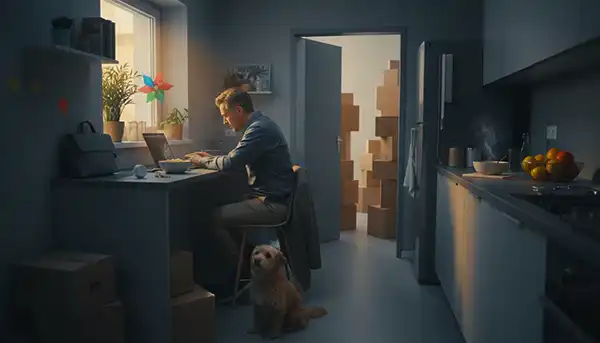
The year I turned forty-one, I noticed something that scared me more than I wanted to admit. It was a Tuesday evening in October, and I was standing in my kitchen in Columbus, Ohio, waiting for the microwave to finish reheating a bowl of soup I did not particularly want to eat. The kids were upstairs doing homework. My husband was on a work call in the other room. And I caught myself thinking, very clearly, I just need to get through this week.
The thought was not new. It was the same thought I had every week, every month, every season. Get through Monday. Get through the week. Get through the winter. Get through this project, this school year, this stretch of ordinary days that felt like something to endure rather than something to live.
What scared me was not the thought itself. It was the realization that I had been thinking it for years. And if I kept thinking it—if I kept treating my life as a series of obstacles to survive rather than moments to inhabit—I would eventually get to the end of the whole thing and realize I had wished it all away.
The microwave beeped. I took out the soup. I sat down at the table, alone, and I made a decision. Not a dramatic one. Not a resolution I would announce to anyone. Just a quiet, private turning. I decided I was going to stop wishing my days away. I was going to learn, however slowly and imperfectly, to be here for them.
That was four years ago. I am still learning.
Why We Treat Time Like Something to Kill
We have a strange relationship with time in this culture. We talk about it as if it were an enemy. We say we are “killing time,” as if it were a threat that needed to be neutralized. We say we are “passing the time,” as if it were a burden to be carried. We count down to the weekend, to the vacation, to the end of the workday, to the next milestone, the next phase, the next thing that will finally make the waiting worthwhile.
The psychologist Philip Zimbardo, who spent decades at Stanford studying how people perceive time, called this “future-focus.” It is the orientation that treats the present moment as a problem to be solved, a period to be survived, a means to some imagined end. Future-focused people achieve a lot. They are good at delaying gratification, at planning, at working toward goals. But they are also, Zimbardo found, more prone to anxiety, depression, and a persistent sense that the present is never enough.
I am a recovering future-focuser. I spent my twenties and thirties with my eyes fixed on the horizon, always convinced that the good stuff was just ahead. The right job. The right house. The right city. The right version of myself, who would finally be calm and happy and present. But the horizon kept moving. The good stuff kept receding. And one day I looked up and realized I had spent twenty years waiting for a life that was already happening.
The researcher and author Ashley Whillans, at Harvard Business School, has studied what she calls “time poverty”—the subjective feeling of never having enough time. Her work shows that this feeling is not primarily about how many hours you work or how full your calendar is. It is about the story you tell yourself about those hours. Two people can have identical schedules, and one can feel rich in time while the other feels starved. The difference is attention. The difference is meaning.
I was time-poor not because I was busy—though I was—but because I was not paying attention. The days were passing, but I was not in them. I was always somewhere else, in the future I was trying to reach, in the past I was trying to outrun. The present was just a waiting room. And waiting rooms are never comfortable.
The Small Act of Not Wishing It Away
Here is what I have learned, four years into this practice, about what actually changes. It is not a system. It is not a philosophy. It is a series of small, almost embarrassing choices, made over and over, in the middle of ordinary days.
The first choice is noticing the wishing. Not stopping it. Just noticing it. When the thought arises—I just need to get through this week—I catch it. I see it for what it is: a habit, an old reflex, a way of protecting myself from the present by escaping into the future. The noticing does not make the thought go away. But it takes the charge out of it. It turns a command into a question.
The second choice is returning. Not to some idealized version of mindfulness. To the actual moment, however boring or uncomfortable it is. The microwave. The soup. The sound of the kids upstairs. The particular quality of light in the kitchen at six o’clock in October. The returning is the practice. It is the whole practice. And it is available in every moment, no matter how small.
The third choice is the hardest one for me. It is the choice to stop treating the present as a means to an end. To let the ordinary Tuesday be enough, not because it is special, but because it is here. Because it is the only Tuesday I will ever have. Because the alternative—waiting, wishing, counting down—is a kind of violence against my own life.
The philosopher and author Maria Popova, who writes the blog The Marginalian, has a line that has stayed with me for years: “How we spend our days is, of course, how we spend our lives.” The line is a warning and an invitation. The warning is that the small moments are not small. The invitation is that they are enough.
Why Monotony Is the Enemy of Meaning
There is a particular kind of suffering that comes from sameness. Not the dramatic kind. The quiet kind. The kind that settles in when every day looks like the day before, when the weeks blur into months, when you cannot remember what you did last Tuesday because it was exactly the same as every other Tuesday.
The researcher and author Mihaly Csikszentmihalyi, who spent his career at the University of Chicago studying what makes life worth living, found that the happiest people are not the ones who avoid routine. They are the ones who find ways to be awake inside the routine. He called this “flow”—the state of complete absorption in what you are doing, whether it is painting a fence or writing a poem or simply watching the light change on the kitchen wall.
Flow is not about escaping the ordinary. It is about entering it fully. And the entry point, Csikszentmihalyi argued, is attention. Not effort. Attention. The difference between a dull day and a vivid one is not what happens. It is whether you are there for it.
I have started doing small things to break the sameness. Not big things. Small ones. I take a different route to work on Tuesdays. I buy a vegetable I have never cooked before. I call my sister in the middle of the afternoon instead of waiting for our scheduled Sunday call. None of these things are impressive. But they interrupt the autopilot. They remind me that I am a person, not a machine.
The poet Mary Oliver wrote that “attention is the beginning of devotion.” I used to think that was beautiful and impractical. Now I think it is the most practical thing I have ever read. Because the attention is what turns the waiting room into a place where you can actually live.
What I Would Tell Someone Who Is Waiting for Life to Start
There is a voice that tells you that the good part is coming. That once you get through this week, this month, this year, you will finally be able to breathe. The voice is not lying, exactly. It is just pointing in the wrong direction. The good part is not ahead of you. It is underneath you, all the time, in the exact place where you are standing.
I know how that sounds. I would have rolled my eyes at it five years ago. But I have lived long enough now to know that the future never arrives as a destination. It just becomes more present. And the present, when you finally stop running from it, is full of more than you expected.
The other day, I was doing the dishes again—the same dishes, the same sink, the same window above it. And I noticed the way the warm water felt on my hands. I noticed the way the soap smelled, clean and faint. I noticed the sound of the plates against each other, the particular clink of ceramic on ceramic. And I thought, very quietly, this is my life. This is it. This is enough.
The thought did not change anything. The dishes were still there. The day was still ordinary. But something in me loosened, just a little. A small, quiet yes.
That yes is the whole practice. Not the grand transformation. The small yes. The willingness to be here, in the middle of the ordinary, and call it what it is.
A life. A real, ordinary, unrepeatable life.
And it has been waiting for me the whole time, not in the future, but in the dishes, in the soup, in the light on the kitchen wall.
The future will come. It always does. But it will not be the thing I was waiting for. It will just be more present. More dishes. More soup. More ordinary Tuesdays, each one unrepeatable, each one enough.
So I am trying to stop waiting. I am trying to be here, in the Tuesday, in the kitchen, in the warm water and the clean smell and the particular clink of ceramic on ceramic.
The small moments are the whole thing. They were always the whole thing.
And the only thing that was ever missing was my attention.
Now, here it is. Back again. Noticing. Breathing. Alive.
The day is not something to get through. It is something to be in. And I am, finally, beginning to be in it.
The soup is gone. The dishes are done. The light has moved across the wall.
And I am still here, in the evening, in the quiet, in the ordinary, unrepeatable miracle of another day.
That is enough. It has always been enough.
The only thing that was ever missing was my attention.
And now, here it is. Back again. Noticing. Breathing. Alive.