Self-Compassion First: Why Healing Yourself Is the Only Way to Truly Help Others
I’ve been absent from this page longer than I intended. Not because I had nothing to say—quite the opposite. There was so much piling up inside me that I froze. The weight of unprocessed experience accumulated until it felt easier to seal everything in boxes and store them somewhere dark. Writing had always been my release, my way of making sense of the chaos. But somewhere along the line, I stopped trusting the process. I stopped trusting myself.
That’s the part I want to sit with today. Not the surface-level productivity problem. The deeper one. The way we abandon ourselves when we need ourselves most.
The short answer to whether self-compassion actually works is yes—but not in the way self-help culture usually presents it. It’s not about positive affirmations or bubble baths. It’s about learning to meet yourself in the middle of your failures with the same warmth you’d offer a friend. And that, I’m discovering, is much harder than it sounds.
The Habit of Turning the Knife Inward
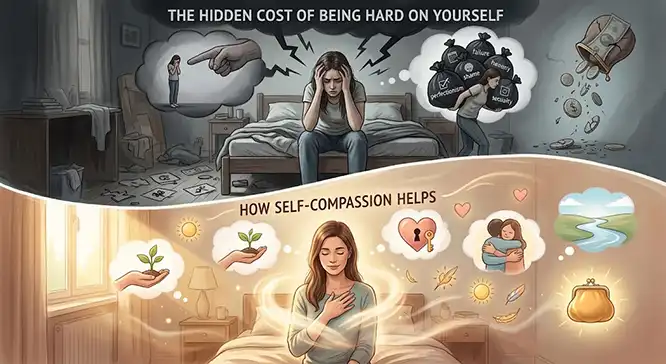
I’ve spent a lot of my life being remarkably good at one thing: blaming myself. If something went wrong, I was the common denominator. If someone was upset, I must have caused it. If a project failed, I hadn’t worked hard enough. This wasn’t humility. It was a reflex. A deeply ingrained habit of self-punishment that I mistook for responsibility.
The problem with this approach is that it doesn’t actually make you better at anything. It just makes you tired. When you’re constantly judging yourself, you’re not learning. You’re just repeating the same cycle of shame and avoidance. The part of you that needs to grow gets shouted down by the part of you that’s convinced you’re fundamentally flawed.
I’ve noticed this pattern in others too. People who are hardest on themselves often have the most compassion for everyone else. They’ll extend grace, understanding, and patience to friends, colleagues, even strangers—but when it comes to themselves, the standards are impossibly high and the penalties for failure are merciless.
That’s not strength. That’s a distortion. And it’s one I’ve been slowly, painfully, trying to untangle.
What I Learned When I Stopped Running
The weeks I spent away from writing weren’t empty. They were full of things I didn’t want to feel. Disappointment. Exhaustion. A quiet sense that I’d been doing too much and receiving too little in return. I pushed those feelings down because they felt inconvenient. But they didn’t disappear. They just festered.
Eventually, I had to stop. Not because I chose to, but because I couldn’t keep going the way I was. The pause was uncomfortable. It felt like failure at first. But somewhere in that stillness, something shifted. I started to hear my own voice again—not the critical one, but the one that actually wanted to be heard.
I realized I’d been treating myself like a machine. Keep going. Produce. Don’t stop. Don’t complain. The problem is, machines don’t need compassion. People do. And I’d been ignoring that basic truth about myself for far too long.
The Moment Everything Changed
I can pinpoint the exact moment my relationship with myself started to shift. It was small. Almost embarrassingly simple. Something had gone wrong—nothing catastrophic, just a frustrating setback. My instinct was to go straight to self-criticism. To list all the ways I’d failed, to calculate the blame, to assign myself full responsibility for the outcome.
But this time, I paused. I imagined a friend sitting across from me, telling me the same story. What would I say to them? I wouldn’t list their failures. I wouldn’t tell them they should have done better. I’d probably say something like, “That sounds really hard. I’m sorry you’re dealing with that. You’ll figure it out.”
So I said it to myself. Out loud. It felt strange and awkward and slightly ridiculous. But it also felt like relief. Like a door I hadn’t known was locked suddenly swinging open.
That was the beginning. Not the end. But the beginning.
A question I keep asking myself
What would it take for you to talk to yourself the way you talk to someone you genuinely love? Not the polite version of yourself, but the real one. The one who’s tired and overwhelmed and doing the best they can with what they have.
I’ve been sitting with this question for months. The answer, I think, is practice. You don’t become self-compassionate overnight. You choose it, over and over, until it stops feeling like an act and starts feeling like a reflex. You catch yourself in the middle of a self-critical spiral and you gently interrupt it. You offer yourself the same understanding you’d offer anyone else.
It’s not about letting yourself off the hook. It’s about recognizing that punishment doesn’t lead to improvement. Curiosity does. Kindness does. The willingness to say, “This didn’t work out the way I hoped. What can I learn from it?” instead of “This didn’t work out the way I hoped. I’m a failure.”
The Unexpected Gift of Self-Compassion
Something surprising happened when I started treating myself with more kindness. I didn’t become lazier or less driven. I actually became more productive. Not because I was pushing harder, but because I wasn’t spending so much energy on self-criticism. The mental noise quieted down. I could focus. I could make decisions without second-guessing every move.
The other thing that shifted was my relationships. When I stopped treating myself like a problem to be solved, I stopped projecting that onto other people. I became more patient. More present. Less likely to interpret someone else’s mood as a reflection of my worth. It wasn’t a dramatic transformation. It was gradual. But it was real.
I’ve started to think of self-compassion as a kind of home base. You can’t really show up for others if you’re not showing up for yourself. It’s not selfish. It’s the foundation. The oxygen mask principle applies here: you secure your own mask before helping others. That’s not a luxury. That’s survival.
Let’s be honest about something
Self-compassion can feel suspiciously like making excuses. There’s a voice that says, “If you’re kind to yourself, you’ll stop trying. You’ll settle for mediocrity. You’ll lose your edge.” I’ve heard that voice loud and clear. I’ve believed it.
But I’ve also noticed that the people I admire most—the ones who are genuinely accomplished and also genuinely kind—are not the ones who are hardest on themselves. They’re the ones who have figured out how to hold themselves accountable without destroying themselves in the process. They take responsibility for their actions without taking responsibility for the entire universe.
That’s the balance I’m aiming for. It’s not about avoiding responsibility. It’s about separating what’s actually your fault from what’s just the inevitable messiness of being alive. That distinction is everything.
What I’ve noticed about hope
Hope doesn’t come from pretending everything is fine. It comes from acknowledging that things are hard and still believing you can find a way through. I lost touch with hope for a while. Not because my circumstances were unbearable, but because I’d exhausted myself with my own criticism. There was no room for hope because there was no room for anything except judgment.
When I started making space for self-compassion, hope crept back in. Not grand, dramatic hope. Quiet hope. The kind that says, “You’ve been through hard things before. You’ll figure this out too.” It didn’t fix anything overnight. But it made the hard things feel less impossible.
A few things I’m still learning
The journey toward self-compassion isn’t linear. There are good days and bad days. There are moments when I slip back into old patterns and catch myself thinking the same harsh thoughts I’ve always thought. The difference now is that I notice it sooner. I can interrupt the cycle before it spirals.
I’ve also learned that self-compassion isn’t a destination. It’s a practice. You don’t arrive and stay there. You keep showing up. You keep choosing the kinder voice. You keep reminding yourself that you’re human and that being human means imperfection.
Where this leaves me
I’m still figuring it out. I still have days when the critical voice is louder than the compassionate one. But I’m getting better at noticing the difference. And that noticing is everything.
If you’re someone who has spent a lifetime being harder on yourself than you’d ever be on anyone else, I want you to know that you can change that. It won’t happen all at once. It might feel unnatural at first. But it’s possible. You can learn to be your own advocate instead of your own judge.
The first step is just acknowledging how you’ve been treating yourself. The second step is deciding you deserve better. The rest is practice.
Start today. Small. A single kind thought. A moment of pause before the criticism begins. A question instead of a verdict. That’s enough. That’s more than enough. That’s where everything begins.