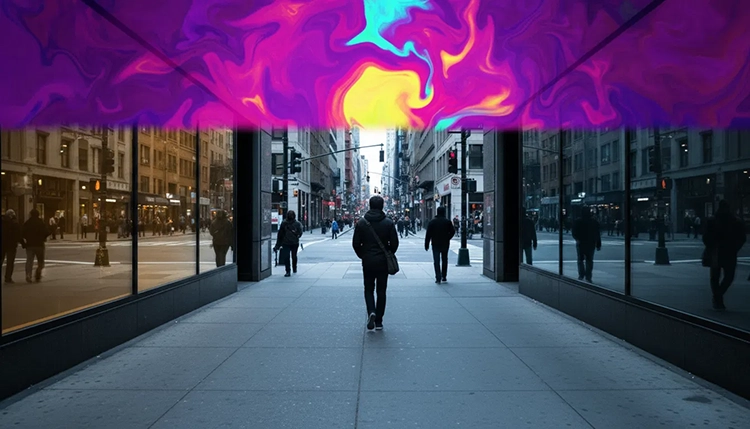
Living Beyond the Mirror: Is It Possible to Exist Without Illusions?
“There is nothing sadder than the death of an illusion.” — Arthur Koestler
Our lives are perpetually suspended between the pull of illusion and the elusive shape of reality. Because our minds reside in the subjective theater of concepts, symbols, and language, our desperate search for meaning constantly complicates things. We attempt to describe a living universe using tools that are inherently reductionist, leaning on paradoxes and rigid distinctions just to steady ourselves against the void.
What, precisely, is reality? At its broadest, we might define it as everything that exists. Physical reality encompasses what stands independent of the observer—mass, space, and the cold mechanics of matter. Mental reality, by contrast, has no spatial extension; it exists solely within the quiet landscape of individual minds. When we look at a stone, a flower, or an atomic particle, we are not looking at reality itself, but at a partial representation projected by our senses. Recognizing the vast chasm between our mental representation of the world and the world as it actually is gives us our first genuine glimpse into the nature of illusion.
Ultimate reality resists concepts and words. We assume it is unchanging, yet virtually nothing in the universe remains static. Even the foundational physical laws offer no absolute guarantee of permanence. In that sense, ultimate reality may not exist at all, or it may remain forever sealed behind the limits of human cognition.
Why Do We Cling to Illusions?
“Life is something conducted in our ignorance of its foundational meaning.” — Terry Eagleton
Every human being is cast into a specific time and space, burdened with a finite lifespan shadowed by uncertainty and mortality. During this brief, fragile tenancy, we wage a ceaseless battle against the unknown, forced to construct mental scaffolding just to adapt to an indifferent outside world.
The limitations of our biology and cognition push us to craft comforting illusions. We anchor these fabrications to grand ideas: knowledge and certainty, time and eternity, freedom, free will, and the ultimate meaning of life. Illusions can be born entirely of unverified imagination, offering us a profound existential shelter. Their quiet danger, however, is that they foster deep-seated biases—an unconscious unwillingness to things as they truly are simply because clarity is too heavy to bear.
“How sad a time we live in when it is harder to destroy a prejudice than to split the atom.” — Albert Einstein
Even those of us who pride ourselves on piercing the veil often discover we have merely traded one illusion for another, more sophisticated costume. Neurological research reveals that the human brain is a tireless meaning-making machine, hardwired to distort raw data just to make existence survivable. We lean toward illusions that soothe our anxieties and validate our desires, using language and theoretical frameworks as our primary instruments of distortion.
We transmit our theories through symbolic systems like mathematics and conceptual categorization. Yet these are entirely human architectures—they possess no independent existence outside the mind, remaining forever partial and transient. Because our lived experience is wholly mediated by these mental approximations, we never truly touch reality raw. We live inside our conceptual sanctuaries, finding comfort in a predictable universe of our own design. But in doing so, we trap ourselves, losing the ability to distinguish between the map and the territory.
When an unexpected storm breaks our routines—be it a personal crisis or a collective catastrophe—we feel the sharp pinch of uncertainty. We crave guarantees, absolute safety, and a tidy narrative where everything happens for a reason. Yet nature remains entirely indifferent to our interpretations. It is neither moral nor malicious; it simply is.
The Illusion of Meaning and the Architecture of “We”
“No trouble in life can be solved by throwing life away.” — Viktor E. Frankl
Confronted by this vast, unblinking reality, we search desperately for our own uniqueness, trying to extract a favorable verdict from every twist of fate. But “meaning” itself is a shape-shifter. In Douglas Adams’s The Hitchhiker’s Guide to the Galaxy, a supercomputer named Deep Thought is asked for the “Ultimate Answer to the Ultimate Question of Life, the Universe, and Everything.” After 7.5 million years of computation, the computer delivers its answer: $42$. When the creators express their bafflement, Deep Thought gently replies: “The problem, to be quite honest with you, is that you’ve never actually known what the question is.”
Perhaps the philosophers are right: there is no single question and no single correct answer. Life is not a riddle to be solved once and for all, but an ongoing dialogue.
We construct our realities and fall deeply in love with them because absolute meaninglessness feels like a psychological freefall. History teaches us that when collective meaning collapses, societies fracture. In moments of doubt, continuing to search for meaning is perhaps the most courageous thing we can do. Yet, wading through this ocean of concepts while trying to stay anchored to truth is exhausting. This friction is why we cling so fiercely to our dogmas, turning our fragile interpretations into absolute laws and shutting out competing truths.
The Cognitive Equilibrium Framework (Definition Block):
Cognitive Equilibrium is a mental operating model where an individual consciously cycles between forming conceptual frameworks to navigate uncertainty and periodically dismantling those same frameworks through radical self-doubt. It is the deliberate practice of learning deeply while retaining the agility to unlearn when reality shifts.
Perhaps the only honest response to this existential bind is to hold our conceptual frameworks lightly—to learn with absolute dedication, but to remain willing to unlearn when the season changes. By recognizing how tightly our language and categories confine us, we begin to see through our own illusions.
Our fundamental task is remarkably simple: to live freely, to foster life, and to seek out paths of genuine connection. We build our lives around fragile pillars of health, peace, security, and love. The true measure of our awareness lies in what we choose to nurture and what we choose to let go.
If there is a way forward through the maze of our own biases, it perhaps begins when individual egos quiet down enough to let a collective, harmonious “we” breathe—building a more livable world while we still have the light to see it.