Why the Best Part of Traveling Is the People You Meet Along the Way
The bus in Mexico City was so crowded that I could feel the heartbeat of the stranger pressed against my back. It was my first solo trip outside the United States. I was twenty-four, terrified, and trying very hard to look like I knew exactly where I was going. The bus lurched through traffic, and I watched the city unfold through a smeared window—neon signs, street vendors, a woman balancing a basket of fruit on her head, a group of teenagers laughing at a joke I would never understand.
I did not speak the language. I had a paper map that was already falling apart. And I had never felt so completely, dizzyingly free.
That was nearly twenty years ago. I have been lucky enough to see a lot of the world since then. Not because I am rich—I am a high school English teacher from Portland, Oregon, and I save for months and travel cheap—but because I learned something on that first, terrifying bus ride that changed how I understand travel, and maybe how I understand life.
The places are beautiful. The places are breathtaking. But the places are not the point.
The people are.
What We Are Really Looking For When We Leave Home
There is a line from the ancient philosopher Lao Tzu that I have carried with me for years, though I could not have told you where I first heard it. It goes something like this: “The universe does not give you the people you want. It gives you the people you need. To help you, to hurt you, to leave you, to love you, and to make you the person you were meant to be.”
I used to think travel was about escaping people. About getting away from the noise, the demands, the familiar faces that came with so much history. I thought solitude was the goal. And there is a real joy in walking alone through a foreign city, in being anonymous, in answering to no one.
But the older I get, the more I understand that what I was actually looking for was not the absence of people. It was a different kind of connection. A cleaner one. A connection unburdened by the past.
When you are a stranger in a strange place, every interaction is stripped down to its essentials. You cannot hide behind your job title or your reputation or the person everyone back home expects you to be. You are just a traveler. They are just a local. And in that simple exchange—asking for directions, ordering food, sharing a table—something real happens.
The social psychologist and researcher Dr. Gillian Sandstrom has studied these “weak ties”—the brief, casual interactions with strangers that we often dismiss as meaningless. Her work, conducted at the University of Essex and later at the University of Sussex, suggests that these tiny moments of connection actually contribute significantly to our sense of wellbeing. A chat with a barista, a smile exchanged with a stranger on a train—these are not trivial. They are the threads that make up the fabric of a life.
Travel magnifies this. It throws you into a thousand of these small moments every single day. And if you are paying attention, they begin to change you.
The Night in New Orleans That Taught Me to Listen
I remember a trip to New Orleans a few years ago. I had spent the day alone, walking the French Quarter, taking pictures of balconies and cemeteries, feeling very pleased with my own independence. In the evening, I wandered into a small jazz club on Frenchmen Street. The band was tight, the room was dark, and I found a seat at the back.
An older couple at the table next to me struck up a conversation. They were locals. Retired teachers, like me. We started talking about music, about teaching, about the strange trajectory of our lives. The husband had been a drummer in a touring band in the 70s. The wife had written poetry. I listened to their stories for two hours, and by the end of the night, I felt like I had known them for years.
When I walked back to my hotel, the city looked different. It was not just a collection of beautiful buildings and good food. It was alive, pulsing with the private worlds of a million strangers, each one carrying a story I would never fully know.
That is the magic of travel. It is not that it takes you somewhere new. It is that it strips away the illusion that your own story is the only one that matters.
The Places You Remember Are the Places Where You Felt Seen
I have been fortunate. I have watched the sun rise over a black sand beach in Iceland, the cold wind whipping my face while the ocean crashed against the shore. I have stood under the desert sky in Morocco, looking up at stars so bright they seemed almost fake, like someone had poked holes in a dark cloth.
But when I close my eyes and travel backward through my memories, it is not the landscapes I see first. It is the faces.
I see the fisherman in Costa Rica who shared his lunch with me on the beach, even though we could barely understand each other. I see the group of runners I met in Moab, Utah, who invited me to join them for a sunrise run through the canyons, and how we stumbled back to the trailhead, exhausted and laughing, bonded by something deeper than words.
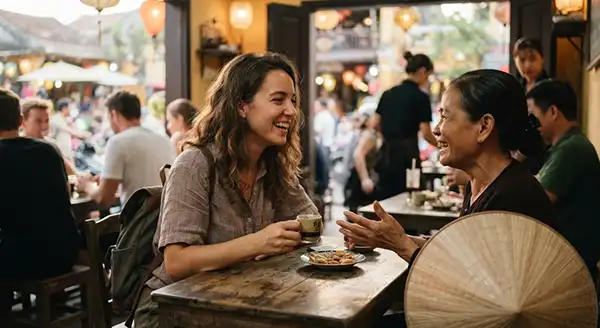
I see the old woman in Tokyo who noticed I was lost and walked me three blocks to the right train station, bowing politely before she disappeared into the crowd. She never knew my name. I never knew hers. But I have thought about her kindness for years.
These are the experiences that stay with you. Not because they are dramatic. Because they are proof that you are not alone in the world. That strangers can become, for a moment, exactly what you need.
Why Travel Is a Form of Radical Empathy
The author Pico Iyer once wrote that travel is a way of “reversing the relationship between the self and the world.” At home, the world is something that happens to you. On the road, you are the thing happening to the world. You are the stranger. You are the one who does not understand the customs, who mispronounces the words, who needs help.
That vulnerability is a gift. It forces you to ask for directions, to accept kindness, to trust people you have never met. And in doing so, it builds a kind of empathy that is hard to cultivate any other way.
I have a friend in Austin who refuses to travel because he says the world is too dangerous. He reads the news and sees only threats. I do not argue with him anymore. I just tell him about the people I have met—the Chilean man who helped me when I was lost in Santiago, the Irish family who insisted I join their dinner table, the Italian barista who gave me a free pastry because I looked tired.
The world is not always safe. I am not naive. But it is also full of people who will go out of their way to help you, if you are willing to let them.
The Weight of the Connections We Carry
The Harvard Study of Adult Development, directed for decades by researchers like Dr. Robert Waldinger, has followed the same group of men for over eighty years. The findings are remarkably consistent: the single most important factor in a happy, healthy life is not wealth, not fame, not achievement. It is the quality of your relationships.
Travel does not replace those deep, long-term relationships. It cannot. The stranger on the bus will not be there when you are sick or heartbroken. But travel does something else. It reminds you that those deep relationships are part of a much larger web of human connection. It reminds you that every person you meet is a world unto themselves, a whole universe of hopes and fears and private jokes.
And that, I think, is the real magic. The world is not a series of coordinates on a map. It is a network of hearts, and when you travel, you get to touch a few of them.
What I Would Tell the Person Afraid to Go
I am not a natural traveler. I am anxious. I overpack. I check my passport forty times before a flight. But I go anyway, because the alternative is to let the fear win, and I have seen what happens to people who let the fear win. Their world shrinks. Their curiosity dies. They start to believe that the only safe life is the one they already know.
There is a quote from the writer Mark Twain that I love: “Travel is fatal to prejudice, bigotry, and narrow-mindedness.” The quote is old, but the truth is not. You cannot hate a people up close. You cannot fear a stranger who has fed you soup.
So go. Even if it is just one trip. Even if it is just to the next state over. Go with your eyes open and your phone in your pocket and your heart ready to be surprised.
Because the places are beautiful. The places are breathtaking.
But the people are the point.
And the people, it turns out, are everywhere.
Just waiting to meet you.