The Butterfly That Could Not See the Door
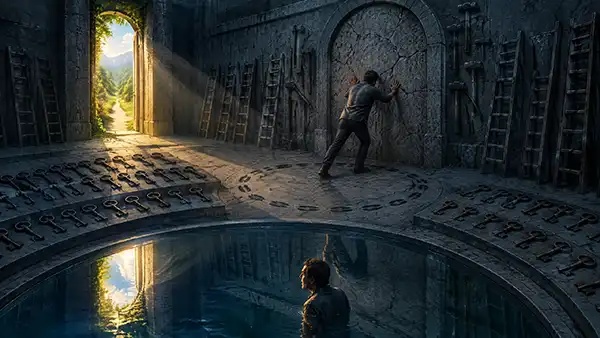
A butterfly flies into a garage through an open door and then cannot find its way out. It beats its wings against the windows, again and again, drawn to the light, convinced that the transparent pane is the exit. The actual door—the one it entered through minutes earlier—stands wide open, but the butterfly never looks down. It is fixed on the brightest surface, the most obvious candidate for escape, and that fixation becomes a prison. This is not a story about a stupid insect. It is a story about a cognitive pattern so common among humans that we rarely notice when we are inside it. I call it clarity fixation: the tendency to pursue the option that appears most obviously correct, even when it is sealed, while ignoring the option that is open but less legible.
The butterfly does not lack effort. It does not lack motivation. It lacks a method of search that can detect alternatives outside its current frame. And that, more than laziness or fear, is what keeps most people trapped in jobs, relationships, and habits long after the exit has become available.
This article explores cognitive patterns, problem-solving, and mental flexibility from a general, educational perspective. It is not a substitute for professional mental health care. If you are experiencing persistent difficulty with decision-making, focus, or emotional distress, please consult a qualified mental health professional who can provide individualized support.
This is not an abstract problem. It shows up in the job you keep because you have always done that kind of work, even though you stopped enjoying it years ago. It shows up in the argument you keep having with the same person, using the same words, expecting a different result. It shows up in the business that keeps using the same marketing strategy because it worked in 2015. The window is familiar. The door is unfamiliar. The brain chooses familiar.
The pattern is not limited to individuals. Organizations do the same thing. A company that built its success on a particular product line will keep investing in that line long after the market has moved on. A team that solved a problem one way will use that method for every subsequent problem, even when the problems are fundamentally different. The window is the strategy that worked before. The door is the strategy that has not been tried.
Why the mind prefers the transparent wall
The human brain is a pattern-completion machine. It learns what works and then repeats it, because repetition is efficient. This is usually adaptive. If a strategy solved a problem once, it is likely to solve a similar problem again. But efficiency has a cost: the mind becomes attached to its own solutions. It stops scanning for alternatives once it has found something that seems to fit.
Karl Duncker, a Gestalt psychologist at Clark University, demonstrated this in the 1930s with a problem that became famous in cognitive science. He gave participants a candle, a box of tacks, and a book of matches, and asked them to attach the candle to a wall so that it would burn without dripping wax onto the table. Most people tried to tack the candle directly to the wall, or to melt it onto the surface. The solution required seeing the tack box not as a container but as a platform. Participants had to overcome what Duncker called functional fixedness—the inability to see an object as anything other than what it is normally used for.
The butterfly in the garage is experiencing a version of this. The window is fixed in its mind as “the way out.” The open door is not processed as an option because it does not match the expected form of escape. The insect is not failing to try. It is failing to reconsider what trying should look like.
The implications extend beyond insects. Consider the professional who has been trying to get a promotion by working longer hours, even though the organization rewards visibility and relationship-building rather than sheer output. Consider the writer who keeps submitting to the same publications, using the same voice, wondering why the acceptance letters never arrive. Consider the person who keeps trying to fix a relationship by talking more, when the other person needs silence. In each case, the method is not wrong in itself. It is wrong for this situation, at this time, with this person. But the method has become the identity, and abandoning it feels like abandoning the self.
The Einstellung effect and the cost of expertise
A related phenomenon was documented by Abraham Luchins at the University of California, Berkeley, in the 1940s. Luchins gave participants a series of water-jar problems, each solvable by a complex procedure. After several trials, participants learned the method and applied it automatically. Then Luchins presented a problem that could be solved by the complicated method or by a much simpler one. Most participants used the complicated method, even when the simple solution was obvious. Some failed to solve it at all. Luchins called this the Einstellung effect—a mechanized state of mind, a blind application of a familiar procedure.
The effect has been replicated many times. A 2016 study by researchers at the University of Oxford and University College London used chess problems to show that even expert players, when they recognized a familiar pattern, would overlook a better move. The problem was not lack of skill. It was that skill had become a filter. The experts saw what they expected to see.
When competence becomes a cage
This is the uncomfortable implication for anyone who has built a career on a particular method. The more competent you become, the more likely you are to default to what you know. Expertise is a tool that can become a cage. The accountant who has spent twenty years doing things one way. The manager who has led every team with the same playbook. The writer who has one voice and uses it for every subject. These are not failures of talent. They are successes of learning that have hardened into rigidity.
The garage has many windows. But it also has a door. The problem is that the door does not look like an exit. It looks like a hole in the wall. It looks like nothing. The butterfly’s visual system is calibrated for brightness, for contrast, for the obvious. The door is not obvious. It is just open.
What the butterfly teaches about method loyalty
There is a version of professional advice that celebrates persistence above all else. Keep going. Do not quit. Push through the resistance. This advice is not wrong, but it is dangerously incomplete. It assumes that the resistance you are encountering is a signal that you are on the right path. Sometimes it is. But sometimes resistance is a signal that you are pushing against a window while a door stands open behind you.
The butterfly’s tragedy is not that it tried. It is that it tried the same thing, over and over, without pausing to ask whether the thing itself was the problem. This is the sunk-cost fallacy applied to method: I have already invested so much in this approach that abandoning it now would mean admitting I was wrong. But the energy spent on a failed method is not recovered by spending more energy on it. It is only compounded.
Barry Staw at the University of California, Berkeley, first described the sunk-cost effect in organizational settings. He found that decision-makers who had invested resources in a failing project were more likely to continue funding it, even when the evidence suggested it would never succeed. The investment itself became the justification for further investment. The window became more attractive precisely because the butterfly had already hit it so many times.
This is why changing course is so difficult. It is not just a practical decision. It is an emotional one. The window has been the focus of so much energy, so much hope, so much self-definition. To look away from it is to admit that the energy was misdirected. That admission is painful. And so the butterfly keeps hitting the glass, not because it believes the glass will break, but because stopping would require a kind of grief.
The intelligence of looking down
What would it mean to look down? For the butterfly, it would mean breaking the assumption that escape must come from the brightest direction. For a person, it means deliberately asking what the situation would look like if the current method did not exist. What would I do if this approach were forbidden? What would I try if I had no prior experience to guide me? These are not comfortable questions. They require setting aside the identity that has been built on the old method.
Ellen Langer at Harvard has spent decades studying what she calls mindful learning, the practice of noticing what is new and uncertain rather than relying on categories from the past. Her research suggests that people who approach familiar tasks with a mindset of novelty—treating them as if for the first time—perform better and remain more engaged. The opposite is mindless repetition, the automatic application of old solutions to new problems.
The practical version of this is unglamorous. It looks like asking a colleague who knows nothing about your project what they would do. It looks like writing down the three assumptions you are making and asking which one you would bet against. It looks like taking a different route home, not because the old route is bad, but because the sameness of it has stopped being visible to you. These small disruptions do not solve the problem directly. They loosen the frame that made the problem feel unsolvable.
One of the most useful questions in any stuck situation is this: what would someone who knew nothing about my history do? The stranger’s advantage is not intelligence or insight. It is freedom from the frame. The stranger does not know which window you have been hitting. The stranger sees the door because the stranger has not been trained to ignore it. This is why outside perspectives are valuable, not because other people are smarter, but because they are not trapped in the same perceptual field.
When the wall is real and persistence is correct
I want to be honest about the limits of this metaphor. Not every barrier is a window. Some barriers are walls, and the appropriate response is to push through them, to go around them, or to accept that they cannot be moved. The difference between a window and a wall is not always obvious from the inside. The butterfly could not tell that the glass was solid because it had never encountered glass before. A person facing a career setback, a difficult relationship, or a creative block may genuinely need to persist, and the advice to “try a different method” may be a form of premature surrender.
The discerning question is not whether to quit or keep going. It is whether the current method is still the best available method, or whether it is being repeated because it is familiar. That question requires honesty, which is harder than effort. It requires being willing to disappoint the version of yourself that has already committed. It requires tolerating the possibility that the time you have spent was not an investment but a cost.
There is a difference between persistence and repetition. Persistence is the willingness to keep working toward a goal. Repetition is the willingness to keep using a method that has already failed. The first is a virtue. The second is a habit that masquerades as one. The butterfly was persistent. It was also repeating. It could not tell the difference, and that inability was fatal.
The distinction matters because the language of persistence is often used to justify rigidity. Grit, the combination of passion and perseverance that Angela Duckworth at the University of Pennsylvania has studied extensively, is a genuine predictor of success. But Duckworth herself has cautioned against treating grit as a blanket virtue. Perseverance without flexibility becomes stubbornness. Passion without adaptation becomes obsession. The butterfly was gritty. It was also doomed.
The door was always open
The butterfly eventually died in the garage, or it did not. The story does not say. What the story leaves is the image of an open door and a creature that could not see it. The door had been there the entire time. It was not hidden. It was simply not the thing the butterfly was looking for.
Most of the doors in our lives are like that. They are not locked. They are not even hard to find. They are just less obvious than the window we have been staring at. The work is not to try harder. It is to look in a direction we have been ignoring. That direction is rarely dramatic. It is often embarrassing in its simplicity. The open door is usually the thing we have been avoiding because it does not fit the story we have been telling about how escape is supposed to happen.
The butterfly’s wings were designed for flight, not for glass. The open door was made for passage. The only thing standing between the insect and the sky was the assumption that escape had to look like light.