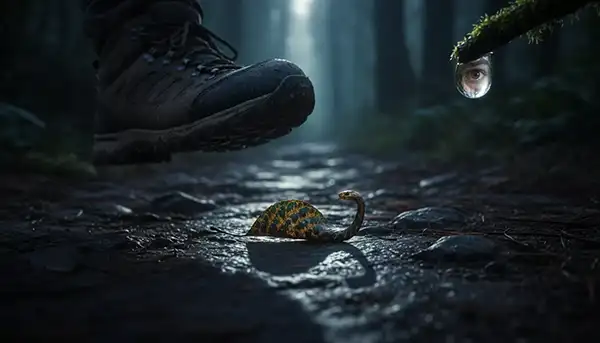
Surviving the freeze with a painted leaf
Human survival is rarely just a biological mandate. It is a narrative one. When the body starts failing, when the cells are misfiring and the lungs are heavy with fluid, the brain demands a symbol to anchor the will to live. We manufacture these symbols—painted leaves on cold brick walls, a single green shoot in the ash, a flickering candle in a blackout—because raw data tells us to give up. A constructed illusion gives the nervous system the permission to keep fighting. This is not weakness. It is the ultimate evolutionary hack. We do not survive because we are strong. We survive because we can lie to ourselves just well enough to see the next sunrise.
Counting backward in a freezing room
Picture the room. Drafty. Smells like turpentine and sickness. The mind is a broken clock. Ticking backward. Twelve. Eleven. Ten.
The patient is looking out the window at a bare brick wall, watching the last leaves of an ivy vine fall in the autumn wind. Every leaf that hits the pavement takes a piece of her will with it. It is a morbid game. A fatal countdown. But it makes perfect, terrifying sense. When you are running on fumes, when the internal machinery is dead in the water, you need an external metric to measure your own expiration. You need the writing on the wall, literally.
The medical establishment used to call this giving up. They used to call it a failure of the immune system. But they were looking at the wrong variable. They were looking at the blood, not the belief. The girl in the attic is not dying simply because her lungs are compromised. She is dying because her mind has already accepted the narrative of the falling leaf. She has tied her biological clock to the botanical clock outside her window. When the last leaf drops, the script says she goes with it.
It drops.
Zero.
The brain is a ruthless editor. When it decides the story is over, it shuts down the production. It stops sending the signals that keep the heart beating in rhythm, that keep the white blood cells hunting for infection. It pulls the plug. But the reverse is also true. If you can interrupt the script, if you can introduce a plot twist that defies the established narrative, the brain will suddenly flood the system with a different kind of chemistry. It will restart the engines.
Mapping the biology of manufactured hope
For decades, the scientific community treated the placebo effect as a nuisance, a statistical error to be controlled for in double-blind trials. They wanted the pure, unadulterated data of the molecule. But researchers at Harvard Medical School and the Ohio State University College of Medicine have completely flipped the script over the last twenty years. They now understand that belief is not just a psychological quirk. It is a physiological trigger.
When the brain genuinely expects rescue, it floods the body with endogenous opioids and dopamine. It literally alters the immune response. The field of psychoneuroimmunology has proven that the mind and the body are not two separate entities communicating through a slow postal service. They are the same system. The thoughts you think, the symbols you latch onto, they physically rearrange your cellular environment.
This is where we see the mechanism of what I call Fictional Tethering. This is the act of tying one’s biological survival to a constructed, external narrative symbol. The brain does not care if the symbol is a sugar pill, a prayer, or a painted leaf on a brick wall. It only cares that the symbol exists. The tether holds. The body obeys.
When the girl looks out the window and sees the leaf still clinging to the branch after a night of violent, howling wind, her brain receives a massive, undeniable signal. The narrative shifts. The exit door is locked. The tether holds. Her nervous system, which was already packing its bags and heading for the door, suddenly stops. It unpacks. It gets back to work. She asks for soup. She asks for a mirror. She asks for life.
When the brain refuses the exit
Why a leaf? Why not a number on a calendar? Why not a stock market ticker?
Because the brain is an ancient, visual organ. It needs environmental proof. It needs to see the struggle mirrored in the physical world. The leaf is battered. Its edges are yellowing. It is hanging by a thread in a storm that wants to tear it apart. The patient sees her own fragility in the leaf, but she also sees its stubborn, irrational refusal to let go. It is a mirror made of chlorophyll and paint.
We do this all the time, even when we are not sick. We tether our sanity to external fictions. A writer tethers her will to keep working to the word count on a screen. A trader tethers his sense of security to a green line on a chart. A teenager tethers his entire identity to the number of likes on a photograph. When the symbol holds, we hold. When the symbol crashes, we spiral. We are all just looking for something green against a gray wall, waiting for it to prove that we are still here.
Hidden toll of the masterpiece
But illusions do not generate themselves out of thin air. They require a scaffolding. They require a sacrifice.
The old painter in the apartment below understands this better than anyone. He is a failure, a man who has spent forty years talking about the masterpiece he is going to paint, while drowning his ambitions in cheap gin and missed deadlines. He listens to the girl counting backward. He knows the danger of the eleventh hour. He knows that when the mind decides it is time to go, no amount of chicken soup or medical advice will stop the slide.
So he goes out into the freezing, violent storm. He carries a lantern. A ladder. And his paints.
This is the intersection of art and survival. We like to think of art as something that hangs in sterile, climate-controlled museums. We think it is a luxury for the living, a decorative afterthought. But at its core, art is a life raft. It is the desperate, beautiful act of altering reality when reality becomes unbearable. It is the refusal to accept the gray wall exactly as it is.
Painting in the dark
The old man climbs the ladder in the howling wind. His hands are shaking. The cold is biting through his clothes, settling into his joints, invading his lungs. He paints the leaf. He paints it with the green of life and the yellow of decay, making it look exactly like the fragile, dying things it represents. He creates the Fictional Tether. He gives the girl a reason to stay.
And in doing so, he contracts the pneumonia that will kill him.
He trades his remaining days for her future ones. It is a brutal, beautiful economy. The masterpiece is not the painting itself. The masterpiece is the fact that the painting worked. It is the fact that a lie, painted in the freezing dark, was convincing enough to trick a dying brain back into the land of the living. The old man dies, but his fiction survives. The leaf holds. The girl breathes.
Knowing the difference between the wall and the paint
There is a dark side to this, of course. We cannot romanticize the suffering, and we cannot pretend that a painted leaf is a substitute for actual medicine, actual therapy, or actual intervention.
When the despair is so deep that the nervous system is entirely hijacked by trauma, when the mind is trapped in a feedback loop of its own deteriorating chemistry, looking for a symbol is not enough. The tether might snap. The leaf might actually fall. If you find yourself staring at the wall, counting backward, waiting for the final leaf to drop, you cannot paint it yourself. The cognitive load is too high. The cold is too deep.
This is the moment you bring in the professionals. A licensed therapist or a psychiatric specialist acts as the actual ladder in the storm. They do not just paint the leaf; they rebuild the wall. They help you process the underlying rot so you no longer need to tie your survival to a fragile illusion. They give you the tools to survive the freeze without needing to manufacture a miracle every single night. There is no shame in needing the ladder. The old man used a ladder, too.
The storm breaks. The morning light hits the brick wall. The girl opens the window and looks. The leaf is still there. Defiant. Green and yellow against the gray. She asks for soup. She asks for life. Down below, the old man is gone. His shoes are soaked. His clothes are frozen. But on the wall, his masterpiece holds. The wind howls, but the paint does not flake. The girl breathes in the cold air, completely unaware of the cost of her own recovery, watching the green leaf hold its ground against the brick.