The First Student Is Always the Teacher
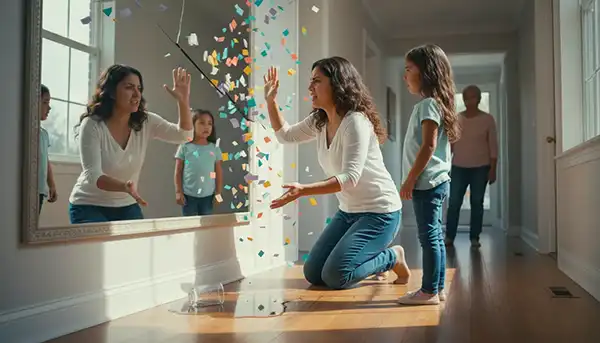
The most important lesson I ever taught my daughter was not about honesty or responsibility or self-respect. It was about my own dishonesty. She was seven years old. She had broken a glass. I heard the crash from the kitchen and asked what happened. She said the cat did it. We did not have a cat. I knew she was lying. But instead of addressing the lie, I heard myself saying something that stopped me. I said, “I understand why you are scared to tell me.” I had not planned to say it. The sentence arrived before the strategy. And in that moment, I recognized something that twenty years of parenting books had not taught me. The child was not the only one in the room who was learning. The child was not the only one in the room who was afraid. The child was not the only one in the room who needed to be taught how to tell the truth.
I call the work of examining your own inherited lessons before trying to teach new ones to a child inherited curriculum. It is the set of beliefs, fears, and relational patterns that were installed in you before you had the language to question them, and that will be transmitted to your children unless you deliberately examine them. The transmission is not optional. It happens whether you intend it or not. The only choice is whether it happens consciously.
Honesty cannot be demanded if it is not modeled
Every parent wants a child who tells the truth. Very few parents ask themselves how they respond when the truth is inconvenient. The research on honesty in children has shown that the most reliable predictor of truth-telling is not the threat of punishment. It is the child’s belief that telling the truth will be safe. A 2025 study published in the Journal of Experimental Child Psychology found that children were significantly more likely to confess to a transgression when they believed the adult would respond with understanding rather than anger. The confession was not a moral achievement. It was a calculation based on the child’s model of the adult.
If you want a child who says “I broke the vase,” you must be an adult who can hear that sentence without exploding. You must be an adult who can distinguish between the mistake and the lie, and who can address the lie without making the truth more dangerous than the deception. The research on parenting and honesty has consistently found that the children who lie most are the children who are most afraid of the consequences of telling the truth. The fear is not a character flaw in the child. It is a reasonable adaptation to the environment the parent has created.
Responsibility is not a lecture
The parent who tells a child to take responsibility is teaching a vocabulary word. The parent who takes responsibility in front of the child is teaching a practice. The difference is everything. The research on observational learning, pioneered by Albert Bandura at Stanford University, has shown that children learn far more from what adults do than from what adults say. The child who watches a parent apologize for a mistake learns that apology is possible. The child who watches a parent blame traffic, blame the boss, blame the system learns that blame is the default.
If you want a child who takes responsibility, you must be an adult who takes responsibility. Not perfectly. Not always. But visibly. The parent who says “I was wrong about that” is not losing authority. They are demonstrating the very behavior they want the child to adopt. The demonstration is the lesson. The lecture is background noise.
The difference between protection and possession
The most important lesson I ever taught my son was about the difference between loving someone and owning them. He was fourteen. He had a girlfriend. He told me he did not want her to go to a party because other boys would be there. He said this with the confidence of someone who believed he was expressing care. I asked him a question. I asked him whether he wanted a partner or a possession. He did not understand the question. I explained it.
A partner is a person who chooses you every day. A possession is a thing that stays where you put it. If you require someone to stay, you do not have their love. You have their compliance. The two are not the same. The research on relationship satisfaction has consistently found that controlling behavior is one of the strongest predictors of relationship failure. The control may be motivated by fear. It may be motivated by insecurity. But the effect is the same. The partner feels trapped, and the relationship becomes a cage.
He did not change overnight. But the question stayed with him. Years later, he told me it was the sentence that taught him what love actually was. Not the lecture. The question.
Fear masquerading as love
Many of the patterns we inherit are not obviously harmful. They are dressed as concern. A parent who demands to know where the child is at all times is not protecting the child. They are managing their own anxiety. A parent who criticizes the child’s appearance is not teaching standards. They are transmitting their own shame. A parent who cannot tolerate disagreement is not maintaining order. They are teaching the child that love is conditional on agreement.
The research on emotional transmission has shown that anxiety, depression, and relational patterns are passed from parent to child not through genetics alone but through the daily interactions that shape the child’s developing nervous system. A 2025 study published in the Journal of Family Psychology found that parental anxiety was a significant predictor of child anxiety, even when controlling for genetic factors. The mechanism was not biology. It was the environment the anxious parent created.
If you want to give your child a different curriculum, you must first examine the one you received. The unexamined curriculum does not disappear. It reproduces itself.
The child inside the parent
The most difficult part of parenting is not the child. It is the child inside the parent. The one who was told to be quiet. The one who was told that crying was weakness. The one who learned that love was earned. That child is still there. That child is the one who reacts when your own child misbehaves. That child is the one who feels the old shame rise when you are criticized. That child is the one who needs the lessons you are trying to teach.
The research on intergenerational trauma has shown that unresolved experiences in one generation can shape the nervous systems of the next. A 2025 study published in the Journal of Traumatic Stress found that parental trauma was associated with alterations in children’s stress response systems, even when the trauma was not discussed. The transmission was not verbal. It was physiological. The parent’s body was teaching the child’s body what to expect from the world.
The work of parenting is not just the work of raising a child. It is the work of raising the child inside yourself. The two are inseparable. You cannot teach what you have not learned. You cannot give what you do not have.
When the curriculum is too heavy to carry alone
There is a limit to what self-reflection can accomplish. If the patterns you inherited are accompanied by persistent sadness, anxiety, or distress that interferes with sleep, appetite, work, or relationships, the appropriate response is not to try harder to be a better parent through willpower alone. It is to speak with a mental health professional who can help you understand what was installed in you and develop strategies for changing it. The research on attachment, trauma, and intergenerational transmission is robust, and effective treatments exist. The support is not a sign that you have failed as a parent. It is a recognition that some lessons were taught before you could refuse them.
The only lesson that matters
The only lesson that matters is the one you live. Your child is watching. They are not listening to your words. They are reading your behavior. They are learning what love looks like by watching how you love. They are learning what honesty looks like by watching how you tell the truth. They are learning what responsibility looks like by watching how you handle your mistakes. They are learning what respect looks like by watching how you treat the people around you.
The curriculum is not a document. It is a life. And the life is yours. The first student is always the teacher.