What If the Person Everyone Loves Isn’t Actually You?
You are standing at a crowded dinner party, nodding warmly as someone shares an opinion you secretly find exhausting. You smile, laugh on cue, and pitch your voice to match the gentle cadence of the room. On paper, you are charming, agreeable, and deeply liked.
Yet beneath your ribs, a quiet, phantom ache begins to settle. You leave the evening thoroughly celebrated, but completely drained.
We spend our lives desperate to be seen. From ancient philosophical traditions suggesting that existence itself was created so the divine could be witnessed, down to the fictional forests of Pandora where the Na’vi greet each other with a sacred “I see you,” human beings share a fundamental existential hunger: the desire to have our internal reality mirrored by another mind.
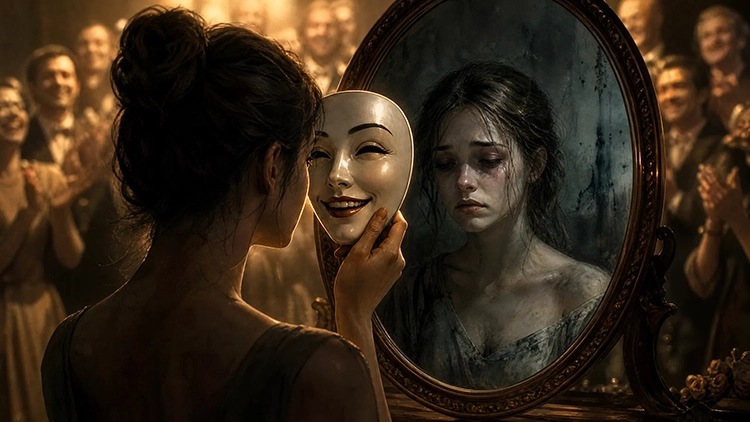
Yet in our frantic quest for that visibility, we perform a tragic trick. We construct a hyper-palatable, frictionless proxy—pleasant, effortless, unflappable—and send it out into the world to do the work of living for us.
When people shower that proxy with affection, it doesn’t soothe us. It isolates us further. Deep down, our nervous system registers a lonely truth: they don’t love us. They love our performance.
The Social Camouflage Tax The Social Camouflage Tax is the cumulative psychological and physiological cost of chronic behavioral masking. When an individual routinely suppresses authentic internal states to secure relational harmony, the brain perceives an ongoing threat to self-preservation. Over time, this autonomic hypervigilance erodes self-trust, leaving a person feeling utterly invisible even while surrounded by admiration.
This performance was not born out of vanity. It was forged in survival.
Think back to early childhood. You were instructed to kiss an uncle whose energy made your stomach churn. You were reprimanded for crying when a toy was snatched away, told to “be a good girl” or “be a brave boy” whenever your body naturally revolted. You were taught, implicitly and repeatedly, that your internal compass was a social inconvenience, and that staying safe required emotional erasure.
Behavioral scientists refer to this as early social conditioning, but at a neurobiological level, it is a basic survival adaptation. When a developing brain realizes that expressing raw emotion—anger, distress, or refusal—endangers its primary attachment bonds, it makes a swift calculation: authenticity is a risk; compliance is safety.
Fast forward thirty years.
You say yes to an invitation you dread because saying no feels like an act of war.
You remain silent when an acquaintance misinterprets your intentions, convincing yourself it isn’t worth the trouble.
You smile gently through a conversation that leaves you feeling fundamentally misunderstood, trading your actual voice for a moment of easy consensus.
We call this maturity, politeness, or emotional intelligence. In truth, it is often just learned helplessness wearing a polished outfit.
To become yourself is not an act of self-indulgent narcissism or reckless disregard for those around you. It is an act of quiet, radical honesty. It means accepting that if someone withdraws their affection the moment you draw a boundary, they were never attached to you—they were attached to your convenience.
True selfhood rarely requires a dramatic upheaval of your life. It unfolds in micro-moments: allowing a beat of silence before answering a request, admitting you don’t enjoy a wildly popular trend, or letting someone experience their own disappointment without rushing in to fix it.
When you drop the mask, some people will inevitably walk away. But the ones who stay will finally be looking at you.
The Unmasking Audit
If you suspect you have been paying too high a tax for keeping the peace, try this simple friction exercise over the coming week:
- Locate the Bodily Hesitation: Pay attention to the exact physical sensation in your body—a tightening in the throat, a drop in the stomach—the next time you agree to something you do not want to do.
- Name the Perceived Threat: Ask yourself: “If I voiced my true impulse right now, what catastrophic outcome is my brain trying to protect me from?” (Usually, it is the fear of being seen as selfish, difficult, or unlovable.)
- Deliver One Unbuffered Response: Choose one low-stakes interaction. State your genuine preference—whether selecting a restaurant, declining a non-essential task, or voicing a different perspective—without adding a self-deprecating joke or an over-explanation.
Notice that the room does not collapse. Notice that the world remains intact. To be truly seen by others, you must first afford yourself the permission to exist exactly as you are.