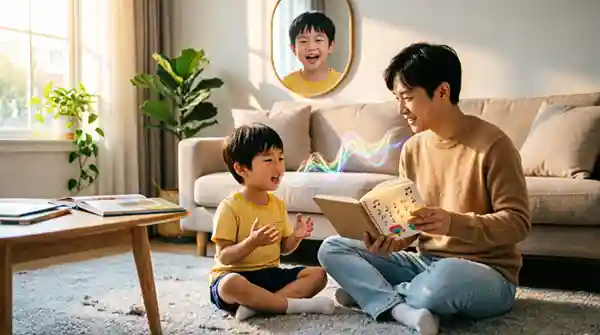
A Family’s Journey Through Articulation Therapy
The first time Maya said her own name, she was four years old. It came out as “Maya.” Not the soft, clear “Maya” her mother had been repeating to her since birth. It came out as “Maya” with a slight distortion, a sound that hovered somewhere between a “y” and a “w,” a sound that belonged to no language Maya’s mother had ever heard. She did not correct her. She did not want to make a big deal of it. She just smiled and nodded and pretended not to notice. But she noticed. She noticed every time. And she started to wonder if something was wrong.
That was two years ago. Maya is six now. She still cannot say the “r” sound. She substitutes “w” for “r” in almost every word. “Rabbit” becomes “wabbit.” “Car” becomes “caw.” “Birthday” becomes “bithday.” Her kindergarten teacher has started to mention it. Not in a worried way. In a “we are keeping an eye on it” way. But Maya’s mother is not reassured. She is starting to feel that familiar knot in her stomach, the one that shows up whenever she thinks about her daughter’s speech and what it might mean.
I have spent the last four years documenting the journeys of families like Maya’s. I have interviewed speech-language pathologists, sat in waiting rooms, watched therapy sessions through one-way mirrors, and listened to parents describe the moment they knew something was different. And I have learned that the gap between knowing something is different and knowing what to do about it is one of the loneliest places a parent can stand.
What Articulation Disorder Looks Like in Real Life
The clinical definition is simple. Articulation disorder is a speech sound disorder characterized by difficulty physically producing specific speech sounds. The tongue, lips, teeth, and palate are not coordinating the way they should. The child knows exactly what they want to say. The words are in their head. But the sounds will not come out right.
The symptoms are not random. They follow patterns. The American Speech-Language-Hearing Association identifies four types of articulation errors. Substitutions, where one sound is replaced by another. Omissions, where a sound is left out entirely. Distortions, where a sound is changed into something that is not quite right. Additions, where an extra sound is inserted into a word.
Maya’s pattern is substitution. She replaces “r” with “w.” It is one of the most common articulation errors in young children. The “r” sound is one of the last sounds to develop, and some children do not master it until they are seven or eight. But Maya is six. And she is not just having trouble with “r.” She is also having trouble with “th.” “This” becomes “dis.” “Think” becomes “fink.” The errors are starting to stack up. And the stacking is what makes her mother worry.
Why Speech Sounds Matter More Than We Think
The research on speech sound disorders and their long-term effects is not kind. A 2025 study published in Frontiers in Psychology found that children with speech sound disorders are at increased risk for reading difficulties, spelling difficulties, and academic struggles. The risk is not inevitable. But it is real. And it is higher than most parents realize.
The mechanism is not mysterious. Speech and literacy are connected. The same phonological awareness that allows a child to hear the difference between “cat” and “bat” is the same awareness that allows them to learn to read. If the sounds are fuzzy, the reading is harder. If the reading is harder, the academic confidence suffers. And if the academic confidence suffers, the whole trajectory of the child’s life can shift.
Maya’s mother knows this. She has read the studies. She has talked to the pediatrician. She has been told to “wait and see.” She has been told that “some children just develop later.” She has been told not to worry. But she is worried. And the research says she is right to be.
The Difference Between Articulation and Phonological Disorders
Before Maya’s mother could figure out what to do, she had to understand what she was dealing with. And the first thing she learned was that not all speech sound problems are the same.
Articulation disorder is a motor problem. The child cannot physically produce the sound. The tongue is not in the right place. The lips are not forming the right shape. The sound comes out distorted, substituted, or omitted because the mechanics are not working.
Phonological disorder is a cognitive or language-based problem. The child can physically produce the sound. But they do not understand the rule system that governs how sounds are organized in their language. They might leave off the final consonant in every word. They might replace all back-of-the-mouth sounds with front-of-the-mouth sounds. The errors are not random. They are patterns.
Maya has articulation disorder. She can hear the difference between “r” and “w.” She knows she is saying it wrong. She just cannot make her mouth do what her brain is telling it to do. This distinction matters because the treatment is different. Articulation therapy focuses on motor placement. Phonological therapy focuses on rule learning. The wrong therapy is not just ineffective. It can be frustrating for the child and the family.
The Evaluation That Changed Everything
Maya’s mother finally made the call. She contacted a speech-language pathologist. Not the school. Not the pediatrician. A private SLP who specialized in pediatric speech sound disorders. The evaluation took two hours. It was not painful. It was not scary. It was just thorough.
The SLP tested Maya’s hearing first. This is always the first step. You cannot learn to say sounds you cannot hear. Maya’s hearing was normal. The SLP then conducted an oral mechanism exam. She checked the strength and range of motion of Maya’s lips, tongue, and jaw. She looked at the structure of Maya’s mouth. She asked Maya to say specific sounds and specific words. She recorded the errors.
When the evaluation was over, the SLP sat down with Maya’s mother and explained what she had found. Maya had an articulation disorder. Specifically, she had difficulty with the “r” sound, the “th” sound, and the “s” sound. The errors were consistent. They were not developmental. They were not going to resolve on their own. The SLP recommended therapy.
What Articulation Therapy Actually Looks Like
Maya started therapy in September. She goes once a week for forty-five minutes. Her mother sits in the waiting room and reads. Sometimes she watches through the window. The sessions are not what she expected.
The SLP does not sit at a table and drill Maya with flashcards. She plays games. She reads books. She uses mirrors. She uses a tongue depressor to show Maya where her tongue should go. She uses a straw to help Maya feel the airflow. She uses a mirror so Maya can see what her mouth is doing.
The therapy is structured but it does not feel structured. The SLP starts with sounds in isolation. Maya practices saying “r” by itself. Then she practices “r” at the beginning of words. Then in the middle. Then at the end. Then in sentences. Then in conversation. The progression is slow. It is supposed to be slow. The research on motor learning is clear. You cannot rush a motor skill. You have to build it one repetition at a time.
Maya’s mother learned that she had a role to play. The SLP gave her homework. Not worksheets. Not drills. Just five minutes a day of practice. Maya’s mother would sit with her at the kitchen table and play a game. The game involved saying words with the “r” sound. Maya would say the word. Her mother would listen. If Maya said it right, she got a point. If she said it wrong, her mother would model the correct sound and Maya would try again. No pressure. No criticism. Just practice.
The Things That Actually Help at Home
The research on parent-implemented articulation therapy is robust. A 2025 study published in Wiley Online Library found that parent-led interventions can be effective when parents are given clear instructions, ongoing coaching, and realistic expectations. The key is not the quantity of practice. It is the quality.
The first thing Maya’s mother learned was to stop correcting every mistake. The research is clear on this. Correcting every error in conversation is counterproductive. It makes the child self-conscious. It makes them stop talking. It makes them avoid the very sounds they need to practice. The SLP told Maya’s mother to pick one sound and one time of day. Five minutes. That was it. The rest of the day, she was just supposed to listen.
The second thing she learned was to model, not correct. If Maya said “wabbit,” her mother would not say “No, rabbit.” She would just say “rabbit” back in a natural way. The research on recasting shows that this is more effective than direct correction. The child hears the correct version without feeling criticized. The correction is embedded in the conversation. It does not feel like a correction at all.
The third thing she learned was to make it fun. The SLP gave her a list of games. Sound scavenger hunts. Articulation hopscotch. A flashlight game where Maya had to find objects that started with her target sound. The games were not complicated. They were not expensive. They were just ways of sneaking practice into play. The research on play-based therapy is clear. Children learn best when they are having fun. The fun is not a distraction from the learning. It is the learning.
When the School Gets Involved
Maya is in first grade now. Her teacher has noticed the progress. But she has also noticed that Maya still struggles with “r” in conversation. The school has suggested an IEP. Maya’s mother is not sure. She has heard stories about IEPs. She has heard that they can be helpful. She has also heard that they can be a bureaucratic nightmare.
The research on school-based speech therapy is mixed. A 2025 study published in the Journal of Speech, Language, and Hearing Research found that school-based services are effective for many children. But the study also found that the intensity of services varies widely. Some children get five minutes a week. Some get thirty. The variation is not based on need. It is based on resources.
Maya’s mother decided to request an evaluation. She wanted to know what the school could offer. She wanted to know how it would fit with the private therapy. She wanted to know whether the two approaches would be coordinated or whether they would be two separate islands with no bridge between them. The research on coordinated care is clear. When parents, therapists, and teachers work together, outcomes improve. When they work in silos, progress stalls.
The Moment It Clicked
It happened on a Tuesday afternoon in March. Maya was playing in the backyard. She was talking to herself. Not to anyone in particular. Just narrating her play. And her mother heard it.
“Look at the bird,” Maya said. “He’s flying to the tree. He’s going to eat the berries.”
Her mother froze. She did not want to interrupt. She did not want to make a big deal of it. She just listened. And she heard it. The “r” sound. It was there. Not perfect. Not every time. But it was there. “Bird.” “Tree.” “Berries.” The sounds that had been missing for six years were starting to arrive.
She did not cry. She did not cheer. She just stood there and listened. And she felt something she had not felt in a long time. Not relief. Not exactly. Something quieter. Something that felt like hope.
The Things Nobody Tells You
The journey is not over. Maya still has sessions. She still has homework. She still has days when the “r” disappears and the “w” comes back. But the trajectory is clear. The research on articulation therapy is unambiguous. With consistent, targeted intervention, most children with articulation disorders can learn to produce the sounds correctly. The timeline varies. The work is real. But the outcome is achievable.
What nobody told Maya’s mother was how much of this would be about her. Not about the therapy. Not about the school. About her. Her patience. Her consistency. Her willingness to do five minutes a day, every day, without expecting a miracle. The research on parent involvement is clear. The parents who show up, who practice, who stay calm, who keep it fun — those are the parents whose children make the most progress.
What nobody told her was that the worry would not go away. It would just change. She would stop worrying about whether Maya would ever say “r.” She would start worrying about something else. That is what parenting is. A series of worries, one after another, each one slightly different from the last.
What nobody told her was that the speech would become normal. Not the struggle. Not the therapy. The sound. Maya would say “rabbit” and it would sound like “rabbit.” And her mother would not even notice. Because it would just be how Maya talked. That is the goal. Not perfection. Not the absence of effort. Just normal.
When the Journey Requires More Than a Home Program
There is a limit to what parents can do alone. If a child has a structural cause for their articulation disorder — a cleft palate, a tongue-tie, a hearing impairment — no amount of home practice will resolve it. Those conditions require medical evaluation and treatment. If a child has a neurological condition — apraxia of speech, dysarthria — the therapy must be delivered by a professional with specialized training.
If the child is frustrated, if they are starting to avoid speaking, if they are being teased at school, the psychological impact of the disorder is itself a reason to seek professional support. The research on speech sound disorders and social-emotional development is clear. Children with persistent speech errors are at higher risk for anxiety, social withdrawal, and low self-esteem. The therapy is not just about the sounds. It is about the child’s relationship with their own voice.
If the anxiety, the frustration, or the social struggles are persistent and interfere with the child’s daily life, the appropriate response is not to try harder at home. It is to speak with a mental health professional who can help the child and the family navigate the emotional dimensions of the journey. This is not a sign of weakness. It is a sign of wisdom. You do not try to fix a broken bone with positive thinking. You go to a doctor. You do not try to fix a broken spirit with flashcards. You get help.
The Sound That Came Back
Maya will be seven next month. She still has therapy. She still has days when the “r” is hard. But she also has days when it is easy. She does not think about it anymore. She just talks. She talks about her friends, her teacher, the bird in the backyard. She talks about the things that matter to a six-year-old.
Her mother still listens. Not for the “r” anymore. Just for Maya. For the sound of her daughter’s voice, clear and confident and hers. The sound that took so long to come. The sound that was always there, waiting for someone to help it find its way out.
That is the whole thing. Not the therapy. Not the technique. Not the hours of practice. The voice. The child. The willingness to keep going until the sound finds its way home.
The rest is patience. And patience, unlike the sound, is something you can always choose.