The premature verdict: why the people who told you no were not the final judge
The music teacher told Beethoven he was hopeless. Imagine that. A man who would go on to write the Ninth Symphony, the Fifth Symphony, the Moonlight Sonata, told by some guy with a chalkboard that he had no future in music. The teacher was not evil. He was just wrong. And that is the whole story, isn’t it? The people who tell you no are not prophets. They are people. They have bad days. They have limited vision. They have their own fears and their own failures and their own reasons for looking at you and seeing a threat instead of a promise.
I call this the premature verdict: the act of treating an early failure, a rejection, or an external judgment as a final assessment of a person’s capacity, when it is only a snapshot. A snapshot is not a sentence. A rejection is not a destiny. But the brain does not know that. The brain treats the verdict like a courtroom ruling. It files it away. It builds a story around it. And then it lives inside that story for years, sometimes decades, sometimes a whole life.
A music teacher told Beethoven he was hopeless
Beethoven’s teacher was not the only one. Walt Disney was fired from a newspaper because he “lacked imagination and had no good ideas.” Michael Jordan was cut from his high school basketball team. Elvis Presley was told he had no future in music and should go back to driving a truck. Churchill failed sixth grade. Einstein was not actually bad at math—that story is a myth—but he was a late talker, and his teachers thought he was slow. Edison’s teachers thought he was addled. Charles Dickens was rejected by publishers who told him writing was not for him.
These stories are repeated so often they have become wallpaper. We nod at them. We post them on social media. We use them to feel better about our own rejections. But we rarely stop to ask what they actually mean. The meaning is not “great people fail first.” The meaning is “the people who judge you are not the final authority.” The judgment is an event. The event is not the truth. The truth is what you do after.
What the research on early failure actually shows
The research on failure and success is more nuanced than the motivational posters suggest. A 2019 study published in Nature Communications by Dashun Wang and colleagues at Northwestern University examined the careers of scientists, entrepreneurs, and artists. The findings were surprising. Early failure did not predict later success. What predicted later success was how the person responded to failure. The people who tried again, who adjusted their approach, who learned from the feedback, were more likely to succeed. The people who quit, or who repeated the same mistake, were not.
The research on grit, developed by Angela Duckworth at the University of Pennsylvania, has shown that perseverance and passion for long-term goals predict success beyond intelligence or talent. But grit is not stubbornness. Grit is the willingness to keep going when the going gets hard, combined with the flexibility to change course when the course is wrong. The people in the Beethoven story did not just keep hitting the same wall. They found a different wall. Or they built a door.
Carol Dweck at Stanford University spent decades studying what she calls mindsets. A fixed mindset treats failure as a verdict on identity: I failed, therefore I am a failure. A growth mindset treats failure as information: I failed, therefore I need to learn something. The difference sounds small. It is not. The fixed mindset avoids challenges because challenges risk exposure. The growth mindset seeks challenges because challenges produce growth. The research is clear. The mindset predicts the outcome.
Why the verdict feels final
The premature verdict feels final because of how the brain works. The brain is a prediction machine. It builds models of the world based on experience. When someone in authority tells you that you are not good enough, the brain updates its model. The update is not logical. It is emotional. The amygdala, the brain’s threat center, registers the rejection as a social threat. The prefrontal cortex, the part that can reason and contextualize, goes partially offline. The result is a belief that feels like a fact. I am not good at this. I am not the kind of person who succeeds.
The research on learned helplessness, pioneered by Martin Seligman at the University of Pennsylvania, explains what happens next. When a person is exposed to repeated stressors they cannot control, they eventually stop trying to escape. They learn that effort does not produce results. The learning is not conscious. It is physiological. The brain stops generating options. The person becomes passive. The passivity looks like laziness. It is actually a survival adaptation. The brain is conserving energy because it has concluded that energy does not work.
The premature verdict is a form of learned helplessness. The verdict is the uncontrollable stressor. The quitting is the adaptation. The tragedy is that the adaptation outlives the stressor. The teacher is gone. The newspaper editor is gone. The basketball coach is gone. But the verdict remains. It runs in the background. It whispers. It shapes choices. It becomes the story.
The difference between a snapshot and a sentence
A snapshot is a moment in time. A sentence is a final judgment. The premature verdict confuses the two. The music teacher looked at young Beethoven and saw a snapshot. He saw a boy who was not yet skilled. He turned the snapshot into a sentence. He said, “You are not a composer.” That was not a description of the boy. It was a prediction about the man. The prediction was wrong.
The research on expert performance, developed by Anders Ericsson at Florida State University, has shown that expertise is not a fixed trait. It is the result of deliberate practice: focused, repetitive work on tasks that are just beyond current ability, with feedback and correction. The music teacher did not see a lack of talent. He saw a lack of practice. He confused the two. He is not alone. Most people confuse the two. They see a snapshot of current performance and assume it reflects a permanent ceiling. The ceiling is not real. The ceiling is a story.
When the failure is not the teacher
Sometimes the failure is not a person. Sometimes it is a circumstance. The economy crashes. The industry disappears. The illness arrives. The accident happens. The premature verdict is not always spoken by a teacher or a boss. Sometimes it is spoken by life itself. The question is the same. Do you treat the event as a verdict, or do you treat it as a condition?
The research on post-traumatic growth, developed by Richard Tedeschi and Lawrence Calhoun at the University of North Carolina at Charlotte, has shown that people who experience significant adversity sometimes report profound positive changes: deeper relationships, greater appreciation for life, increased personal strength. The growth is not guaranteed. It is not a reward for suffering. But it happens. And it happens when the person who suffers is able to integrate the experience into a larger story. The story is not “I am broken.” The story is “I was broken, and I am rebuilding.”
How to read your own premature verdicts
The first step is to notice. The verdict is usually a sentence that starts with “I am” or “I am not.” I am not a writer. I am not smart enough. I am not the kind of person who gets promoted. The second step is to ask: Who said that? When did they say it? What was the evidence? Was the evidence a snapshot or a pattern? The third step is to look for counter-evidence. The brain is biased toward confirming the verdict. It ignores the times you succeeded. It minimizes the times you improved. The third step forces the brain to see the whole picture.
The research on cognitive reappraisal, developed by James Gross at Stanford University, has shown that the capacity to reinterpret a situation in less threatening terms is associated with better emotional outcomes. The reinterpretation is not denial. It is not positive thinking in the greeting-card sense. It is the recognition that there are multiple valid interpretations of any event, and that some are more useful than others. The verdict is one interpretation. It is not the only one.
The room where the verdict was wrong
I have a friend who was told by a professor that she should not pursue a graduate degree. She was told she did not have the “academic temperament.” She was told she would be happier doing something else. She was devastated. She almost quit. But she did not. She applied anyway. She got in. She finished. She is now a tenured professor at a major university. The professor who told her no is not a villain. He was just wrong. He looked at her and saw a snapshot. He did not see the woman who would write a dissertation, publish articles, teach hundreds of students, and win awards. He could not see what was not yet there.
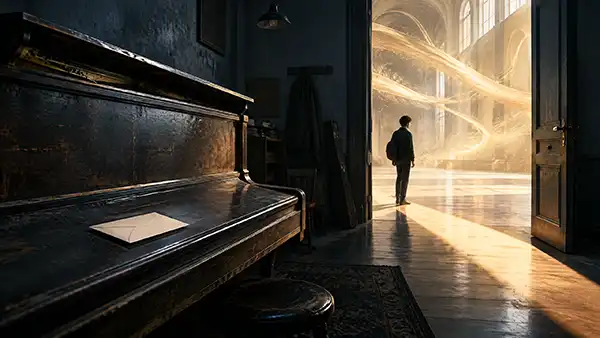
The room where the verdict was wrong is a room we all have inside us. It is the room where the teacher’s voice still echoes. It is the room where the rejection letter is still folded in a drawer. It is the room where the fear lives. The work is not to pretend the room does not exist. The work is to open the door, turn on the light, and see that the room is not the whole house. The room is a room. The house is bigger.
What you do with the stone
The boy in the car story—the one about the father who beat his son for scratching the car—ended with the father seeing the words “I love you, Dad.” The father could not undo the damage. But he could see the love. The premature verdict is like the scratch. It is a mark. It is a wound. It is a moment that changed things. But it is not the end of the story. The story continues. The father continues. The son continues. The love continues.
The research on resilience has consistently found that the single most important factor in overcoming adversity is the presence of at least one stable, caring relationship. The relationship does not erase the verdict. It provides a counter-verdict. The counter-verdict is not always spoken. Sometimes it is a look. Sometimes it is a touch. Sometimes it is simply the decision to stay.
If you are struggling with the weight of a premature verdict, if the voice of the teacher or the boss or the parent has become your own voice, if the shame and the doubt are interfering with sleep, appetite, work, or relationships, the appropriate response is not to try harder to prove them wrong. It is to speak with a mental health professional who can help you separate the verdict from the truth and develop strategies for moving forward. The research on self-compassion and cognitive therapy is robust. Support is not a sign that the verdict was right. It is a recognition that some wounds need more than willpower to heal.
The last word
Beethoven went deaf. Think about that. The man who was told he could not compose lost his hearing. And he kept composing. He wrote the Ninth Symphony when he could not hear a single note. He did not do it because he was fearless. He did it because the music was bigger than the fear. The verdict was not the end. The verdict was not even the beginning. The verdict was just a noise. And the music was the answer.
You have a verdict inside you. You have a noise. You have a voice that says you are not enough. The voice is not the truth. The voice is a teacher who was wrong. The voice is a snapshot that was mistaken for a sentence. The voice is a premature verdict. And you are not required to obey it.
The only thing you are required to do is to keep going. Not because it is easy. Not because it is fair. Not because you are guaranteed to succeed. But because the verdict is not the final word. You are the final word. And the word is not yet written.