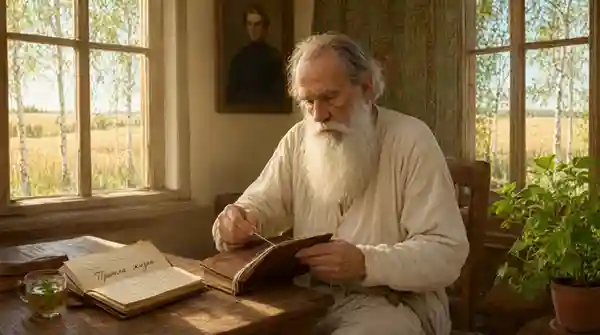
What Tolstoy knew about self-improvement that most productivity books miss
Tolstoy’s personal-development ideas are not a system. They are maintenance rules. That is why they still work. They do not promise a dramatic reinvention. They describe the quiet repair work of keeping a character intact through ordinary decisions—how you speak, how you work, how you decide, how you treat people when no one is watching. I call this Tolstoyan maintenance: the daily, unglamorous practice of keeping your conduct aligned with your values through small, repeated acts rather than grand resolutions. The modern self-help industry tends to sell transformation. Tolstoy sells upkeep. Upkeep is harder. Upkeep is also more useful.
Why thoughtful speech beats constant opinion
The first rule is about speech, and it is blunt. People who know a lot speak carefully because they do not want to be wrong. People who know little—and people who are too pleased with themselves—have an opinion about everything. You have met both types. The first type makes you lean in. The second type makes you check your phone.
The difference is not intelligence. It is epistemic humility. A 2025 study in the Journal of Personality found that intellectual humility predicted greater openness to opposing views and better learning from disagreement. The humble person is not quieter because they have nothing to say. They are quieter because they know how much they do not know. The conceited person fills the silence because silence feels like a verdict. It is not. Silence is just silence.
Happiness starts with a belief you can defend
Tolstoy says you cannot be happy unless you believe happiness is possible. That sounds like a greeting card. It is actually a claim about attention. If you believe happiness is impossible, you will filter out the evidence that contradicts the belief. You will notice the setbacks. You will miss the small wins. The belief becomes a self-fulfilling prophecy, and the prophecy is grim.
The research on learned optimism, developed by Martin Seligman at the University of Pennsylvania, has shown that people can be taught to recognize and challenge pessimistic interpretations. The point is not to pretend everything is fine. The point is to stop treating every difficulty as permanent, pervasive, and personal. Happiness is not a mood you wait for. It is a stance you practice.
Work is how you keep your value
Tolstoy says a person can preserve their worth only through work. The sentence is easy to misread. It does not mean that your worth is measured by your output. It means that work is one of the ways you stay in relationship with yourself. The person who stops working—not just for money, but for purpose—begins to erode. The erosion is slow. It looks like boredom. It feels like restlessness. It becomes resentment.
The clean life Tolstoy describes requires work, failure, restarting, and struggle. That is not a motivational slogan. It is a description of the maintenance cycle. The research on post-traumatic growth has shown that people who experience adversity sometimes report deeper relationships, greater appreciation for life, and increased personal strength. The growth is not guaranteed. But it is more likely when the person keeps moving, keeps working, keeps trying. The struggle is not the punishment. The struggle is the practice.
Decide first, then let the step land
Tolstoy’s advice on decisiveness is almost athletic. If you are not sure, be quick. Take the first step yourself. Even if the step does not land where you intended, take it. The advice is not about recklessness. It is about breaking the paralysis that comes from waiting for certainty.
The research on implementation intentions, developed by Peter Gollwitzer at New York University, supports the underlying logic. A 2006 meta-analysis by Gollwitzer and Paschal Sheeran reviewed 94 studies and found that people who specify when, where, and how they will act are significantly more likely to follow through than people who simply intend to act. The step does not need to be perfect. It needs to be taken. The taking is the beginning. The beginning is the point.
Simplicity is not a style. It is a discipline.
Tolstoy says the most beautiful things are often made in simplicity, not in noise and spectacle. You can see this in a well-run kitchen. You can see it in a good sentence. You can see it in a company that does not need a slogan to explain what it does.
The opposite is also true. The loudest room is often the least productive. The most decorated résumé is often the least happy. The most expensive car is often the least necessary. Simplicity is not about having less. It is about knowing what matters and refusing to let the rest take up the room. The proof is in the pudding. The pudding is usually plain.
Goals at every scale, including the next minute
Tolstoy says you should have a purpose for your life, for the year, for the month, for the day, and even for the minute. The scale is the insight. A life purpose without a daily practice is a fantasy. A daily practice without a life purpose is a treadmill. The two need each other.
The minute-level goal is the one most people skip. It is also the one that changes the day. What are you trying to do in the next sixty seconds? If the answer is “scroll,” that is a choice. If the answer is “write one sentence,” that is a different choice. The choice is small. The choice is not nothing. The compounding is made of minutes.
Give without an audience
Tolstoy says do not do good for show. Do it for good. The instruction is simple, and it is almost impossible to follow perfectly. The human brain is a social organ. It wants credit. It wants recognition. It wants the small dopamine hit of being seen as generous.
The research on prosocial behavior has shown that people are more likely to help when they are observed. That is not a flaw. It is a feature of social life. But it becomes a problem when the observation becomes the reason. The good deed that is done only for the audience is not a good deed. It is a performance. The performance can be useful. It is not the same as the deed. The deed is what you do when the audience is gone.
Moral shortcuts always send a bill
Tolstoy says do not trample moral rules, because revenge comes quickly. The language is old. The logic is modern. The moral shortcut is a loan. You take it because it is convenient. You pay it back with interest. Sometimes the interest is reputation. Sometimes it is trust. Sometimes it is the quiet knowledge that you are not the person you claimed to be.
The research on moral disengagement, developed by Albert Bandura at Stanford, describes the cognitive mechanisms people use to justify behavior that violates their own values. The mechanisms include moral justification, euphemistic labeling, and displacement of responsibility. The mechanisms work in the short term. They fail in the long term. The bill always arrives. The only question is who pays it.
Silence has a higher interest rate than speech
Tolstoy says you may regret a spoken word, but you will regret a withheld word a thousand times. The claim is not about oversharing. It is about the cost of avoidance. The conversation you did not have. The apology you did not offer. The boundary you did not set. The love you did not express. These are the regrets that compound.
The research on regret, conducted by Thomas Gilovich and Victoria Medvec at Cornell University, found that in the short term people regret actions more than inactions. In the long term, the pattern reverses. People regret the chances they did not take, the words they did not say, the risks they did not accept. The silence feels safe in the moment. It is expensive in the decade.
Real strength looks like steadiness
Tolstoy says a person’s real power is not the leap but the unshakable stance. The leap is dramatic. The stance is boring. The leap gets the applause. The stance gets the results.
The research on grit, developed by Angela Duckworth at the University of Pennsylvania, has shown that perseverance and passion for long-term goals predict success beyond what can be explained by intelligence. The gritty person is not the person who sprints. The gritty person is the person who keeps showing up after the sprint is over. The showing up is the strength. The strength is the stance.
Thinking is a defense against blind belief
Tolstoy says anyone who has learned to think does not believe anything blindly. The sentence is a warning and a promise. The warning is that blind belief is comfortable. It gives you a tribe. It gives you a story. It gives you a way to stop thinking. The promise is that thinking is available. You do not need a credential to do it. You need the willingness to be uncomfortable.
The research on cognitive reflection, developed by Shane Frederick at MIT, has shown that people differ in their tendency to override an intuitive answer and engage in deliberate reasoning. The differences predict outcomes across domains. The person who thinks is not smarter in the abstract. They are more willing to pause. The pause is the skill. The skill is the defense.
Humor is a social technology
Tolstoy says humor is a great quality. Nothing brings people closer than a good smile. The claim is not about comedy. It is about the small, shared moment of lightness that makes the rest of the interaction possible. A meeting without humor is a meeting without oxygen. A relationship without humor is a relationship without repair.
The research on laughter and social bonding has shown that shared laughter increases feelings of closeness and reduces stress. The effect is not about the joke. It is about the shared moment. The moment says: we are in this together. The saying is the technology. The technology is free.
When maintenance becomes a mental-health issue
There is a line between ordinary self-improvement and something that requires professional attention. Ordinary maintenance is a practice. It has good days and bad days. It does not stop you from sleeping, eating, or functioning. If the self-criticism has become persistent—if it interferes with sleep, appetite, relationships, or your ability to work—the appropriate response is not to try harder to follow the rules. It is to speak with a mental health professional who can help you assess what is happening. The research on self-criticism, perfectionism, and depression is robust. Support is not a sign that you have failed to maintain yourself. It is a recognition that some maintenance requires a second set of hands.
The file that stays open
The file on Tolstoy’s personal-development rules is not closed. It is open on the desk. The rules are not a system. They are a set of reminders. Speak carefully. Believe happiness is possible. Work. Decide. Simplify. Set goals at every scale. Give without an audience. Do not take moral shortcuts. Do not confuse silence with safety. Stand steady. Think. Laugh.
The reminders are old. The reminders are useful. The reminders are not the point. The point is the maintenance. The maintenance is the life.