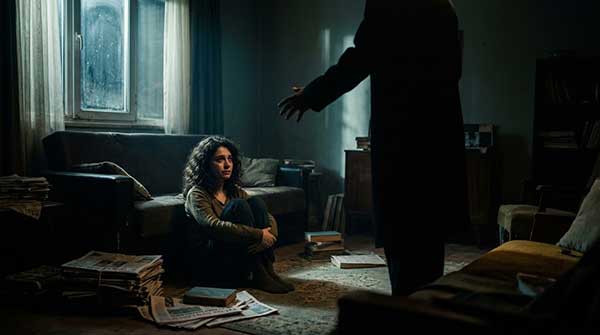
What Does Emotional Abuse Actually Look Like In A Relationship
Jenna kept a running list on her phone for almost two years — not of arguments, not of grievances, just small notes to herself: he said I was too sensitive again. I apologized for crying. She showed it to a therapist in Phoenix eventually, almost by accident, mentioning it the way you’d mention a grocery list. The therapist read through eleven entries and asked her a single question: when was the last time you apologized for something that was actually your fault. Jenna couldn’t answer. She sat there doing the math in her head and came up empty.
That’s usually how this starts — not with a slammed door or a bruise, but with a slow erosion so gradual the person inside it can’t find the edge of where it began. The World Health Organization estimates that roughly one in three women worldwide experiences physical or sexual violence in her lifetime, most often at the hands of a partner. Those are the numbers that make headlines. What almost never makes headlines is the version of harm that leaves no mark anyone can photograph.
I want to be upfront about something before going further: this isn’t a tidy topic with clean edges, and I don’t think it should be treated like one. Psychological abuse is slippery precisely because it doesn’t look like violence. It looks, most of the time, like a relationship.
How Do I Know If What I’m Experiencing Counts As Abuse
Here’s where a lot of people get stuck, and I don’t think it’s a failure of intelligence — it’s a failure of definition. Belittling a partner. Controlling what they’re allowed to do or who they’re allowed to see. Withholding information deliberately. Cutting them off from friends and family, one canceled plan at a time. Neglect disguised as busyness. Dumping the entire emotional weight of the relationship onto one person’s shoulders. Damaging someone’s belongings or invading their privacy as a form of control. Researchers studying intimate partner dynamics — including work published by Atakay in 2014 — have catalogued these behaviors precisely because so many people living through them don’t recognize the pattern until it’s named out loud.
The American Psychological Association has been tracking this for years too, and the numbers aren’t small. Turkey’s national statistics institute found that nearly 44 percent of women report having experienced emotional abuse in a relationship — and closer to home, the CDC’s National Intimate Partner and Sexual Violence Survey has found that more than 1 in 3 women and nearly 1 in 3 men in the United States report experiencing psychological aggression by an intimate partner at some point in their lives. During the pandemic, researchers in multiple countries documented a spike in reported psychological abuse of close to 93 percent within a single year. Almost everyone surveyed in some of these studies said yes, this happened to me. Which means the real question isn’t really “does this happen to other people.” It’s whether it’s happening in your own house right now, and whether you’d even recognize it if it were.
Why Do Victims Of Psychological Abuse Stay Silent For So Long
Emotional abuse tends to produce a specific, exhausting cluster of symptoms — depression, anxiety, disrupted sleep, disordered eating. Confidence erodes slowly enough that most people don’t notice it going until it’s mostly gone, and isolation creeps in right alongside it, one skipped dinner with friends at a time.
I’ve sat across from a version of this pattern more times than I can count, and it tends to follow a specific shape. One partner communicates openly, names what they feel, asks for what they need. The other keeps everything locked down, solves problems alone, and over time starts describing the first partner’s honesty as “too much” — dramatic, exhausting, exaggerated. What happens next is the part that actually breaks my heart a little every time I see it: the open partner starts believing it. She starts calling her own honesty “dramatic” before her partner even gets the chance to. She goes quiet. And then she finds herself explaining his coldness away — it’s just how he was raised, he doesn’t mean it, I’m probably overreacting — building him a defense he never had to build for himself.
There’s a second pattern I run into just as often, and it usually sounds smaller from the outside, which is part of what makes it dangerous. “Didn’t you make dinner?” “You didn’t wash my shirt?” “Why is the baby crying, what did you do?” Small questions, dressed up as ordinary, that quietly train someone to feel perpetually inadequate. Somewhere along the way it’s worth saying plainly: a household is a shared project. A husband who occasionally helps with dinner isn’t doing his wife a favor — half of that responsibility was already his. Partners are absolutely allowed to critique each other. There’s a real difference, though, between a critique that opens a conversation and one that’s engineered to make somebody smaller.
What Should I Do If I Think My Partner Is Emotionally Abusing Me
If you’ve read through this and something in your stomach dropped — that specific, uncomfortable recognition — the first real step is naming it directly, with actual examples, to the person doing it. Not vaguely. Specifically. “When you said X, this is what it did to me.”
I want to be honest about something here, because I think false hope does more damage than blunt truth: awareness is the first step toward change, not the whole staircase. Recognizing a pattern doesn’t dissolve it. The person causing harm has to actually do something with that awareness — real effort, sustained over time, not a single tearful apology that resets the clock until the next incident.
And if both people are communicating, and trying, and the pattern still won’t loosen its grip — that’s not a sign you’ve failed at fixing it yourselves. That’s usually the exact moment a licensed therapist stops being optional and starts being necessary. Psychologist Lundy Bancroft, who spent years running intervention programs for abusive partners before writing about the patterns he’d observed, has made a point that’s stuck with me: the behaviors rarely change through willpower alone. They change, when they change at all, through sustained outside accountability — which is a different thing entirely from good intentions.
A Question Worth Sitting With Tonight
If you had to write down, right now, the last time you apologized for something that genuinely wasn’t your fault — could you do it in under a minute? If the answer comes too easily, that’s worth paying attention to, not brushing past.
This is a heavy subject, and if any part of it landed close to home, I want to say clearly: you don’t have to sort through this alone, and reaching out for support — whether that’s a therapist, a trusted friend, or a confidential hotline — is a reasonable next step, not an overreaction.
A Few Things Readers Ask
Is emotional abuse considered as serious as physical abuse? Mental health researchers increasingly treat it that way, precisely because the psychological damage — the anxiety, the eroded self-worth, the isolation — often outlasts physical wounds by years. The absence of a visible mark doesn’t mean the absence of real harm.
Can someone who’s emotionally abusive actually change? It happens, but rarely through willpower alone — it usually requires sustained outside accountability, like structured therapy specifically aimed at the behavior, not just a partner’s patience and hope.
What’s the first practical step if I recognize these patterns in my own relationship? Start by naming specific incidents out loud to your partner rather than the general feeling — and if that conversation goes nowhere after real effort on both sides, treat professional support as the next reasonable step, not a last resort.