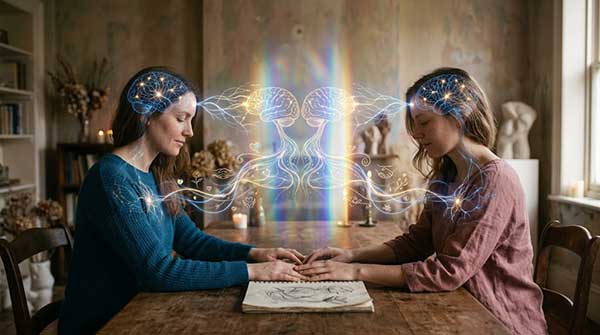
Mirror Neuron Therapy Explained: How Watching Can Rewire the Brain
The monkey was not doing anything. That is the part that changed everything. It was sitting in a lab in Parma, Italy, in the early 1990s, with electrodes planted in its brain. The researchers were studying movement. They had already mapped the neurons that fired when the monkey reached for a peanut. Then something strange happened. One of the researchers picked up a peanut. The monkey just watched. And those same neurons fired again. Not because the monkey moved. Because the monkey saw.
That accidental moment broke open a field that had been quietly waiting to exist. The researchers, led by Giacomo Rizzolatti, had stumbled onto what we now call mirror neurons. Brain cells that respond the same way whether you perform an action or watch someone else perform it. The boundary between doing and seeing turned out to be thinner than anyone had assumed.
I first heard this story in a lecture hall in Columbus, Ohio, and I remember thinking it sounded like science fiction. It was not. It was neuroscience catching up to something we have always known in our bodies: watching is not passive. It is a form of participation.
What Those Firing Cells Actually Mean
The initial studies were in macaque monkeys. That detail matters because it tells you how old and deep this system is. It is not a human invention. It is part of the mammalian inheritance. But the real confirmation came when imaging technology improved. Functional MRI and EEG studies showed the same thing in human brains. When you perform an action, certain motor areas activate. When you watch someone else perform that same action, those same areas light up. The brain does not fully distinguish between doing and observing.
This is not a metaphor. It is a measurable, reproducible finding. And it has consequences.
Think about what this means for how we learn. Babies do not learn to wave by reading instructions. They watch. They imitate. Language is the same. A toddler does not conjugate verbs from a textbook. She listens, watches mouths move, and eventually her own mouth makes the shapes. The mirror neuron system is one of the mechanisms under that process. It is why a room full of babies will eventually produce one who claps, and then suddenly all of them are clapping.
The source material I keep returning to this month describes this plainly: babies learn movement, language, and speech through observation, repetition, and imitation. That is the mirror system at work. Not a theory. A biological fact.
How Watching Can Trick a Brain Into Healing
Here is where the therapy part comes in. If watching activates the same motor areas as doing, then watching might be a way to practice without moving. For someone who cannot move, that is not a small thing.
Stroke patients are the clearest example. After a stroke, the connection between intention and movement can be damaged. A hand will not obey. A leg will not lift. The desire is there. The signal is not. Mirror neuron therapy asks those patients to watch someone else perform the movement they cannot perform themselves. To observe a hand opening and closing, a foot lifting, a cup being raised. The brain, watching, fires the motor areas involved in those actions. The theory is that this repeated activation helps rebuild the pathway.
It is not magic. It is not a cure. But it is a tool, and in rehabilitation, tools matter. The source material notes that this approach is used with stroke patients, in pain treatment, and with developmental conditions including autism, Down syndrome, and Asperger syndrome. The common thread is not the condition. It is the mechanism. Observation as a form of rehearsal.
I have a cousin in Arizona who is a physical therapist. She works with stroke patients, and she started using mirror therapy a few years ago. She told me once that the hardest part for patients is not the exercise. It is the idea that watching could count as work. They want to feel like they are doing something. And she has to tell them: you are. Your brain is doing the work. Your hand just has not caught up yet.
The Phantom Limb and the Mirror Box
There is a strange, almost poetic application of this research that does not get enough attention. Phantom limb pain. People who have lost an arm or a leg but still feel pain in the missing limb. The brain is sending signals to a body part that no longer exists, and the body has no way to answer back.
In the 1990s, a neuroscientist named V.S. Ramachandran built something called a mirror box. It was a simple wooden box with a mirror in the middle. A patient with a missing hand would place their intact hand on one side of the mirror and position the mirror so that the reflection created the illusion of two hands. Then they would move the intact hand. The brain, watching the reflection, saw the missing hand moving. And for some patients, the phantom pain decreased.
That is mirror neuron therapy in its purest form. Not because the mirror healed anything physically. Because the brain believed what it saw. The watching became the doing. The illusion became the treatment.
I think about that a lot. The idea that seeing can be enough to shift pain. It sounds like a trick. But the brain is a trickster. And sometimes the trick is the medicine.
Empathy Is Not Just a Feeling
There is another side to this, and it is the one that matters most for how we live with each other. The source material mentions that mirror neurons are important for empathy. That word gets thrown around a lot. But what does it mean at the level of neurons?
It means that when you see someone stub their toe, your own pain circuits flicker. Not as intensely. Not as vividly. But they respond. Your brain is simulating the experience of the other person. Not because you are kind. Because you are wired that way. Empathy is not a moral achievement. It is a biological default. We feel each other. Literally.
That is why watching someone cry can make your throat tight. Why seeing someone laugh can lift your mood without a single word being exchanged. Why a room full of anxious people makes you anxious. The mirror system is always on, always attuning, always blurring the line between self and other.
This is also why the therapy applications for autism and similar conditions are so interesting. If the mirror system is involved in reading other people, then strengthening that system might help. The evidence is still emerging. Some studies show promise. Others are more cautious. The honest answer is that we are still in the early stages of understanding what this means.
What I Still Do Not Know
I want to be careful here. Mirror neuron research has been through periods of hype. In the 2000s, people were calling mirror neurons the basis of everything from language to culture to morality. Some of that overreaching has been walked back. The science is real, but it is not the whole story. The brain is not a single mechanism. It is a tangle of systems, and the mirror system is just one thread.
The source material is measured about this. It describes the therapy as part of a treatment approach. Not a miracle cure. Part. That word matters. It is honest.
There are questions I still cannot answer. How much of the effect is specific to mirror neurons versus general attention? Does watching a video work as well as watching a live human? Do some people have stronger mirror systems than others? The research is ongoing. I have my guesses, but guesses are not the same as evidence.
What I do know is this: the discovery in that Parma lab changed how we think about learning, healing, and connection. It gave us a biological language for things we had always sensed but could not explain. Watching is not nothing. Attention is not passive. And the distance between one person and another is smaller than it looks.
The next time you watch someone do something — swing a bat, play a chord, chop an onion — notice what happens in your own body. There is a faint echo. A ghost of the movement. That is your mirror system, practicing. Not so you can imitate. So you can understand.
Questions I Keep Turning Over
Can mirror neuron therapy be done at home?
Some of it can. Watching videos of movements, especially if you imagine yourself performing them, can activate some of the same areas. But for rehabilitation after stroke or for pain management, it is better to work with a therapist who knows how to structure the exercises. The dose matters, not just the activity.
How strong is the evidence for mirror therapy in stroke recovery?
There are systematic reviews showing benefits for motor function in stroke patients, particularly for hand and arm movement. The effect sizes vary, but the overall direction is positive. It is considered a complementary approach, not a replacement for conventional physical therapy.
Do mirror neurons really explain empathy?
They are part of the explanation. Empathy involves multiple brain systems, including emotional processing and cognitive perspective-taking. Mirror neurons seem to provide the automatic, embodied component — the part where you feel someone’s pain without choosing to. But full empathy is more than that. It includes what you do with the feeling.