The Science of Heartbreak: What Happens to Your Brain and Body When Love Ends
Two years ago, my best friend called me at 2 AM. I knew something was wrong before I answered. Her voice was flat, hollow—the kind of quiet that comes after hours of crying. She said four words I’ll never forget: “He left me today.”
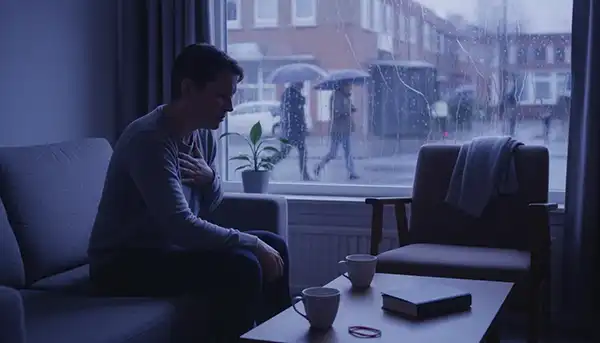
I spent the next three hours on the phone with her. She described physical sensations I’d heard before but never fully understood. “It feels like someone punched me in the chest,” she said. “Like I can’t breathe properly. Like my ribs are caving in.” She wasn’t being dramatic. She was describing, with unsettling accuracy, what happens to the body when a heart breaks.
I’ve been there too. Most of us have. The end of a relationship. The loss of a friendship. A dream that died before it had a chance to live. We use words like shattered, crushed, ripped apart—not because we’re reaching for poetry, but because we’re reaching for something that captures the physical weight of emotional pain. And science has shown that we’re not just speaking metaphorically. Emotional pain and physical pain share the same neural real estate.
Why Heartbreak Hurts So Much: The Brain’s Response
When I first learned that emotional and physical pain activate the same brain region—the anterior cingulate cortex—it made sense of something I had never been able to articulate. That region is responsible for processing the distress component of pain. Whether you cut your hand or get your heart broken, the brain registers it as damage. A threat. Something that needs attention.
Researchers have found that people who experienced social rejection showed increased activity in the same neural pathways as people who experienced physical burns. The brain doesn’t distinguish between a broken bone and a broken heart as clearly as we’d like to believe. It just knows something is wrong.
But here’s the cruel asymmetry. Physical wounds heal relatively quickly with proper care. Cut your hand, clean it, bandage it, and within days you see improvement. Emotional wounds don’t work that way. They can linger for weeks, months, even years. You can’t put a bandage on a memory. You can’t ice a feeling. And that’s what makes heartbreak so uniquely exhausting—you’re carrying a wound that doesn’t show, doesn’t close, and doesn’t follow a predictable timeline.
The Hormonal Storm: Dopamine, Oxytocin, and Cortisol
What I didn’t understand until I started reading the research is that heartbreak is also a biochemical event. When you fall in love, your brain releases dopamine and oxytocin—the reward and bonding hormones. Dopamine gives you that rush of anticipation, that feeling of walking on air. Oxytocin deepens attachment, makes you feel safe and connected. Together, they create something close to addiction. You crave the person the way you’d crave a drug.
When that person leaves, the supply of those hormones drops sharply. Dopamine plummets. Oxytocin fades. And cortisol—the stress hormone—rises to fill the gap. This is your body’s emergency response. It interprets the loss as a survival threat. Your heart rate increases. Your sleep gets disrupted. Your appetite changes. You feel wired but exhausted, alert but unable to focus.
A study from the University of California found that people going through a breakup had cortisol levels comparable to people facing major surgery. That’s not an exaggeration—it’s a physiological fact. Your body is in crisis mode, and it doesn’t know the difference between a broken relationship and a broken leg.
Norepinephrine, another hormone involved in attention and vigilance, also drops during heartbreak. That’s why you feel foggy, forgetful, unable to concentrate. Your brain is flooded with signals that something is wrong, but it can’t figure out how to fix it. It keeps replaying memories, scanning for solutions, running the same loop over and over.
When Heartbreak Gets Physical: Broken Heart Syndrome
This is where I need to be direct with you.
If you are experiencing chest pain, shortness of breath, or palpitations after a major emotional event—do not assume it’s just anxiety. These are also symptoms of a condition called Broken Heart Syndrome, or Takotsubo Cardiomyopathy. It was first identified in 1990 in Japan, and it happens when severe emotional stress causes a temporary weakening of the heart muscle. The left ventricle balloons out, making it look like a takotsubo—a Japanese octopus trap. The symptoms mimic a heart attack, but unlike a heart attack, there’s no blockage in the arteries. The damage is functional, not structural.
If you feel any of these symptoms—chest pressure, pain radiating to your left arm, dizziness, cold sweats—please seek medical attention immediately. Do not wait. Do not assume it will pass. Broken Heart Syndrome is treatable, and most people recover fully with proper care, but it can be life-threatening if ignored. Tell the doctor about any recent emotional stress. They need that information to make the right diagnosis.
The good news about Broken Heart Syndrome is that unlike a heart attack, it doesn’t cause permanent damage to the heart tissue. Once the stress resolves, the heart usually returns to normal function within days or weeks. But the bad news is that you can’t recover from it by pretending you’re fine. It requires medical attention, rest, and emotional support—often the same things you need to heal from the heartbreak itself.
How the Body Changes When You’re Hurting
Heartbreak doesn’t just affect your mood. It affects your skin, your weight, your immune system. Elevated cortisol levels can trigger acne breakouts. Sleep disruption can slow your metabolism. Emotional distress can lead to weight gain or loss, depending on how your body responds to stress.
I’ve seen this in friends and in myself. After a difficult breakup a few years ago, I lost eight pounds in three weeks. I wasn’t trying. My appetite disappeared, and my body was running on adrenaline. At the same time, my skin broke out in ways it hadn’t since high school. I felt like a stranger in my own body. The physical changes made the emotional ones worse. It felt like I was falling apart from the inside out.
This is why self-care during heartbreak isn’t optional. It’s not indulgence. It’s necessity. Your body is under siege, and it needs resources to fight back. That means eating when you can, sleeping when you can, moving your body even when you don’t want to. It also means reaching out to people who can hold space for you without judgment.
The Toxic Trap: Why We Keep Pain Alive
One of the hardest things to learn about heartbreak is that our own habits can keep it alive longer than necessary. We cling to reminders. We replay conversations. We check our ex’s social media compulsively. We look for answers in places that have none.
I did this after my breakup. I spent hours scrolling through old photos, reading through texts, trying to pinpoint exactly where things had gone wrong. I thought I was searching for closure. What I was actually doing was picking at the scab. Every time I looked at his profile, I felt the same sharp sting. Every time I replayed a memory, I reopened the wound.
A friend finally sat me down and told me something I needed to hear: “You’re not grieving. You’re rehearsing.” I didn’t know what she meant at first. But eventually I understood. Grieving is letting go. Rehearsing is holding on. And rehearsing doesn’t lead to healing. It leads to a loop.
The same logic applies to toxic people, toxic environments, toxic habits. If you keep exposing yourself to the things that hurt you, the wound doesn’t have a chance to close. You can’t heal in the same place that broke you. Sometimes the most loving thing you can do is create distance—not out of anger, but out of survival.
What Actually Helps: The Four Pillars of Recovery
I don’t have a magic cure, but I have a few things that worked for me and for people I’ve watched heal.
Support. People who listen without fixing. Friends who let you cry without rushing to make you feel better. A therapist who understands that grief is a process, not a problem to be solved. Isolation is the enemy of healing. Connection is its ally.
Movement. Exercise releases endorphins, which are natural painkillers. I started walking, even when I didn’t feel like it. Fifteen minutes at first. Then thirty. Then an hour. I didn’t feel better immediately, but I felt something other than despair. And that was enough to keep going.
Routine. When everything feels unstable, routines anchor you. I started writing every morning. Three pages, longhand. No editing. No judgment. It wasn’t about producing anything. It was about showing up for myself consistently. Over time, those pages became a record of my own slow return.
Rebuilding. Heartbreak takes something from you, but it also gives you space. Space to ask: What do I actually want? What do I actually need? Who am I without this person? The answers don’t come quickly, and they don’t come comfortably. But they come.
A Question to Sit With Tonight
If you’re reading this and your heart is still heavy, here’s something I want you to ask yourself: What would I say to a friend who was going through exactly what I’m going through?
Most of us are much kinder to others than we are to ourselves. We’d tell a friend they’re not broken. We’d tell them it’s okay to grieve. We’d tell them they’re allowed to take as much time as they need. We’d remind them that they’ve survived difficult things before. We’d say all of that without hesitation.
Now try saying it to yourself. That’s where healing begins.
Questions that come up
How long does heartbreak usually last?
There’s no fixed timeline. Research suggests that most people start feeling significantly better within three to six months, but it depends on the depth of the attachment, the nature of the loss, and the support available. Some people take longer. Some take less. Comparing your timeline to someone else’s is a form of self-punishment. Your grief is your own.
Is it normal to still love someone even after they hurt you?
Yes. Love and hurt are not opposites. They coexist. You can love someone who treated you poorly. You can grieve someone who wasn’t good for you. This doesn’t mean you’re weak or foolish. It means you’re human. The goal isn’t to stop loving. The goal is to stop placing your worth in someone else’s hands.
When should I see a professional?
If your sadness has lasted more than a few weeks and is interfering with your ability to work, eat, sleep, or care for yourself—if you’ve lost hope, if you’ve thought about harming yourself—please reach out to a therapist, a doctor, or a crisis line. You are not meant to carry this alone. Reaching out is courage, not weakness. And for the physical symptoms—chest pain, palpitations, shortness of breath—go to the emergency room. Let them rule out anything serious. Better to be safe than to be sorry.
I still think about that phone call with my friend at 2 AM. She didn’t know how she would survive. But she did. Not because she was stronger than others, but because she showed up for herself—and let others show up for her. She walked. She cried. She talked. She rested. She rebuilt.
There’s no shortcut through grief. But there is a way through it. You don’t have to be okay. You just have to keep moving. Even slowly. Even broken. Even when you don’t believe it will get better.
It will. Not because the world guarantees it. But because you are still here, still breathing, still capable of the thing that hurt you in the first place: love.
And that, in the end, is the most stubbornly hopeful thing about being human.