The Ships Are Not Sinking You
I quit a job once with no plan. Walked into the office on a Wednesday morning in Nashville, sat down across from my boss, and said the words I had been rehearsing in my car for six months: “I’m done.” No backup. No savings to speak of. Just a certainty in my chest that felt less like courage and more like suffocation. The fear arrived before I reached the parking lot. It sat in the passenger seat all the way home. It followed me into the apartment, onto the couch, into the shower. It was not a feeling. It was a companion.
The source text begins with a quiet observation: every change carries a loss. Not a metaphor. A real loss. The old life, the old identity, the old rhythms — they die when you step into something new. And that death is what we are actually running from. Not the risk. Not the failure. The grief.
I did not understand that for a long time. I thought I was afraid of the unknown. I was afraid of the known ending.
The Ocean Gives You Ships You Didn’t Ask For
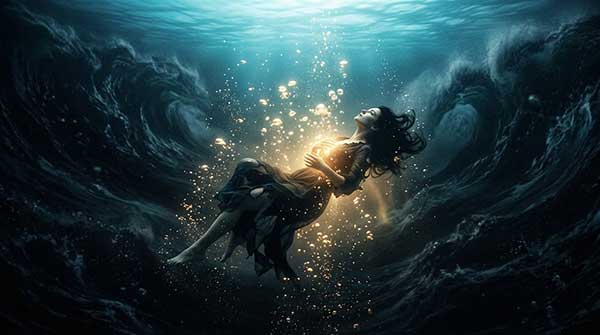
The text uses an image that has not left me since I first read it. Life is an ocean, full of opportunity and change and possibility. You are standing at the edge, ready to dive in, when suddenly ships appear on the water. Heavy ships. Like ingots, the text says. They float, somehow. And the beautiful part is learning you can carry them.
Those ships are the emotions that accompany every new beginning. Fear. Anxiety. Inadequacy. The need for approval. The dread of being judged. They arrive without invitation. They are heavy. They look like they should sink you. But they do not. They float. And so do you.
I have spent years trying to wait for the ships to leave before I started anything. I would stand on the shore, watching the horizon, telling myself I would dive in when the water was clear. The water was never clear. The ships kept coming. The fear never got smaller. It just got older.
The shift happened when I stopped trying to get rid of the fear and started trying to carry it. Not because I was brave. Because I was exhausted. The waiting had become heavier than the doing.
What Would It Feel Like to Look Further Out
The source text asks a question that cracked something open in me: “What would it feel like if I looked further?” The narrator is standing somewhere, focused on something close, and then wonders what would happen if their gaze moved outward. The answer, they admit, is that they lose themselves. The body gets distant. The ground disappears.
I know that feeling. It is what happens when you imagine the future and it is too big to hold. You leave your body. You float away from your own legs. The fear becomes a fog and you are in it and there is no floor.
But the text keeps going. It asks whether the fear lives in the legs, in the body, in the space between the near and the far. That question is not rhetorical. It is a diagnostic. Where does the fear actually live? In the future you are imagining, or in the legs that are standing here now?
Most of my fear lives in the future. It lives in the catastrophic images my mind produces about what will happen if I fail, if I am rejected, if I am seen and found lacking. Those images are not real. They are ships. Heavy, yes. But they float on water. They do not drown me unless I climb onto them and refuse to get off.
The Quote That Would Not Let Me Go
The source text quotes Frank Herbert, and it is the kind of quote that finds you when you need it. “I must not fear. Fear is the mind-killer. Fear is the little-death that brings total obliteration. I will face my fear. I will permit it to pass over me and through me. And when it has gone past, I will turn the inner eye to see its path. Where the fear has gone there will be nothing. Only I will remain.”
I have read those words a hundred times. They are from Dune, a book about a young man who is terrified and does the thing anyway. But I never noticed the most important part until the source text pointed it out: only I will remain. Not the fear. Not the ships. Not the imagined catastrophes. Me.
That is the whole promise. The fear moves through you, not around you. You do not fight it. You do not suppress it. You let it pass over and through. And when it is gone, you are still there. Changed, maybe. Tired, certainly. But present. The fear does not destroy you. It just takes a long time to walk through.
I have started practicing this in small ways. When the fear shows up, I do not push it away. I say, “There you are. Come on in.” Then I keep doing the thing. The fear sits in the chair across from me and talks while I work. It is not comfortable. But it is not unbearable either. The discomfort of carrying it is lighter than the despair of running from it.
What Happens When the Ships Carry You Instead
There is a strange gift hidden in the source text. It says sometimes we let the ships carry us, and we never arrive at the threshold. We never make the leap. We drift. And the text says — and this is the part I keep returning to — that this is also possible. This is also okay. Noticing that you have let the ships carry you is valuable. It is not failure. It is information.
Maybe the question to ask in that moment is not “Why am I so weak?” but “Where am I right now?” Not as a judgment. As an observation. Am I in the water? Am I on the ship? Am I still standing on the shore? Where am I, actually?
I used to think being on the shore was the problem. Now I think it is just a place. You can stand there for a while. You can watch the water. You can feel the fear and not pretend it is not there. The shore is not a punishment. It is a vantage point.
But it is not the only place. And eventually, if you want to live the life you keep imagining, you have to get wet.
The Truth I Keep Forgetting
Every new beginning is a little death. The old self does not come with you. That is the loss. That is the grief. And the grief is real, even when the change is wanted. You do not just gain a new life. You lose the one you had. The one you knew. The one that, however imperfect, was familiar.
I did not let myself grieve the job I quit. I was too busy performing courage. The fear was not allowed because I thought fear meant I had made a mistake. So the fear went underground and came back as insomnia, as irritability, as a dull ache in my chest that would not go away.
The source text says the way through is not to reject the feelings but to include them. To let them ride along. The fear, the anxiety, the inadequacy — they are not enemies. They are evidence that you are doing something that matters. You do not feel terror about things you do not care about.
When I finally let myself be afraid, the fear softened. It did not disappear. It stopped being a wall. It became weather. Heavy weather, yes, but weather. And weather passes.
Where I Am Now
I do not have a clean ending for this. The source text ends with a single word: “Merhaba!” — “Hello!” It is the greeting you offer when you arrive at the other side and find yourself still standing. Hello, self. Hello, new life. Hello, fear that moved through me and left me intact.
I am standing in that hello. It is not triumphant. It is not polished. It is just me, on the other side of a threshold I thought would kill me, still breathing. The ships are still there. They will always be there. But I have learned they can be carried. And so can I.
The next time you are standing at the edge of something new, do not wait for the fear to leave. It will not. Invite it along. Let it pass over you and through you. Then turn and watch its path. Where the fear has gone, there will be nothing. Only you. That is the promise. That is the whole thing. Hello.