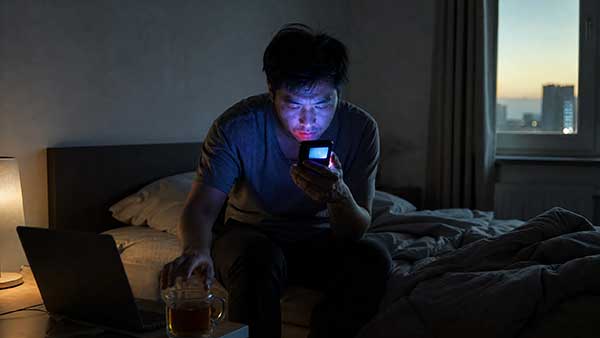
The threat treadmill: why the mind craves the news that breaks it
There is a primitive part of the human psyche that remains convinced we are perpetually twenty minutes away from a tiger attack. For most of our evolutionary history, this hyper-vigilance was a brilliant survival strategy. The person who spent their time worrying about the rustle in the tall grass was far more likely to become an ancestor than the person who assumed it was just the wind. We are the descendants of the anxious, the worried, and the obsessive. However, in the digital age, this ancient biological software has been hijacked by a hardware update it was never designed to handle. We have moved from the tall grass of the savannah to the infinite scroll of the smartphone, and the result is a phenomenon that has recently entered the psychological lexicon: doomscrolling. It is a state where we find ourselves unable to look away from depressing or discouraging news, even as we feel our mental well-being evaporating with every flick of the thumb.
I’ve often thought about how we’ve essentially outsourced our survival instincts to an algorithm that doesn’t care about our survival. We are currently living on what I call a threat treadmill. We run and run through headlines of economic collapse, pandemic updates, and environmental catastrophes, convinced that if we just gather enough information, we will eventually reach a state of “safety.” We think that being informed is the same as being prepared. But a treadmill, by definition, is a machine that provides movement without progress. The faster the news cycle spins, the harder we scroll, yet we never actually arrive at a moment of peace. We are simply exhausting our cognitive reserves on a track that has no finish line.
The pandemic provided the perfect laboratory for this malfunction. During the early months of 2020, many of us became voluntary prisoners of the “refresh” button. We needed to know the case counts, the mutation rates, and the latest restrictions. We told ourselves we were being responsible citizens, but the reality was more primal. We were assessing the environment for predators. But unlike a tiger in the grass, a global virus is an abstract, invisible threat that cannot be solved by knowing its daily statistics. When the pandemic was joined by wars, wildfires, and food shortages, the treadmill began to redline. We found ourselves in a state of high-porosity, where every global tragedy felt as though it were happening in our own living room.
The biological mandate of the negative bias
To understand why we do this, we have to look at the “negativity bias” inherent in human cognition. Our brains are biologically weighted toward bad news because bad news usually requires a more immediate response than good news. You can afford to miss a sunset, but you cannot afford to miss a fire. Researchers in the field of media psychology, such as Pamela Rutledge, have noted that doomscrolling explains our impulsive need for answers during times of fear. We are biologically driven to evaluate whether new information constitutes a threat. In an ancestral environment, this evaluation took seconds. In a digital environment, where the information is curated by engagement-based algorithms, the evaluation never ends. The threat is always “updating.”
I want to be careful here, because the popular narrative often claims that we are “rewiring” our brains permanently through this behavior. I’m not entirely sure that the evidence for long-term structural change is as settled as the headlines suggest. Most studies on digital consumption rely on self-reporting, which the field debates constantly. However, what we do know is that chronic exposure to negative stimuli triggers a persistent release of cortisol and adrenaline. We are keeping our bodies in a state of “fight or birth” for hours a day, which leads to a biological wear and tear known as allostatic load. It reminds me of those old analog television sets that would sometimes get stuck on a channel of pure static. You’d sit there for minutes, staring at the gray snow, hoping for a signal that never came. Our minds become that static; we lose the ability to distinguish between a genuine personal threat and the background noise of a chaotic world.
It is a strange thing to have to admit, but for some, doomsurfing actually provides a warped sense of satisfaction. There is a specific kind of “certainty” in bad news. Uncertainty is often more taxing to the nervous system than a confirmed negative outcome. By scrolling through the disaster, we are seeking a “bottom” to the pit. We want to know exactly how bad things are so that we can stop wondering. But the digital pit has no bottom. Psychoanalyst Babita Spinelli has pointed out that in times of high stress, people turn to social media for a sense of control, turning doomsurfing into a maladaptive coping mechanism. We are trying to use a fire to put out a fire.
The high cost of the informed illusion
The tragedy of the threat treadmill is that it creates an illusion of agency while simultaneously paralyzing us. We feel that by knowing about the food shortage on the other side of the globe, we are somehow contributing to the solution or at least protecting ourselves from its impact. In reality, we are just decreasing our capacity to handle the problems that are actually within our reach. High-intensity media consumption narrows our attention, a phenomenon sometimes called “cognitive tunneling.” We become so focused on the global static that we stop noticing the immediate world.
This creates a state of existential malnutrition. We are consuming “empty calories” of information—bits of data that trigger our stress response without providing any nutritional value for our growth or our happiness. If we are to reclaim our mental landscape, we have to recognize that the algorithm is not our friend. It is designed to keep the treadmill moving because a running person is a person who keeps clicking. Awareness is the first step toward stepping off the belt. We have to learn to distinguish between a “need to know” and an “urge to scroll.”
Strategies for reclaiming the horizon
Breaking the cycle of doomscrolling is not about becoming ignorant or indifferent to the world’s pain. It is about protecting the integrity of your own attention so that you can actually be of use to the world. A person who is constantly vibrating with digital dread is rarely a source of stability for others.
- Audit your sources: Most information pollution comes from unverified social media accounts that thrive on outrage. Redirect your attention to primary sources and scientific data. Read the verified research rather than the inflammatory summary of that research.
- Set a scrolling curfew: The brain is most vulnerable to the threat treadmill in the early morning and late at night when our cognitive defenses are low. Decide on a specific, narrow window—perhaps twenty minutes in the afternoon—to catch up on the world. Outside of that window, the treadmill is off.
- The pivot to the immediate: When you feel the urge to “doomsurf,” perform a physical task. Wash a dish, walk a different route to the store, or just pay attention to the sensation of your own breathing. This is not just “distraction”; it is a way of telling your amygdala that you are currently safe in your physical environment.
We are living in an era of information obesity, where the sheer volume of data has become toxic. But the “grid” only has as much power as we give it with our attention. The world will always be full of crises, and there will always be a new catastrophe waiting in the wings. But your life is happening in the quiet moments between the headlines. It is happening in the room where you are sitting, in the air you are breathing, and in the people who are standing right in front of you.
Sources for further reflection:
- The Psychology of Doomscrolling, Pamela Rutledge, Media Psychology Research Center.
- Negativity Bias and the Evolutionary Mind, various studies in the Journal of Personality and Social Psychology.
- The Shallows: What the Internet Is Doing to Our Brains, Nicholas Carr.
A few things worth clarifying
Does doomscrolling mean I should stop watching the news entirely?
Not necessarily. Information is a tool, but like any tool, it can be used to build or to destroy. The goal is to move from “passive consumption” to “active inquiry.” When you check the news, have a specific question in mind, find the answer, and then leave. If you are just “surfing” without a destination, you are no longer using the tool; the tool is using you.
How do I handle the guilt of looking away when the world is suffering?
This is a common emotional trap. We often mistake “staying informed” for “bearing witness.” But watching a tragedy on a six-inch screen for four hours is not an act of solidarity; it is a form of self-torture that helps no one. You are more capable of helping others when your own nervous system is regulated. You don’t have to carry the weight of the entire world to prove that you care about it.
Is it possible that the “algorithm” is actually changing our personality traits?
The research here is mixed and requires a lot of caution. While some studies suggest that high-engagement platforms can increase traits like neuroticism or social anxiety, it is difficult to prove causality. It is more likely that these platforms amplify existing tendencies rather than creating new ones. We are not being “reprogrammed” by a machine; we are being tempted by a machine that knows exactly which of our ancient survival buttons to push.
A small shift in focus
Tomorrow morning, before you check a single notification, spend five minutes looking out a window. Don’t look for anything in particular. Just watch the light change, or notice the way the wind moves through the trees. For those five minutes, refuse to enter the digital tall grass. Acknowledge that the world is large and often difficult, but also acknowledge that in this specific moment, you are here, you are breathing, and the treadmill is stationary. Reclaim the first hour of your day as a sovereign territory where the news is not allowed to enter.