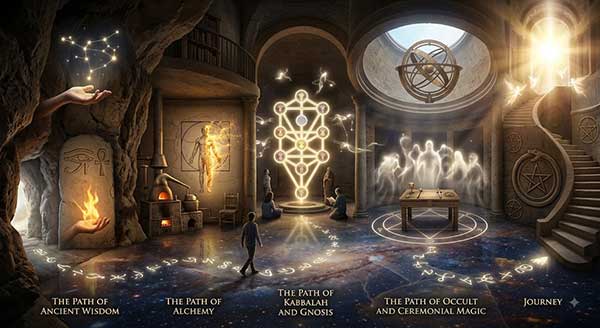
Unlocking the Hidden Depths of Esotericism and Ancient Wisdom
There is a quiet, persistent whisper that runs underneath the loud architecture of human history. While mainstream culture builds its cathedrals out in the open—codifying laws, organizing public rituals, and establishing clear lines of orthodoxy—there has always been another current running silently beneath the floorboards. It is a current that asks not what you must do to conform to society, but who you are when all the social scaffolding is stripped away.
We live in a world that deeply loves the surface. We measure life by productivity, visibility, and measurable metrics. Yet, every so often, a strange restlessness creeps in. You find yourself wondering if there is a deeper grammar to existence, a hidden key that makes sense of the labyrinth. That perennial human itch—the unquenchable desire to look behind the curtain—is the very heartbeat of what we call esotericism.
When we first encounter the word, it often conjures up images of dusty manuscripts, robed figures whispering in dimly lit cellars, or complex astrological charts covered in cryptic symbols. But when you peel back the layers of myth and cultural prejudice, esotericism reveals itself to be something far more intimate: an ancient, shifting map of human inner transformation. It is the art of looking inward while the rest of the world is busy staring outward.
The Fine Line Between the Public Altar and the Private Key
To truly understand why esoteric traditions have fascinated—and occasionally terrified—mainstream institutions for centuries, we have to look at the eternal tension between the outer and the inner. Sociologists and historians of religion often split human spiritual expression into two distinct categories: exotericism and esotericism.
Exoteric practices are the public face of culture and organized religion. They are the laws, the shared communal liturgies, the visible hierarchies, and the moral codes designed to keep a civilization running smoothly. They are necessary, grounding, and communal. Esotericism, on the other hand, leans inward. It is intensely personal, focused on direct mystical experience, self-realization, and the cultivation of an inner garden that no government decree can touch.
Yet, drawing a hard line between the two is rarely clean. Many esoteric traditions borrow heavily from folk traditions, ancient myths, and local folklore. Over time, through the patient hands of antiquarians and scholars, these raw folk practices get polished into elite philosophical systems. Interestingly, much of what was once considered forbidden or hidden knowledge is now openly available on bookstore shelves or digital libraries. Part of this shift comes from modern safety—we live in an era where exploring alternative spiritual perspectives is no longer an immediate ticket to being branded a heretic.
Another reason knowledge remains “hidden” is less about secretive gatekeepers locking doors and more about natural cognitive friction. Some truths cannot simply be handed to you on a printed page; they require a specific inner preparation to be understood. Think of alchemy, for instance. Long before it was misunderstood as a primitive chemistry trying to turn lead into physical gold, classical alchemists viewed their work as a grueling, meticulous metaphor for psychological and spiritual purification. If you hand a profound spiritual framework to someone who lacks the emotional maturity or intellectual patience to digest it, it simply bounces off them like rain on a stone. The barrier isn’t a velvet rope; it is the readiness of the seeker’s own consciousness.
Historically, the reception of these inner traditions varied wildly depending on the neighborhood and the century. In Western Christianity, straying too far into private mystical interpretations often flirted with the dangerous edge of heresy. Conversely, within rich traditions like Jewish mysticism, or Kabbalah, the boundaries between the mainstream faith and its hidden dimensions were woven much closer together, where respected rabbinic leaders were often the master custodians of both realms. While the word “esotericism” is most frequently dropped into conversations about Western magical and philosophical lineages, its spirit echoes globally—stretching from the meditative interiority of Eastern traditions to the subtle body maps of Tantra and yoga.
A Journey Along the Tapestry of Time
If you go looking for a single, neat timeline of esotericism, you will quickly find yourself lost in a sprawling labyrinth of unrelated characters, secret societies, and philosophical mutations. It is not a straight highway; it is an overgrown garden where ancient seeds keep sprouting in unexpected soil.
The roots stretch back deep into the classical world. The Roman Empire birthed not only the early structures of institutional Christianity but also a thriving ecosystem of mystery religions that placed immense value on personal initiation. Even early Christianity, with its central ritual of baptism, shared certain structural traits with these initiatory movements. As Christianity solidified its grip as the Roman state religion, however, the tolerance for independent spiritual lineages evaporated.
This brings us to ancient intellectual families like Gnosticism. While modern historians frequently debate whether “Gnosticism” was ever a single, unified category, the term generally points to early Jewish, Christian, and pagan movements united by a singular, striking premise: that the material world we touch every day is a flawed, secondary illusion, and true salvation comes through acquiring a direct, secret spark of divine knowledge, or gnosis. Alongside this ran Hermeticism, a body of philosophical texts attributed to the legendary Egyptian figure Hermes Trismegistus, which taught that the human soul and the cosmic universe are intimately and mysteriously mirrored.
As Europe moved through the Middle Ages, fields like astrology, alchemy, and natural magic were not viewed as fringe crackpot theories; they were often standard components of an educated scholar’s toolkit, sitting side-by-side with early science and theology. The tension between esoteric streams and orthodox religion wasn’t always a war; rather, Christian imagination eagerly absorbed esoteric flavorings, giving birth to enduring cultural myths like the Arthurian quest for the Holy Grail.
When the Italian Renaissance rolled around in the fifteenth century, thinkers like Marsilio Ficino and Pico della Mirandola dusted off forgotten classical texts, translating neo-Platonic philosophy and breathing new life into what they believed was an ancient, primordial theology. Fast forward to the nineteenth century, and you see a massive, eclectic wave of esoteric revivals, often uncomfortably tangled up in the rising nationalisms of the era. Figures like Madame Blavatsky stepped onto the global stage, founding the Theosophical Society by weaving ancient Hindu and Buddhist philosophies together with Western occult traditions. She envisioned a grand, invisible brotherhood of sages—a spiritual counterpart to the local Masonic lodges that were sprouting across Europe and America.
As humanity stepped into the twentieth century, the landscape underwent a profound psychological translation. When traditional, literal interpretations of old esoteric practices began hitting intellectual dead ends, thinkers found new ways to decode them. Take Carl Jung, for instance. Rather than viewing alchemy as a literal laboratory process for manufacturing precious metals, Jung brilliantly reframed alchemical symbols as a psychological mirror, mapping the hidden architecture of the human unconscious mind. At the same time, traditionalists like René Guénon were championing perennial wisdom and warning against the hyper-secularization of the modern world.
The Living Anatomy of Esoteric Themes
If you gathered ten different esoteric scholars in a room and asked them to define a single dogma binding all these movements together, you would likely leave empty-handed. Esotericism is defined less by a rigid set of dogmas and more by recurring motifs and a relentless hunger for meaning.
Consider how different streams approach the human experience:
- The Hermetic Principle of Correspondence: Summarized by the famous Hermetic maxim, “As above, so below; as within, so without.” It is the radical proposition that the macrocosm of the universe and the microcosm of the human soul are bound together in a continuous, living dialogue.
- The Gnostic Awakening: The persistent teaching that we are sleepwalking through an illusory reality, and that spiritual awakening is the act of remembering our true, divine origin rather than adapting to the superficial demands of the world.
- The Alchemical Metaphor of Transformation: Whether practiced through literal laboratory apparatuses or symbolic mental refinement, the core idea remains identical: base matter (our raw, unexamined ego) must be broken down, melted, and purified to reveal the pure gold of our higher nature.
- The Psychology of the Automaton: Thinkers like Gurdjieff argued that most human beings live their entire lives on autopilot—reacting to environmental stimuli like biological machines. Esoteric practice, in this view, is the rude awakening that shakes us out of our hypnotic slumber.
- The Integration of Opposites: In Jungian depth psychology, the ultimate esoteric task is not destroying the dark parts of ourselves, but bringing our inner dualities and unconscious shadows into conscious integration.
What links all of these varied frameworks isn’t a set of secret handshakes or ancient passwords. It is the restless, searching human spirit. It is the refusal to accept that the visible, mundane world is all there is.
Whether you find your answers in the intricate geometry of Kabbalah, the quiet stillness of Taoist balance, or the psychological excavation of your own dreams, the true core of esotericism has never been about hiding secrets from the world. It has always been about un-hiding yourself from the illusions that keep you small.
Frequently Asked Questions
Is esotericism the same thing as practicing magic or witchcraft? Not necessarily. While historical esotericism frequently includes traditions like ceremonial magic, alchemy, and astrology, the broader umbrella also covers deep philosophical frameworks, psychological self-exploration, mysticism, and esoteric interpretations of major world religions. Magic is just one room in a very large house.
Why are esoteric teachings often associated with secrecy? Historically, some esoteric knowledge was kept under wraps to protect practitioners from religious or political persecution during intolerant eras. However, much of the “secrecy” is structural—meaning the concepts require a certain level of personal maturity, inner preparation, and direct experience to understand, making them inherently difficult to communicate to someone who isn’t looking for them.
How does modern psychology relate to ancient esoteric traditions? 20th-century pioneers like Carl Jung fundamentally shifted how we view esoteric systems like alchemy and astrology. Instead of taking them purely literally, psychology began treating these ancient symbols as profound maps of the human unconscious, helping modern seekers understand their own internal conflicts, archetypes, and paths toward self-integration.