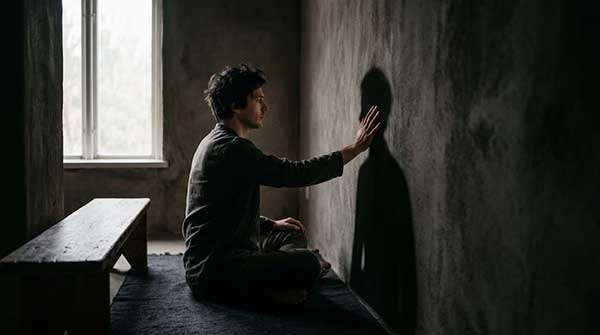
The gold in the basement: why we must stop running from our own shadows
I remember moving into a rented apartment years ago that had a heavy, padlocked cellar door right in the middle of the kitchen floor. The landlord was vague about what was down there, and for the first six months, I behaved as if that room didn’t exist. I filled the upstairs with light, hung bright curtains, and bought enough plants to make the living room look like a botanical garden. But every time the house got quiet, I could feel the presence of that cold, dark square of earth beneath my feet. It didn’t matter how much I polished the floorboards above it; the basement remained, a silent, subterranean weight that influenced the temperature of the entire house.
We do this with our lives. We spend an incredible amount of energy building a persona that is all “living room”—hospitable, curated, and brightly lit—while shoving every impulse, every ugly thought, and every perceived weakness into the basement of the unconscious. Carl Jung, the Swiss psychiatrist who spent his life mapping these internal depths, called this hidden room the Shadow. He argued that we do not become enlightened by imagining figures of light, but by making the darkness conscious. The tragedy of the modern self is that we are terrified of our own cellar doors, not realizing that the very “gold” we spend our lives searching for is often buried in the dirt we’ve spent years trying to ignore.
The Shadow is not a collection of monsters, though it certainly feels that way when the door has been locked for a long time. It is simply the “person you would rather not be.” From a very early age, we begin to learn which parts of our personality are “acceptable” and which are not. To survive and fit into our families and societies, we perform a psychological amputation. We take our anger, our selfishness, our wilder creative impulses, and even our raw power, and we shove them into the basement because they are too messy for the living room. The result is a psyche that is split, a house divided against itself, where the “me” we show the world is only a thin, fragile fraction of the “Self” we actually are.
The architecture of the locked door
Repression is a full-time job. It requires a massive amount of metabolic energy to keep the door to the cellar barred. When we deny these parts of ourselves, they don’t simply vanish; they ferment. They take on a life of their own in the darkness, growing distorted and aggressive because they have been denied the light of consciousness. This is why the person who prides themselves on being “perfectly kind” often has a shadow that is remarkably cruel, manifesting in passive-aggressive barbs or sudden, inexplicable outbursts of rage. The more we insist on our own light, the darker the shadow behind us becomes.
There is a biological and psychological cost to this division. When we are “acting” our lives rather than living them, we experience a profound sense of exhaustion. We are divided between the life we are performing and the life we are suppressing. Jungian psychology suggests that this split is the root of much of our modern malaise. We feel “unreal” because we are only inhabiting half of our own house. We are terrified that if the cellar door were to open, everyone would see the “bad” person we’ve hidden away. But the irony is that the shadow is only dangerous when it is ignored. When it is brought into the light, it often loses its monstrous quality and reveals itself as a source of vital energy that has simply been misdirected.
This brings us to the phenomenon of projection. Because we cannot bear to look at the clutter in our own basement, we see it everywhere else. If I haven’t reconciled with my own capacity for manipulation, I will see manipulative intentions in every coworker, friend, and stranger I meet. The world becomes a giant mirror reflecting our own repressed traits back at us. This is why we often have an irrational, visceral hatred for certain people. Usually, they are simply inhabiting a trait that we have locked in our own cellar. We aren’t judging them; we are judging the part of ourselves that looks like them.
The high cost of the living room performance
Living exclusively in the “living room” leads to a state of psychological humility—or rather, a lack of it. When we don’t know our own shadow, we are prone to a dangerous kind of self-righteousness. We believe we are the “good guys” and that the “bad guys” are out there, somewhere else. But the work of self-discovery requires us to admit that the potential for everything we hate in others also exists within us. This is a difficult, ego-bruising realization. It requires a level of honesty that most of us would rather avoid. But as the I Ching suggests, it is only when we have the courage to face things exactly as they are, without self-deception, that a light will develop to show the way.
The shadow often communicates through our symptoms. It speaks through our recurring patterns of failure, our inexplicable fears, and the feeling that we are “not enough.” It tells a story that sounds like: “I am not worthy.” Many people spend their lives believing this story, unaware that it is being whispered by a part of themselves that is simply lonely and misunderstood. When we externalize this fear, we project it onto our careers, our relationships, and our families, creating a cycle of self-sabotage that feels like fate. But as Jung famously said, until you make the unconscious conscious, it will direct your life and you will call it fate.
Reclaiming the shadow is not about becoming “bad.” It is about becoming whole. It is about integrating the dragon rather than trying to slay it. When you accept your capacity for anger, you gain access to your capacity for boundaries. When you accept your capacity for selfishness, you find the ability to truly care for yourself. The “basement” is where the furnace is; it is where the raw, combustible energy of the house is located. If you lock the door to the furnace room, the rest of the house will eventually freeze.
Reclaiming the furnace from the dark
The process of bringing the shadow into the light is what Jung called individuation. It is the long, often painful journey of becoming “undivided.” It isn’t about reaching some state of divine perfection; it is about reaching a state of structural integrity. An integrated person is not someone who never feels anger or greed, but someone who knows exactly where those feelings come from and can choose how to respond to them. They have walked through their own cellar and no longer fear what is in the dark.
This work often happens in the world of symbols. Jung noted that in dreams, the shadow often appears as a person of the same gender—a monster, a dragon, or even a devil. These figures are not there to haunt us; they are there to remind us of what we have left behind. When we struggle with these figures in our sleep, we are struggling with our own unlived lives. The goal of dream work is not to defeat the monster, but to listen to what it has to say. Usually, it is asking for a seat at the table. It is asking to be acknowledged as a part of the family.
The long walk toward the self
It is important to remember that the shadow is not just a pit of darkness. There is also what Jungians call the “shadow of light.” This is the part of the basement where we have hidden our greatest strengths, our creativity, and our truest selves because we were told they were “too much” or “too loud.” Many of us are more afraid of our greatness than our weakness. We hide our brilliance in the cellar because the living room feels safer when we are small. Reclaiming this light shadow is just as vital as facing the dark one. It is the act of finally allowing yourself to inhabit the full square footage of your existence.
Individuation is a process that is never truly finished. It is the “Great Work” of a lifetime. The value is not in reaching the “final room,” but in the integrity we build along the way. Every time we take a trait we’ve judged and bring it back into the light of our own compassion, the house becomes a little warmer, a little more stable. We stop being a “person of light” and start being a person of substance. We stop projecting our clutter onto our neighbors and start cleaning our own floors.
In the end, the gold is indeed found in the darkness. By embracing the aspects of ourselves that we find unacceptable, we gain access to a depth of character and a reservoir of creativity that the “living room” could never provide. We become more compassionate toward others because we have seen the mess in our own cellar. We become more resilient because we are no longer afraid of the dark. The cellar door is still there, and the room is still cold, but we have the key. And when we finally walk down those stairs and embrace what we find there, we realize that we weren’t locking a monster away; we were locking ourselves in.
Before you look away
Try this today: Think of a person in your life who deeply irritates or angers you. Identify the specific trait in them that you find most unacceptable—perhaps they are “selfish,” “lazy,” or “manipulative.” Now, instead of looking at them, look at your own basement. Ask yourself: “In what way have I been selfish, lazy, or manipulative in my own life, even if I’ve tried to hide it?” Don’t judge the answer. Just observe the feeling. For five minutes, try to see that trait not as a foreign invader, but as a locked door in your own house. Notice if the “heat” of your anger toward the other person drops even a few degrees once you recognize the mirror.
Sources for further reflection:
- Archetypes and the Collective Unconscious, C.G. Jung (1999). (The foundational text on the shadow and individuation).
- The Shadow Effect, Debbie Ford (2019). (A practical look at how the shadow influences our daily lives).
- Meeting the Shadow, edited by Connie Zweig and Jeremiah Abrams. (A collection of essays on the various manifestations of the shadow).
Honest answers to hard questions
Does “integrating the shadow” mean I will start acting on my worst impulses?
The short answer is no; it’s actually the opposite. When a part of you is repressed and unconscious, it operates behind your back. It “possesses” you in moments of stress. By bringing it into the light, you gain conscious control over it. You don’t become a bad person; you become a person who knows their capacity for badness and chooses better. Awareness is the ultimate brake system.
Why is it so much harder to see my “light shadow” than my dark one?
Most of us have a deep-seated fear of our own power because it carries the weight of responsibility. If you admit that you are brilliant, creative, or powerful, you can no longer justify staying small or playing the victim. It is often easier to believe we are flawed than to accept the burden of our own potential. The basement is a convenient place to hide from the demands of the light.
Can I do shadow work alone, or do I need a therapist?
You can certainly begin the observation process on your own, but the very nature of the shadow is that it is “blind” to us. We call it a shadow because it is behind our backs. A trusted friend or a professional can often see the “silhouette” that we are missing. However, the most important requirement is not a guide, but a radical, uncompromising honesty with yourself about what you find when you finally open the cellar door.