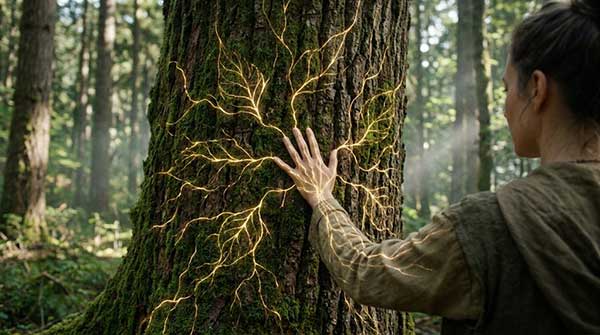
Why We Need Green More Than We Admit
The fern on my windowsill was dying. Not dramatically — the way houseplants do when you forget them entirely. It was dying slowly, one frond at a time, turning brown at the edges like paper held too close to a flame. I noticed it on a Tuesday morning in March while waiting for coffee to brew. I noticed it because I recognized myself in it.
That sounds dramatic. It wasn’t. It was the first honest thought I’d had in months.
I had been living in a loop. Wake up. Commute. Fluorescent lights. Screens. Emails. Meetings. Commute again. Sleep. Repeat. The apartment was fine. The job was fine. Everything was fine. Except I felt like a machine that had forgotten it was made of something alive. The fern was not the problem. The fern was the mirror.
The deepest thing I can tell you about that moment is this: I did not know I was starving for green until I saw the brown.
The Cage We Call a Schedule
There is a particular kind of tired that no amount of sleep fixes. It settles into your bones around the third week of January and stays there. It is not physical exhaustion. It is something older. Something that knows you were not built for this.
The source text names it with a word I keep coming back to: alienation. Not the dramatic kind — the quiet kind that happens when you spend your days inside walls, under artificial light, staring at rectangles that glow. The kind that happens when you stop seeing the sunrise not because you’re busy but because there is no window near your desk. The kind that happens when your feet touch concrete and asphalt and carpet but almost never grass.
Karl Marx wrote about this. Not in the way you might think. He wrote about two kinds of alienation. The first is the necessary one — the one that happens when humans step out of pure nature and build culture. That one is fine. It is what makes us human.
The second one is the problem. It is the alienation created by a system that turns people into parts. Into cogs. Into inputs and outputs. Marx believed capitalism did this systematically — that the way we work under it does not express our creative potential but crushes it. That we become separated from our own labor, our own nature, our own aliveness.
I read that passage and felt something click. The loop I was living in was not a personal failure. It was a structure. A system that needed me to forget I was alive so I would keep producing. The fern was not weak. The fern was in the wrong environment.
What the Scientists Finally Noticed
Here is where it gets interesting. Long after Marx, a biologist named Edward O. Wilson noticed something strange. Humans, he said, are not neutral about nature. We are drawn to it. Instinctively. The sight of green fields, blue water, snowy mountains — these things calm us. They interest us. They feel like home.
Wilson gave this a name: biophilia. The love of living systems. He argued that it is not a preference. It is a biological inheritance. We evolved in nature. Our nervous systems were shaped by savannas and forests and rivers. We carry that history in our bodies, even when our bodies are sitting in cubicles.
The source text points out that Aristotle understood this long before Wilson. He linked love of nature with cooperation — the idea that humans thrive when they work with the living world, not against it. The Greeks did not need a hypothesis. They just knew.
Modern research backs it up. Studies show that time in nature lowers cortisol, reduces blood pressure, improves mood, sharpens focus. Even looking at images of nature does something measurable to the brain. We are not imagining the calm. It is wired in.
The Things We Do Without Knowing Why
The source text asks a question that made me look around my own apartment with new eyes: why do we fill our homes with plants? Why do we buy furniture made of real wood instead of plastic? Why do we choose cotton over polyester, stone over synthetic? Why do we hang paintings of landscapes on our walls?
Not because we are decorating. Because we are reaching. Because some part of us remembers what we came from and is trying, quietly, to get back there.
I have a friend in Seattle who keeps a tiny garden on her balcony. She grows tomatoes and basil and one stubborn rosebush that refuses to bloom. She is not a gardener. She is a software engineer who spends ten hours a day in front of a screen. But every evening, she goes out there with a watering can, and she stands among the green for ten minutes. She told me once that it is the only time she feels like a person instead of a process.
That is biophilia. It is not a hobby. It is a survival strategy.
What the System Does to That Instinct
The problem, of course, is that modern life does not honor this. It cannot. The system that Marx described — the one that turns people into cogs — depends on us staying inside, staying productive, staying disconnected. The less we feel our own aliveness, the easier we are to manage.
The source text names this directly: on one side, there is the self that wants to cooperate with nature. On the other, there is the system that wants to separate you from that self. The tension is not personal. It is structural.
I felt that tension in my bones long before I had words for it. The vague restlessness. The sense that something was missing. The way I would stand at the window and stare at the sky for no reason. I was not lazy. I was not distracted. I was starving.
What I Did With the Fern
I moved the fern to a different window. Not a big gesture. Just a shift from the north side of the apartment to the east side, where the morning light comes in. Then I watered it. Then I wiped the dust off its leaves. It felt ridiculous. Like I was performing a ritual I did not understand.
But here is the thing. The fern started to come back. Not all at once. Slowly. A new frond appeared. Then another. The brown stopped spreading. The green returned.
I am not saying the fern saved me. I am saying that paying attention to a living thing reminded me that I am a living thing. That I also need light. That I also need water. That I also wilt when I am kept in the wrong environment for too long.
The source text ends with a wish: “bountiful biophilic days.” I did not know what that meant at first. Now I think I do. It means days where you remember what you are. Days where you touch something green. Days where you step outside and let the sky do what the sky does.
I am not going to tell you to quit your job and move to a cabin in the woods. That is not the point. The point is smaller. The point is the fern. The point is the ten minutes on the balcony. The point is the walk through the park instead of the parking lot. The point is the tiny, deliberate turning toward what is alive.
The system will not do it for you. It cannot. The system needs you to forget. The forgetting is the product.
But you can remember. Not all at once. Not perfectly. But in small, stubborn ways. A plant on the windowsill. A window opened. A face turned toward the sun for no reason except that it feels like home.
That is the beginning. That is the whole thing. That is biophilia. Not a concept. A return.