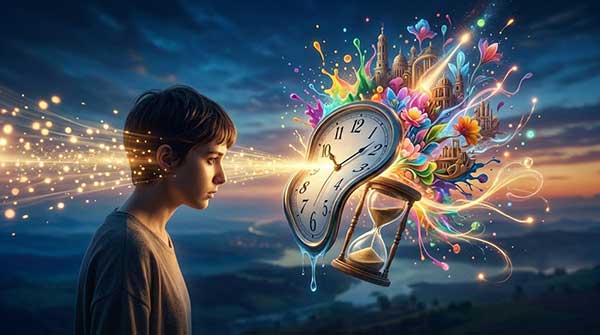
The first time I mapped my own attention, I drew a line on a napkin in a diner outside Cleveland. One end said PAST. The other end said FUTURE. I put a dot in the middle and wrote ME. Then I closed my eyes and took a step toward the past. It felt like sinking into a warm bath. Familiar. Easy. Then I tried stepping toward the future. Also easy. A little electric. A little buzzy. But when I tried to stand still on the dot — just the dot, nothing else — my mind bucked. It wanted to drift. Anywhere but here.
That napkin sat in my pocket for three days. Then I threw it away. But the question stayed.
Where do you actually spend your attention? Not where you think you spend it. Where it goes when you are not looking.
The source text I keep circling this month asks that question in a way I have not been able to shake. It describes a simple exercise. Picture a timeline. Past on one end. Future on the other. You are somewhere in between. Which direction feels lighter? Which direction calls to you? The answer, it says, tells you where you are living most of your life.
I knew my answer before I finished the exercise. I was a future person. Always scanning. Always planning. Always two steps ahead of the moment I was actually in. It felt productive. It felt like ambition. It was actually a kind of absence.
The Sideways Pull of Past and Future
The source text is blunt about what happens when you live too far in either direction. Past-dwelling tends toward depression. The weight of what happened, the replaying, the rehearsing of old scenes. Future-dwelling tends toward anxiety. The endless strategizing, the hunger for something that has not arrived yet and maybe never will. Neither place is real. Both are exhausting.
I have lived in both. The past years felt heavy. The future years felt frantic. Neither felt like life.
The text says something that landed hard: the only time you are actually alive is now. Not because the past and future are unimportant. Because they are not here. The past is a memory. The future is a guess. The present is the only place where anything can actually happen. Where you can actually create. Where you can actually feel.
Creativity, the text says, requires presence. Not talent. Not discipline. Presence. You cannot make something new if you are not here to make it. You cannot hear the idea if you are already three rooms ahead, worried about how it will be received. You cannot feel the work if you are still stuck in the last thing that failed.
I have tested this. On days when I am scattered, my writing is thin. It sounds like someone trying to write instead of someone writing. On days when I am present — actually in my body, actually in the room, actually in the sentence — the words come differently. Not always better. But truer. There is a texture to them.
The Body Is the Doorway
Here is the part that shifted something for me. The text says presence is not a mental state. It is a physical one. You know you are present when you can feel your body. Not think about it. Feel it. The weight of your feet on the floor. The air on your skin. The rhythm of your breath.
It offers another small experiment. Think of a moment when you were eating something you loved. How present were you? On a scale of one to ten. Now think of a moment when you smelled something horrible. How present were you then? The first answer is almost always higher. Pleasure roots you in the body. Disgust roots you in the body. The middle states — the ordinary, the neutral, the distracted — those are where presence leaks away.
I tried this in my kitchen. I remembered a meal from years ago, a bowl of ramen I still think about, the way the broth coated the spoon. I was there. Fully. Ten out of ten. Then I remembered walking past a dumpster behind my old apartment in July. Also fully there. Also ten. The body does not care whether the sensation is pleasant or awful. It only cares whether you are paying attention.
The trick is learning to pay attention to the ordinary. Not just the ramen and the dumpster. The lukewarm coffee. The sound of the furnace. The texture of the steering wheel. The weight of your own hands.
What Would Ten Minutes Change
The text asks a question that feels almost too simple to matter: what if you started every day with ten minutes of presence before the world got to you? Not meditation, necessarily. Not a workout. Just a small, deliberate coming home to the body before the day begins. Ten minutes of movement. Ten minutes of breath. Ten minutes of noticing that you are alive before you start trying to prove it.
Would it change anything? The text says yes. But it also says the only way to know is to try.
I have been trying for the past few weeks. Not every morning. I am not a saint. But most mornings, before I reach for my phone, I sit on the floor of my living room and stretch. Not yoga. Just stretching. I reach for my toes. I roll my shoulders. I breathe. I do not time it. I do not track it. I just do it until I feel like I have arrived.
The days I do this are different. Not dramatically. Subtly. I am less reactive. I catch myself before I spiral. I notice the light coming through the window. I taste my coffee. The day feels less like something happening to me and more like something I am participating in.
The Things That Keep Me Here
The text ends with a personal note. The author says yoga, meditation, and writing are the practices that keep her connected to her body. Then she asks: what keeps you connected?
I have been thinking about that question all week. My answers are small. Walking without a podcast. Cooking something that requires chopping. Sitting on my porch with a cup of tea and no phone. Reading a physical book, the kind with pages, the kind that forces my eyes to slow down. None of these are dramatic. They do not feel like practices. They feel like small acts of remembering. Remembering that I have a body. Remembering that I am here.
The napkin from the diner is long gone. But the question it asked is still with me. Not where do I want to be. Not where should I be. Where am I actually spending my attention?
The answer, more and more, is the dot.
A Few Things I Am Still Chewing On
Can you really train yourself to be more present, or is it just a personality thing?
I used to think it was fixed. Some people are naturally grounded, some people float. But the more I practice, the more I think it is a skill. Not one you master. One you return to. The returning is the practice. You drift. You notice. You come back. Over and over. The gap between drifting and noticing gets shorter. That is the training.
What if I try the timeline exercise and both directions feel heavy?
Then you are probably exhausted. When the past and future both feel like weights, the body is telling you something. It needs rest. Not more focus. Not more discipline. Rest. Presence grows best in a nervous system that is not running on fumes. Start there. The timeline will still be there tomorrow.
Is being present the same as being mindful?
They overlap, but I would not call them the same. Mindfulness often gets packaged as something you do for twenty minutes on a cushion. Presence is looser than that. It is the awareness that shows up while you are chopping vegetables or listening to a friend or sitting in traffic. It does not require a special setting. It just requires noticing that you are already here.