What Does It Mean to Believe? Rethinking Faith as a Human Skill
The last time I questioned my own faith, I was not in a church. I was standing in the parking lot of a Price Chopper in Burlington, Vermont, holding a bag of groceries and watching a man argue with a shopping cart. The cart had a broken wheel. It kept veering left. The man kept jerking it right, cursing under his breath, as if the cart had insulted his mother.
I stood there for longer than I should have, because I recognized something in him. Not the anger. The certainty. The absolute, unshakable conviction that the cart should behave the way he expected it to behave. That his expectation was the truth, and the cart’s refusal was a personal betrayal.
I have spent my whole life inside different versions of that certainty. Not about shopping carts. About bigger things. About who God is, or whether God is, or what a good life looks like, or what happens after we die. I was raised in a small town in Ohio where the answers were handed out like Sunday school pamphlets: neat, folded, certain. For years, I carried those answers around like a pocket watch, checking them whenever the world got confusing.
Then my husband died. And the watch stopped.
What Is Belief, Really
Belief is a strange word. We use it constantly, but almost no one stops to ask what it means. It is not knowledge, exactly. Knowledge is something you can prove, or at least point to. Belief is something else. It is the bridge you build between what you know and what you hope. It is the story you tell yourself so you can get out of bed in the morning.
The psychologist and philosopher William James, who taught at Harvard in the late nineteenth century, spent much of his career trying to understand this. In his essay “The Will to Believe,” he argued that there are certain truths the mind can never reach through evidence alone. Some of the most important decisions in life—whether to trust someone, whether to have children, whether to believe that life has meaning—require a leap. Not a blind leap. A considered one. But a leap nonetheless.
James called this “the will to believe.” Not because belief is arbitrary. Because it is chosen. It is an act. It is something you do with your mind, your heart, your body. The choosing is the belief.
That idea rearranged something in me. For years, I thought belief was something that happened to you. Like weather. Like a lucky break. You either had it or you did not. But James was saying something different. He was saying belief is a skill. A capacity. A muscle you can strengthen or let wither.
I am sixty-eight years old. I have lived long enough to watch my certainties crumble one by one—the certainties of my childhood, the certainties of my marriage, the certainties of my body. And what I have learned, slowly and at great cost, is that the crumbling is not the failure of belief. It is the beginning of it.
Why We Hold On So Tightly
There is a reason certainty feels so good. It is the same reason a child clutches a stuffed animal in the dark. The unknown is terrifying. The open question is a kind of vertigo. And so we build walls around the few things we think we know, and we defend those walls with everything we have.
I watched my own mother do this. She was a good woman, a faithful woman, and she was terrified of doubt. When I came home from college with questions—about the church, about the Bible, about the nature of God—she would not engage them. She would change the subject. Or she would cry. The questions felt like an attack, because her belief had become fused with her safety. If the belief fell, she would fall with it.
The psychologist Robert Kegan, who taught at Harvard for decades, has written about this. He calls it “the immunity to change.” The idea is that we hold onto our beliefs not because they are true, but because they protect us from something we are afraid of. The belief is not just an opinion. It is a shield. And you cannot ask someone to put down a shield without understanding what the shield is protecting them from.
My mother was protecting herself from chaos. From the possibility that the world was not orderly, not just, not overseen by a loving God. The certainty was her shelter. And I was standing at the door, asking her to step outside.
I understand now why she could not. I also understand that the shelter was never as solid as she needed it to be. None of them are. The walls are built from the same material as the fear—imagined, repeated, reinforced. And the wind, when it comes, does not care how tightly you are holding on.
The Difference Between Faith and Certainty
Here is a distinction that took me fifty years to see. Faith and certainty are not the same thing. In fact, they are almost opposites.
Certainty is closed. It does not need to ask questions, because it already has the answers. It does not need to listen, because it already knows. It is not interested in the other side of the argument, because the other side is wrong. Certainty is a wall.
Faith is an opening. It is the willingness to live without certainty, to walk forward without knowing exactly where the road leads. It is not the absence of doubt. It is the decision to move through the doubt, to let the doubt be there, without letting it stop you.
The writer and theologian Paul Tillich, who spent much of his life in the United States after fleeing Nazi Germany, called this “the courage to be.” He argued that real faith is not about having the right answers. It is about having the courage to live with the questions. The questions are not the enemy of faith. They are the soil in which faith grows.
I think about that every time I hear someone speak with absolute certainty—about politics, about religion, about the way other people should live their lives. The certainty is not strength. It is fear. It is the voice of someone who cannot afford to be wrong, because being wrong would mean losing themselves.
The faith I have now, such as it is, does not look like certainty. It looks more like wonder. It looks like standing in the produce aisle and not knowing why any of it exists—the oranges, the fluorescent lights, the woman arguing with the cashier—and being okay with the not knowing. More than okay. Curious.
What Happens When Belief Becomes a Cage
But let me be honest about the dangers. Because belief, for all its power, is not always a force for good. It can be a cage. It can be a weapon. It can be used to justify cruelty, to silence doubt, to flatten the beautiful complexity of human life into a single, rigid story.
I have watched this happen to people I love. A niece who joined a church that told her who she could love and who she could not. A neighbor who fell down a rabbit hole of online conspiracies until he could not have a normal conversation anymore. A friend whose grief hardened into a certainty that God had abandoned her, and then into a certainty that God did not exist at all.
The certainty was the problem. The belief had become a cage, and the door was locked from the inside.
The historian Yuval Noah Harari, in his book “Homo Deus,” offers a warning that has stayed with me. He writes that we are entering an age when the old stories—religious, philosophical, political—are losing their power to hold us together. And into that vacuum, new forces are rushing: artificial intelligence, biotechnology, the algorithms that shape what we see and think. The question, Harari says, is whether we will take responsibility for shaping our own meaning, or whether we will let the market do it for us.
That is not a distant future. It is already here. The feed is shaping our beliefs right now, without our knowledge or consent. The walls of our certainties are being built by people who profit from our fear.
If we do not learn to believe consciously—to choose, deliberately, what we will trust and what we will not—someone else will choose for us. The invisible hand will decide. And the invisible hand does not have our best interests at heart.
How to Believe Without Losing Your Mind
So what does conscious belief look like? Not certainty. Not blind faith. Something in between. Something alive.
I have a practice now, though I came to it late. It is not elaborate. It is just a set of questions I try to ask myself, gently, when I feel myself tightening around a belief.
Is this mine, or did I inherit it? Many of our beliefs are hand-me-downs. They were given to us by parents, teachers, culture. We wear them like old coats. The question is not whether the coat is good or bad. The question is whether it fits.
What am I afraid of losing if I let this go? Every belief, even the ugliest one, serves a purpose. It protects something. It numbs something. It keeps something at bay. Understanding what the belief is protecting you from is the beginning of freedom.
Can I hold this lightly? Not “Can I abandon this?”—that is too much to ask of anyone in one afternoon. Just: Can I hold it a little more loosely? Can I let some air in? Can I imagine, even for a moment, that I might be wrong?
The last question is the most important. The willingness to be wrong is the only thing that keeps a belief alive. The moment a belief cannot be questioned, it is no longer a belief. It is a cage.
A Note for Those Who Feel Numb
There is a kind of belief crisis that goes beyond philosophy. It shows up as numbness, as exhaustion, as a flatness that no amount of thinking can lift. If you are in that place—if the questions feel less like curiosity and more like despair—please do not try to think your way out of it alone. Talk to someone. A counselor. A doctor. A trusted friend who will not try to fix you, but who will sit with you in the dark. Belief can be damaged in ways that require more than introspection. There is no shame in that. It is not a failure of spirit. It is a condition of being human.
The Story I Almost Did Not Tell
I mentioned my husband earlier, and I want to be careful here. I am not going to tell you that his death gave me faith. It did not. It shattered the faith I had, the neat Sunday school certainty, the belief that the world was ordered and just and watched over by something kind. That belief did not survive the hospital room, the beeping machines, the moment when his hand went slack in mine.
What grew in its place was not certainty. It was something smaller and stranger. A willingness to keep looking. To keep asking. To keep walking through the days without knowing what they mean, but trusting—and I use that word deliberately—that the walking itself is enough.
Belief, I have come to think, is not about having the answers. It is about loving the questions. It is about staying alive to the mystery, even when the mystery hurts. Even when the mystery takes everything you thought you could not lose.
I am not a philosopher. I am an old woman in a small town who shops at a grocery store and watches the leaves change and tries, every day, to hold my certainties a little more lightly than I did the day before. That is the whole practice. That is the whole faith.
The rest is just walking.
The Question I Leave You With
There is a moment in every life when the old beliefs stop working. The ones that held you together through the early years. The ones you inherited without question. The ones that felt as solid as the ground under your feet.
And then the ground shifts. A death. A divorce. A diagnosis. A slow, creeping sense that the story you were told is not the only story, and maybe not even the truest one.
In that moment, you have a choice. You can cling to the old beliefs, tightening your grip until your knuckles ache. Or you can let them go, and see what remains.
I do not know what remains for you. I barely know what remains for me. But I can tell you this: it is more than I expected. The not knowing is not empty. It is full—full of questions, full of possibility, full of a strange and stubborn light.
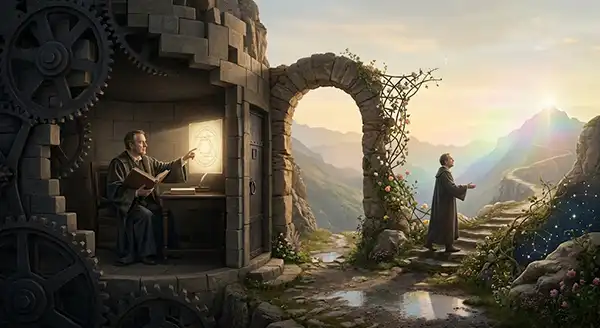
That light is not the light of certainty. It is the light of an open door.
And the door is always open. It has been open the whole time. The only question is whether you will walk through it.
I am walking. Not quickly. Not with confidence. But walking. And the road, whatever it is, feels more like mine than anything I ever inherited.
So ask the question. Let the certainty crack. Let the light in. The light does not ask you to know. It only asks you to see.
And seeing, I have learned, is the beginning of everything.