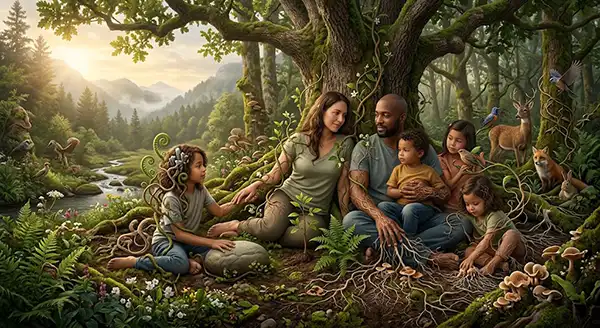
Are Humans Really Different From Other Living Things
The realization came to me in the garden, of all places. I was fifty-six years old, kneeling in the raised bed behind my house in Portland, Oregon, pulling weeds after a long rain. My knees ached. My gloves were wet through. And I was talking to a tomato plant.
Not the way you talk to a pet, with a name and a tone of slight embarrassment. I was talking the way you might talk to a neighbor over the fence—commenting on the weather, on the state of things, on whether the season had been kind. The tomato plant did not answer, obviously. But it did not need to. Its leaves were drooping in a way I recognized.
I know that droop. I have felt that droop. The particular kind of giving up that comes from too much water after too little sun, from roots that are trying to hold on in soil that has gone too soft. I sat back on my heels and looked at the plant, and the plant looked back, and for a moment I could not tell where I ended and it began.
That is the thing I keep coming back to. Not the mystical oneness of it, though there is something like that. The simpler truth: we are not as different from the rest of the living world as we have been taught to believe.
What We Share With the Plants in Our Gardens
I have been gardening for twenty years, and the longer I do it, the more I see us in the beds. Not as a metaphor. As a fact.
Some plants are solitary. They do better on their own, in a corner, away from the competition for root space and light. I have a rosemary bush in the far corner of the yard that has thrived for years precisely because I leave it alone. It does not want my attention. It wants the sun and the dry soil and the long silence of the afternoon. I have met people like that. People who are not lonely but solitary, who need the edges of things more than the center.
Some plants are communal. They grow better together, their roots tangled underground, sharing whatever the soil offers. My beans and my lettuce and my marigolds lean into each other. When one struggles, the others seem to adjust, making room, offering shade or support. I have been part of communities like that. I have also been the struggling plant, leaning into the others, hoping they would adjust.
Some plants are prickly. Not because they are mean. Because they have been stepped on too many times, or because the birds have eaten too many of their fruit, or because the wind blows harder in their corner of the garden. The thorns are not a personality flaw. They are an adaptation. I have grown thorns too. I have spent years learning not to apologize for them.
“The clearest way into the Universe is through a forest wilderness.” — John Muir, the naturalist who knew more about this than almost anyone
Muir wrote that in the late 1800s, when the American wilderness was still vast and mostly unbroken. But the insight holds in a backyard garden, too. The forest is not out there. It is in the tomato plant, in the rosemary bush, in the tangle of roots under the lettuce. It is in the way the garden changes when the weather changes, the way the plants respond to what is happening around them.
And it is in us, whether we remember it or not.
What the Weather Tells Us About Our Inner Lives
I used to think the weather was just the weather. Something that happened to me, something I checked on my phone before deciding what to wear. But the more I pay attention, the more the weather feels like something else. A mirror. A mood. An expression of the same forces that move through me.
The storm is not just a storm. It is the anger I have been holding in my jaw for three days, the pressure building until something has to give. The wind that comes before the rain is not just air. It is the restlessness that keeps me up at night, the feeling that something is about to change and I do not know what.
The sun is not just light. It is the calm after the storm, the quiet that settles in when the worst has passed. The rainbow is not just optics. It is the strange, unearned beauty that appears after a hard season, the thing that makes you think maybe the suffering was not for nothing.
I know how this sounds. I am a practical person. I was raised to believe that the weather is weather and the mind is mind and the two have nothing to do with each other. But I have lived long enough to notice that my best ideas come on windy days, that my worst fears surface in the dark of winter, that the first warm day of spring makes me feel like I have been holding my breath for months.
The psychologists have a name for this, or something close to it. Ecopsychology is the study of the relationship between human beings and the natural world, and the research suggests that our minds are not as separate from our environments as we like to think. A study published in the Journal of Environmental Psychology found that time in nature reduces rumination, the repetitive negative thinking that drives so much of our anxiety and depression. The natural world, it seems, does something to us. It quiets the storm inside.
I do not need the research to believe it. I have felt it, in my own garden, on my own knees, with my hands in the soil. The weather outside and the weather inside are not two different things. They are the same weather, moving through different rooms of the same house.
The Strength We Overlook in the Smallest Creatures
There is a beetle that lives in my garden. I do not know its name. It is small, brown, unremarkable. It moves slowly, deliberately, across the leaves of my zucchini plants, and I used to flick it away without thinking. A pest, I assumed. Something that did not belong.
Then I started watching it. Not scientifically. Just watching. The way it carried on through wind and rain, through the spraying water from my hose, through the long dry stretches when I forgot to water. The way it kept moving, kept eating, kept doing whatever it was doing, with a patience that looked almost sacred.
I began to understand that the beetle was not weak. It was patient. There is a difference. Weakness is the absence of strength. Patience is the presence of it, held in reserve, used only when necessary.
The naturalist E.O. Wilson, who spent his life at Harvard studying ants and other small creatures, wrote that “the little things that run the world” are not the large, charismatic animals we like to photograph. They are the insects, the microbes, the creatures we overlook. Wilson believed that if humans disappeared from the earth, the small things would thrive. But if the small things disappeared, the earth would collapse.
I think about that beetle now, moving across the leaf, doing its slow, patient work. I think about the ants that build their tunnels in the soil, and the earthworms that keep the ground alive. I think about the smallest things, the ones I cannot see, and I feel something like awe.
We are not above them. We are one of them. A species among species, no more permanent, no more important. The only difference is that we have forgotten.
Why We Forget We Are Part of the Natural World
There is a moment in childhood when the world was not yet divided. We were not yet separate from the trees and the animals and the weather. We just were, in the middle of it all, without a story about being different.
Then the stories started. The ones about being special, being chosen, being above. The ones about nature being something to conquer, something to use, something out there that we could dominate. The stories were powerful. They built civilizations. They built the world we live in now, with its screens and its schedules and its constant pressure to produce.
But the stories came at a cost. They cut us off from the thing we are part of. They made us feel alone, even when we were surrounded by life.
The philosopher and ecologist David Abram, in his book “The Spell of the Sensuous,” argues that we have lost the ability to perceive the natural world as alive. We see it as a resource, a backdrop, a thing to be managed. But the world is not a thing. It is a living, breathing, communicating presence. And we are part of it, whether we know it or not.
The garden is teaching me to remember. Not all at once. Slowly, the way the season changes. The tomato plant that droops when it is too wet. The rosemary that wants to be left alone. The beetle that keeps moving through the rain. The weather that mirrors my moods. All of it is me, in some way I cannot fully explain.
And I am it. That is the part I am still learning to accept.
The Question I Keep Asking Myself
I am not a philosopher. I am a woman with dirt under her fingernails and a garden that will not stop growing. But I have started asking a question, quietly, usually in the early morning when the light is still soft and the birds are just beginning to speak.
When will I understand that I am not separate?
I do not know the answer. I am not sure there is an answer, in the way we usually mean that word. But the asking feels like a kind of prayer. A turning toward something I have always known and only recently begun to remember.
The garden is still there, still growing, still teaching. The plants are still drooping and rising and blooming and fading. The beetle is still moving across the leaf. The weather is still doing whatever the weather does.
And I am still here, kneeling in the dirt, trying to see myself in all of it.
Not as a metaphor. As a fact.
The fact is simple: we are not separate from the living world. We are part of it, made of the same stuff, shaped by the same forces, moved by the same weather. The only thing that ever made us feel different was the story. And the story, like all stories, can be changed.
The next time you step outside, look around. Not at the trees and the sky and the creatures as if they were scenery. Look at them as if they were relatives. Because they are. The same blood. The same bone. The same strange, brief, beautiful life.
And if you listen closely, you might hear them talking. Not in words. In the rustle of leaves, in the fall of rain, in the slow, patient movement of a beetle across a leaf.
They are saying: Welcome back. We have been waiting for you.
That is the whole thing. That is the only thing. The rest is just remembering.