What Does It Really Mean to Be Rich? Why Freedom Matters More Than Money
My cousin Mark is the richest person I know. He has the house in Scottsdale with the pool and the three-car garage. He has the Tesla and the boat and the vacation cabin in Telluride. He wears the kind of watch that costs more than my first car. When we were kids in Ohio, he used to say he was going to make a lot of money someday, and everyone laughed, because Mark was not particularly smart or driven or talented. He was just a kid with a chip on his shoulder and something to prove.
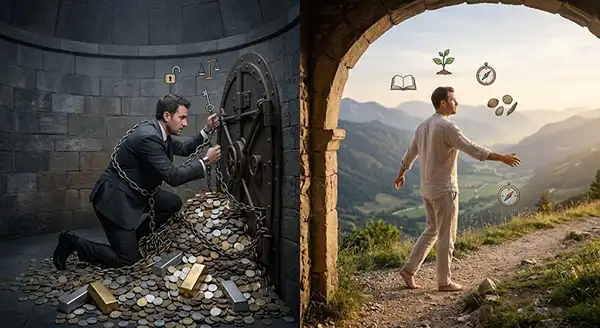
He proved it. He is forty-nine now, and he has more money than the rest of our family combined. And he is also, as far as I can tell, the least free person I know.
I stayed with him for a week last spring. The house was beautiful, the way a hotel is beautiful. But I noticed things. The way he checked his phone during dinner, always, even when no one was calling. The way his shoulders never seemed to come down from around his ears. The way he said yes to things—business calls, “quick” favors for people he did not even like—that clearly made him miserable. The way he could not sit still, could not rest, could not let a single afternoon pass without turning it into something productive.
One evening, after he had spent forty-five minutes on a call with a client who was clearly exploiting him, I asked him why he did it. “You have enough money,” I said. “You could say no.”
He looked at me like I had spoken a foreign language. “You don’t understand,” he said. “This is what it takes.”
What it takes for what, I wanted to ask. But I already knew the answer. What it takes to keep the house. Keep the boat. Keep the image. Keep the life that everyone else envies, even though the person living it seems to be drowning.
That week in Scottsdale changed something in me. Not because I discovered anything new about Mark. Because I started asking a question I had been avoiding for years: What am I actually chasing? And more importantly: If I catch it, will I be free?
What We Really Mean When We Say We Want to Be Rich
Most of us have never examined what we mean by “rich.” We just know we want it. The wanting is in the air, in the culture, in the endless scroll of other people’s lives. We want the money, the house, the car, the freedom that we imagine comes with it. But the freedom is the word we never define.
The psychologist and economist Daniel Kahneman, who won the Nobel Prize for his work on human judgment, studied this directly. Along with his colleague Angus Deaton, he analyzed data from hundreds of thousands of Americans and found something that should have made more headlines than it did: beyond a certain income level—roughly $75,000 a year at the time of the study—additional money does not make people significantly happier. The curve flattens. The extra zeroes stop translating into extra wellbeing.
What the research suggests is that money matters when it buys security. It matters when it buys food, shelter, healthcare, freedom from the constant pressure of not having enough. But beyond that point, the money becomes something else. A scorecard. A status signal. A way of keeping track of who is winning and who is not. And that kind of money does not buy freedom. It buys a different kind of cage.
I have watched this happen to people I love. The wealthiest people I know are also the most tethered. They are tethered to their businesses, their reputations, their possessions, their fear of losing it all. The money has become a master instead of a tool. They do not own the money. The money owns them.
Why Your Freedom Depends on the People Around You
There is a line from the source material that has been rattling around in my head for weeks: the quality of your life is determined, more than almost anything else, by the quality of the people around you. Not the quantity. The quality. The depth of their thinking. The breadth of their vision. The degree to which they can see you clearly, even when what you are saying is uncomfortable.
I did not understand this until I started paying attention to how I felt after spending time with different people. Some people left me feeling expanded. Others left me feeling depleted. The difference was not always obvious. Sometimes it was the quiet friend who asked a real question instead of filling the silence. Sometimes it was the loud one who could not let a single conversation pass without turning it into a performance.
The philosopher and psychologist William James, who taught at Harvard in the late nineteenth century, wrote that “a man’s social self is the recognition which he gets from his mates.” The sentence is old, but the truth in it has not aged. We become, in large part, who the people around us believe we are. If we surround ourselves with people who value only money, we will value only money. If we surround ourselves with people who value freedom—real freedom, the kind that cannot be bought—we will start to value that too.
That is why the people you keep close matter so much. Not because they can do anything for you. Because they shape what you believe is possible.
The Freedom You Can’t Buy
Here is the part I had to learn the hard way. There is a kind of freedom that has nothing to do with how much money you have. It has to do with whether you can make choices without being afraid. Whether you can speak your mind without calculating the cost. Whether you can spend an afternoon doing nothing without feeling guilty. Whether you can say no to the things that are killing you, even when the things look impressive from the outside.
That kind of freedom does not show up in a bank account. It shows up in the way you live your days.
I have a friend in Portland, a woman named June who owns a tiny bookstore and lives in a rental apartment above a coffee shop. She will never be rich. She has accepted that. But she is one of the freest people I have ever met, because she has built a life that belongs to her. She works, but she does not overwork. She has opinions, and she is not afraid to share them. She surrounds herself with people who challenge her, who make her think, who do not let her settle into easy answers.
June does not have Mark’s money. But she has something he does not. She has the freedom to be herself, in every room, with every person, without checking her phone or her conscience. That freedom, I have come to believe, is the real wealth. The other kind is just decoration.
Why We Settle for Being Comfortable Instead of Free
Here is the uncomfortable part. Most of us settle. We settle for the job that pays well but drains us. We settle for the relationship that is stable but not alive. We settle for the city we do not love, the schedule we did not choose, the life that looks good on paper but feels thin in the body.
We tell ourselves we are being practical. We tell ourselves that freedom is a luxury, that security is the real goal, that someday—someday—we will have enough to live the way we want. But someday never comes. The security becomes the cage. The job becomes the identity. The life becomes a series of compromises that no one asked us to make.
The psychologist and author Susan David, at Harvard Medical School, has written about this in her work on emotional agility. She argues that most of us live on autopilot, making choices based on old stories about who we are supposed to be. The stories are powerful, but they are not true. They are inherited. They come from parents and peers and the culture at large. And they keep us from asking the only question that actually matters: What do I actually want?
The question is terrifying. That is why we avoid it. But avoiding it does not make it go away. It just makes the eventual reckoning harder.
What I Am Still Learning
I am fifty-two years old. I have spent most of my adult life chasing the wrong things. Not because I was foolish. Because I was following the only map I had been given. The map said: work hard, make money, buy the house, climb the ladder. The map said: security is the goal, freedom is the reward, and the reward comes later.
The map was wrong. I know that now. The freedom is not the reward. The freedom is the point. And it is available now, not later, in the small choices I make every day about how to spend my time, who to spend it with, and what to say yes to.
I still catch myself chasing the old markers. The bigger project. The more impressive title. The approval of people I do not even like. The old habits are deep. They do not disappear just because I understand them.
But I catch myself faster now. And when I catch myself, I try to ask a different question. Not Will this make me rich? But Will this make me free?
The question changes everything. It changes what I say yes to. It changes who I spend time with. It changes how I spend the hours, which are the only real currency I have ever had.
There are still days when I envy Mark. The house is beautiful. The car is fast. The ease of his life—the way he never has to check a price—is undeniably appealing.
But then I remember the way he looked that night in Scottsdale, tethered to his phone, unable to rest, unable to say no. And I think: That is not wealth. That is a very expensive cage.
The door to the cage is open. It has always been open. The only thing keeping him inside is the belief that the cage is the only safe place to be.
I do not want to live in a cage. Not even a beautiful one. Not even one with a pool and a Tesla and a vacation cabin in Telluride.
I want to be free. Free to rest. Free to say no. Free to spend an afternoon doing nothing without feeling like I am falling behind. Free to surround myself with people who make me think, who challenge me, who see me clearly and still choose to stay.
That is the wealth I am chasing now. It does not show up in a bank account. It shows up in the texture of my days, in the quality of my conversations, in the quiet sense that my life belongs to me.
And here is the strange part: the less I chase the money, the more the money seems to take care of itself. Not because I am lucky. Because I am no longer spending it on things that were never going to satisfy me anyway. Because I am no longer trading my freedom for a version of success that was never mine to begin with.
A Question Worth Sitting With
If you are reading this and feeling uneasy, good. The uneasiness is the beginning of something. It is the part of you that knows, underneath all the striving and performing and proving, that there is another way to live.
The question is not whether you can afford to be free. The question is whether you can afford not to be.
Because the cost of the cage is higher than any of us want to admit. It is measured in hours, in relationships, in the slow erosion of the self. The cage is comfortable, which is why it is so dangerous. You can live in it for years and never notice that you have stopped living.
Mark is still in his cage. I do not know if he will ever leave it. I hope so. But hope is not the same as action, and the cage is very good at convincing you that the door is locked.
Here is what I know now, at fifty-two, with more years behind me than ahead: the door was never locked. It was never even closed. The only thing that ever kept me inside was the belief that I had no other choice.
The belief was a lie. The choice was always there, waiting for me to see it.
It is waiting for you too. In the small decisions. In the quiet moments. In the places where you already know the truth but have been too afraid to act on it.
The truth is simple. It is the only thing the money can never buy.
You are already free. You just have to start living like it.
The bars are not real. The cage is not real. The only thing that is real is the life you are building, right now, with the people you choose to share it with.
So choose carefully. Choose the ones who make you think. Choose the ones who see you clearly. Choose the ones who remind you, just by being themselves, that the only real wealth is the freedom to be who you are.
That is the whole thing. That is the entire secret.
And it has been inside you the whole time, waiting for you to notice it.
A Note for the Hard Nights
If you are feeling trapped—if the cage feels too solid and the door feels too far away—please be gentle with yourself. The work of becoming free is slow and unglamorous and often feels like failure. That does not mean you are doing it wrong. It means you are doing it.
And if the weight of it all feels like more than you can carry alone, please talk to someone. A therapist. A doctor. A friend who will not try to fix you, but who will sit with you in the dark. There is no shame in that. It is not weakness. It is what caring for yourself looks like.
The life you want is not a luxury. It is not something reserved for other people. It is yours, already, in ways you have not yet learned to see.
The seeing takes time. The becoming takes time. But the time is not wasted. It is the only time that matters.
So keep going. Keep asking the question. Keep building the life that belongs to you.
The cage is not as strong as it looks. And you, it turns out, are stronger than you know.