Cyber Psychology and the Metaverse: What Virtual Worlds Do to the Mind
The first time I built a second life, I was twenty-two years old, sitting in a cramped dorm room at a university in the Pacific Northwest, trying to finish a paper on attachment theory. Instead, I was flying.
Not literally. Virtually. In a game called Second Life, a three-dimensional online world where you could design an avatar, buy virtual land, build virtual houses, and have conversations with strangers from every time zone. I was a psychology student, supposedly studying human connection. But at two in the morning, when the library was closed and the loneliness of the semester was pressing against my chest, I would log on and become someone else. Not a different name, exactly. A different body. A different posture. A version of me who was braver, sharper, less tired.
I have been thinking about those nights a lot lately, because the world seems to have caught up to Second Life. In October 2021, Mark Zuckerberg stood in front of a camera and announced that Facebook would become Meta, a company devoted to building the “metaverse.” The word sounded new. It was not. Neal Stephenson coined it in 1992, in his science fiction novel “Snow Crash,” where characters escape a crumbling reality by jacking into a persistent three-dimensional virtual world. Second Life had been doing something like it since 2003. The rest of us were just late to the party.
What Zuckerberg was really announcing was not a product. It was a bet. A bet that the future of human connection would happen not in rooms, but in headsets. That the boundary between the real and the virtual would blur, and that we would all, eventually, choose to live on the other side.
As a psychologist, I have opinions about that bet. Most of them are not comfortable.
What Is Cyber Psychology and Why It Matters Now
Cyber psychology is the study of how technology and human behavior interact. It sounds niche, but it is not. It is the field that asks what happens to our minds when we spend hours in front of screens, when our relationships are mediated by algorithms, when our sense of self is distributed across multiple platforms and avatars and versions.
Alison Attrill, a professor at the University of Wolverhampton who has written extensively on the subject, defines cyber psychology as the study of the behavioral consequences, motivations, and psychological processes of human interaction with any form of technology—across both online and offline worlds. The definition is broad because the phenomenon is broad. We are no longer just using technology. We are living inside it.
I have been practicing psychology for over two decades now, and I can tell you that the questions cyber psychology asks are no longer optional. They are urgent. The metaverse is not a distant speculation. It is already here, in pieces. And the pieces are already changing us.
The early research is sobering. A study by Ha and colleagues, published back in 2006, found that problematic internet use was associated with a range of mental health issues: somatic symptoms, depression, and even psychotic experiences. The percentages were small. The implications were not. The more time people spent in disembodied digital spaces, the more they seemed to struggle with the embodied, analog world.
Another line of research looked at why certain people are drawn to virtual environments in the first place. Schimmenti and colleagues, writing in 2017, found that individuals with schizoid personality traits—people who struggle with emotional connection and social withdrawal—were particularly attracted to online games and virtual worlds. The virtual world offered something the real one did not: escape. A place where the messiness of human contact could be controlled, or avoided altogether.
That is the question that keeps me up at night. Not whether the metaverse will be immersive. It will be. The question is whether it will be safe. And for whom.
The Difference Between Virtual Reality and the Metaverse
Let me be clear about the terms, because they matter.
Virtual reality, or VR, is a technology. It is the headset, the sensors, the experience of being visually immersed in a simulated environment. The metaverse is something larger. It is the persistent, shared, three-dimensional internet that VR will plug into. It is the idea that instead of visiting the internet through a screen, you will step into it. You will have a body there. A home there. A social life there.
The distinction matters because the psychological stakes are different. VR is an experience. The metaverse is a context. It is a place where you will work, shop, date, worship, learn, and grieve. It will not be something you visit. It will be somewhere you live, at least part of the time.
Second Life was the prototype. I remember the strangeness of it, even in 2003. I would log off after two hours and feel disoriented, as if my real body were the avatar and the screen had been the truth. The feeling would fade. But I noticed it. I noticed how quickly the virtual world began to feel real, and how reluctantly I returned to the actual one.
The researchers who study this call it “presence”—the subjective sense of being somewhere other than where your physical body is. Presence is not a bug. It is the whole point. The more present you feel in the virtual world, the more real it becomes. And the more real it becomes, the more it competes with the only world you have ever actually lived in.
What Avatar Identity Does to the Self
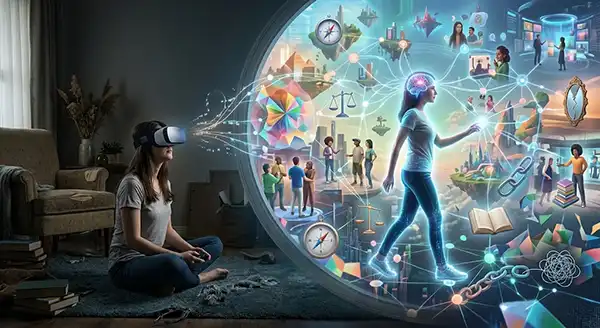
Here is something I learned in that dorm room in 2003, and it has shaped my thinking ever since. When you create an avatar, you are not just choosing a costume. You are choosing a self.
My Second Life avatar was taller than me. Thinner. She had better posture and a habit of speaking first in conversations, which I never did. She was not a lie. She was a possibility. And for a few hours a night, I got to practice being her.
There is a body of research on this now, and it is fascinating. The “Proteus effect,” first described by researchers Nick Yee and Jeremy Bailenson at Stanford, suggests that people internalize the characteristics of their avatars. Give someone a taller avatar, and they behave more confidently in negotiations. Give them an attractive avatar, and they become more socially outgoing. The avatar does not just represent the self. It shapes the self.
That has enormous potential. For people who are shy, or socially anxious, or struggling with body image, the chance to practice a different way of being can be genuinely therapeutic. I have seen patients use virtual environments to rehearse difficult conversations, to experiment with new identities, to try on versions of themselves they were too afraid to inhabit in the real world. The virtual world can be a playground for the self.
But it can also be a trap. The danger is not that the avatar is different from you. The danger is that you might prefer it.
I think about that a lot. The line between exploration and escape is thin, and the metaverse will not make it easier to see.
The Promise and the Peril of Living in Another World
Here is the paradox at the center of all of this. The metaverse is being sold to us as a solution to disconnection. And yet the research on heavy digital immersion consistently points in the other direction.
The psychologist Sherry Turkle, at MIT, has been studying this for decades. Her book “Alone Together” is the most devastating thing I have ever read on the subject. She argues that we are increasingly substituting digital connection for the messier, riskier, more demanding work of being with each other in the flesh. The result is a strange kind of loneliness: surrounded by connection, starved for presence.
The metaverse promises to solve this by making digital connection more immersive. More embodied. More real. And maybe it will. But I am old enough to remember when the internet was going to connect us all, and I have watched it fragment us instead.
That is not a Luddite argument. It is a clinical one. The question is not whether the technology is good or bad. The question is what it does to the people who use it.
And the honest answer, for now, is that we do not fully know. The research is still emerging. The long-term effects will not be clear for another generation. The only thing I can say with confidence is that the metaverse will change the way we think about presence, identity, and connection. It already has, for the people who have been living in these spaces for years.
What I Tell My Patients When They Ask About the Metaverse
When a patient brings up the metaverse—and increasingly, they do—I try not to be prescriptive. The technology is not going away, and the people who use it thoughtfully will probably be fine.
But I also try to be honest. I tell them what I learned in that dorm room all those years ago: the virtual world is real enough to matter, and not real enough to hold you. The avatar can be a teacher, but it is not a home. The presence you feel in front of a screen is not the same as the presence you feel when someone is in the room with you, breathing the same air, seeing the same light. The two experiences are not interchangeable.
If you are in a season of life where the real world feels too heavy—if you are depressed, or anxious, or so lonely that the screen feels like the only place that wants you—please be careful. And please talk to someone. A therapist. A doctor. A trusted friend who will sit with you in the actual world, not the virtual one. The metaverse is not a treatment for what ails you. It may not even be a safe place to hide.
A Final Thought, Back in the Dorm Room
I sometimes think about the young woman I was in 2003, flying over virtual cities at two in the morning, trying to outrun her own loneliness. She was not wrong to seek escape. She was not wrong to build a braver self. She was just tired, and undernourished, and too far from the people who loved her.
The metaverse will not fix that. No technology will. The fix is older and simpler and much harder: it is showing up, in the flesh, for the difficult, ordinary, unrepeatable work of being human with other humans.
The virtual world is a window. It is not a door.
And the world outside the window—the one with weather and heartbreak and imperfect bodies and the terrible, beautiful risk of being seen—is still the only one that can actually hold you.
I hope we remember that. I hope I remember it.
Because the future is coming, and it is wearing a headset. But the future does not have to become the only place we live.
The real world is still here. Still waiting. Still real.
And that, I think, is the whole thing. The only thing. The thing worth staying for.