What Is Field Theory in Psychology and How Does It Shape Modern Therapy
The first patient I ever lost taught me more about therapy than four years of graduate school.
Her name was Ellen. She was thirty-one, a high school English teacher from a small town in Maine, and she had been seeing me for eleven months when she stopped coming. No note. No phone call. Just an empty chair in my office on a Tuesday afternoon, and a silence that stretched for weeks.
I was thirty years old then, freshly licensed, full of the certainty that only the very young and the very well-trained can sustain. I had been taught to be a blank screen, a neutral observer, a careful listener who reflected back what the patient brought and offered nothing of herself. That was the model. That was the science. And according to the model, Ellen’s departure was not my fault. She had been too resistant. Too defended. Too afraid of the work.
It took me two more years to admit the truth: I had been so busy being neutral that I had never actually been present. Ellen had not been resisting the work. She had been sitting across from a woman who was not there.
The realization nearly ended my career. Instead, it started the second half of it.
Why the Old Model of Therapy Was Built on Bad Physics
To understand what changed in that room, you have to understand something strange: psychotherapy has always followed the dominant physics of its era.
When I trained in the early 1980s, the field was still running on a Newtonian model. Cause and effect. Linear chains. The patient as a kind of machine with broken parts, and the therapist as a mechanic who fixed them from a safe, objective distance. Freud had built his entire psychoanalytic apparatus on this foundation—the drives, the defenses, the psychic structures—all of it imagined as a closed system operating according to predictable laws.
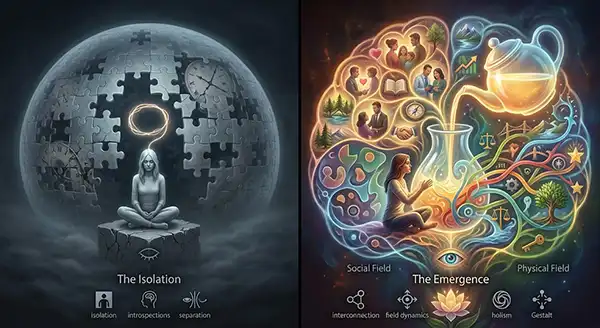
The model was not entirely wrong. It was just incomplete. And it was incomplete for the same reason Newton’s physics was incomplete: it treated isolated objects as though they existed independently, when in fact everything exists in relationship.
The physicist who first saw this clearly, at least for psychology, was not a physicist at all. His name was Kurt Lewin.
Lewin was born in Germany in 1890 and spent the second half of his career in the United States, first at Cornell and then at MIT, where he founded the Research Center for Group Dynamics. He was not interested in treating individual patients. He was interested in something bigger: how people behave in context. Not in a vacuum. In a field.
“There is nothing so practical as a good theory,” Lewin liked to say, and he spent his life trying to prove it.
Lewin borrowed the concept of the field from physics—from the study of magnetic and electrical forces—and applied it to human psychology. A magnetic field is not located in any single particle. It is the space between particles, the invisible web of forces that shapes how every part moves. Lewin argued that the human mind works the same way. We are not isolated units. We are fields within fields: family fields, social fields, cultural fields, relational fields. The forces that move us are not inside us alone. They are between us.
He called it the “life space”—the total psychological environment of a person, including everything that affects them, past and present, real and imagined. A baby’s life space is small: hunger, warmth, the mother’s face. An adult’s life space is vast: memories, ambitions, fears, relationships, the whole tangled architecture of a life. Lewin wanted to map this space. He used topology, a kind of geometry that cares about connection rather than distance, and he drew vectors to show the directions in which a person was being pulled.
It was brilliant and abstract and almost impossible to apply in a clinical setting. But the seed was planted. The mind was not a machine. The mind was a field.
What Happens When Two Minds Meet in a Room
Here is the part that took the field fifty years to catch up to, and it is the part I learned the hard way with Ellen.
If the mind is a field, then therapy cannot be a one-person event. It cannot be a neutral observer treating a passive patient. It is a meeting of two fields, two life spaces, two histories, two nervous systems—and when those two fields meet, something new is created. Something that was not present before.
The psychoanalysts Robert Stolorow, George Atwood, and Bernard Brandchaft called this the “intersubjective field.” Their work, developed over decades starting in the late 1970s and early 1980s, was a direct challenge to the old model. They argued that the therapist is never a blank screen. She is always bringing herself into the room—her history, her body, her moods, her blind spots. And the patient is always responding to what she brings. The two of them are co-creating the therapy, moment by moment, whether they know it or not.
This is not a metaphor. It is not a nice idea to make therapists feel less defensive. It is a description of what actually happens, and the research now backs it up.
The psychotherapy researcher Michael Lambert, at Brigham Young University, has spent decades studying what makes therapy work. His findings are consistent and humbling: the specific technique matters less than almost anything else. What matters is the quality of the relationship. The alliance. The sense, on the part of the patient, that the therapist is actually there, actually present, actually human. That is the field doing its work.
Another researcher, John Norcross, who has led multiple American Psychological Association task forces on empirically supported therapy relationships, came to the same conclusion. The relationship is not the vehicle for the cure. The relationship is the cure. Or at least a very large part of it.
Ellen was trying to tell me this, in her way. She was not looking for a blank screen. She was looking for a person. And when she could not find one, she left.
The Therapist Is Not a Closed System
I want to be careful here, because this is the part that makes some of my older colleagues uncomfortable.
The old model was safe. It was safe because it gave the therapist a place to hide. You could sit behind the theory, behind the role, behind the carefully maintained silence, and you never had to risk being seen. The patient did the work. You just held the frame.
The new model—the field model—offers no such protection. It says: you are in this too. Your presence matters. Your history matters. The way you breathe when the patient says something hard matters. The way you flinch when she mentions her mother. The way your eyes change when she talks about wanting to die. All of it is data. All of it is the field.
The psychiatrist and researcher Daniel Siegel, at UCLA, has spent his career mapping the neuroscience of this. His work on interpersonal neurobiology shows that two brains in close relationship are not separate systems. They are coupled systems. The therapist’s nervous system and the patient’s nervous system are continuously influencing each other, below the level of awareness. Siegel calls it “resonance”—the way one person’s internal state can literally alter the other person’s physiology.
This is not mysticism. It is neuroscience. The vagus nerve, the mirror neuron system, the stress response—all of it is engaged when two people sit in a room together and one of them is suffering. The therapist does not just observe the patient’s pain. She feels it in her own body. And the patient, on some level, knows.
The question is not whether the therapist is in the field. The question is whether she is aware of it.
What This Means for the Person on the Couch
If you are in therapy, or thinking about it, here is what I want you to know.
You are not broken. You are not a machine with faulty wiring. You are a living system, embedded in other living systems, and the pain you feel is not just inside you. It is between you. Between you and your family. Between you and your culture. Between you and the world you have to live in.
Therapy, at its best, is not a place where someone fixes you. It is a place where someone joins you. Where the field between you and another human being becomes a space in which something new can emerge.
The old language of mental health—diagnoses, symptoms, disorders—is not wrong. It is just narrow. It describes the individual in isolation. It misses the field.
The relational therapist sees the pattern, not just the person. She sees how you repeat the same dynamic with her that you repeat with your partner, your boss, your mother. She sees how the field between you two mirrors the fields that shaped you long before you ever walked into her office. And she works with that. Not against it.
This is not a quick fix. It is not a technique you can learn in a weekend workshop. It is a way of being with another person, and with yourself, that is slower and deeper and more demanding than the old model ever was.
But it is also more honest. Because it does not pretend that healing happens in isolation. It happens in relationship. It always has.
A Note for Those Carrying Heavy Things
I have been in practice for four decades, and I have seen almost every kind of pain. The people who get better are not the ones with the fewest problems. They are the ones who find a field in which they can be seen.
If you are struggling—if the weight is heavy and the old strategies are not working—please do not try to carry it alone. Find a therapist. Not just any therapist. One you can actually be in the room with. The research says the relationship matters more than the technique. Trust that. Interview a few. Notice how you feel in their presence. That feeling is data. It is the field.
And if the pain is very dark—if you are thinking about ending things, or if the despair has been there so long it feels like part of your body—please reach out to someone immediately. A doctor. A counselor. The National Suicide Prevention Lifeline is available by dialing 988. That is not a sign of failure. That is what taking care of yourself looks like.
The field is always there, always alive, always capable of holding more than you think it can. But you have to be willing to enter it.
What I Would Tell Ellen Now
I never saw Ellen again. I do not know what happened to her. But I think about her more than I think about almost any other patient from those early years.
I would tell her that I was not ready. That I was too young, too scared, too hidden behind the theory to be the person she needed. That her leaving was not a failure of the therapy, but a failure of me, and that she deserved better.
And I would tell her that I changed. That the field between us—however broken—taught me something no textbook ever could. The mind is not a machine. It is a field. And the only way to heal a field is to enter it.
The rest, as they say, is practice.
I am still practicing. Still learning. Still discovering, at sixty-eight, that the field is bigger and stranger and more alive than I ever understood. The old physics said isolation. The new physics says relation. The truth, as usual, is somewhere in the space between them—in the field itself, where two people can finally meet.
That is where the work happens. That is where the healing happens. That is where, if you are very lucky and very patient, you get to watch another human being become more fully themselves.
And you get to become more fully yourself in the process. Because the field does not just change the patient.
It changes everyone in it.