The Universe’s Magnificent Mathematics: Are You Ready to See It?
Look at a pinecone. Notice how the scales spiral outward. Now count those spirals. One direction yields a number. The other direction yields a different number. And those two numbers? They’re almost always consecutive Fibonacci numbers. 8 and 13. Or 13 and 21. Always.
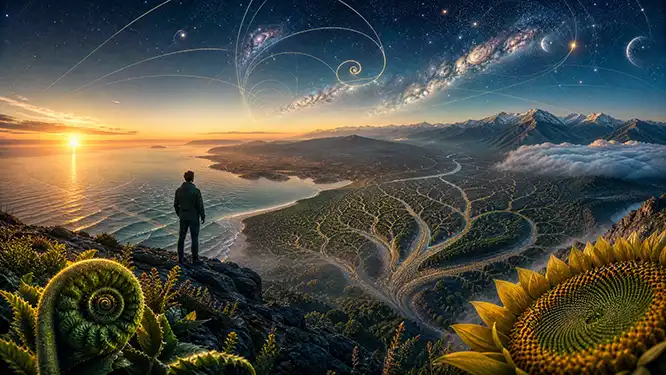
Look at a sunflower. The seeds arrange themselves in the same pattern. A spiral within a spiral, each count a Fibonacci number. Look at a nautilus shell. Same spiral. Same math. Look at the branching of trees, the veins in a leaf, the arrangement of petals. Same patterns, repeated endlessly.
The short answer to whether the universe is built on mathematics is yes—and it’s not just a human invention. It’s a discovery. The math was already there. We just learned to read it. And once you start seeing it, you can’t unsee it.
The Awe That Never Fades
There’s something about sunrises that never gets old. The colors shift from dark to light, from cold to warm, from silence to sound. The first rays of light touch the horizon, and everything changes. It happens every day. And every day, it’s still extraordinary.
The same is true for seasons. For the way water moves. For the way a seed knows to grow toward the sun. For the way a baby’s heart starts beating without instruction. For the way a symphony of cells organizes itself into a human being.
These things are so common that we stop noticing them. We take them for granted. We forget that they’re miracles. Not in a mystical sense. In a literal sense. They’re extraordinary events that we’ve stopped paying attention to.
The philosopher Alfred North Whitehead once said that philosophy begins in wonder. The same could be said of science. Of art. Of any genuine attempt to understand the world. It starts with the recognition that something amazing is happening. And that we don’t fully understand it.
The Hidden Order Beneath Everything
For centuries, scientists and mathematicians have been uncovering the hidden order beneath the surface of things. The laws of physics. The principles of chemistry. The patterns of biology. Everywhere they look, they find structure. Everywhere they look, they find math.
Galileo famously said that the universe is written in the language of mathematics. Its characters are triangles, circles, and other geometric figures. Without these, he said, it’s impossible to understand even a single word.
That’s a bold claim. But it’s also an accurate one. Every major breakthrough in science has involved discovering a mathematical relationship that was previously unknown. Newton’s laws of motion. Maxwell’s equations of electromagnetism. Einstein’s field equations for gravity. Each one revealed a deeper layer of mathematical order.
And the more we discover, the more we realize how much we don’t know. The universe is not simple. It’s not easily explained. But it is structured. And that structure is mathematical.
The Fibonacci Connection
The Fibonacci sequence is one of the most famous patterns in mathematics. Each number is the sum of the two preceding ones: 1, 1, 2, 3, 5, 8, 13, 21, 34, and so on. It was discovered by Leonardo of Pisa, also known as Fibonacci, in the 13th century. But the sequence itself existed long before he described it. It’s built into the structure of the natural world.
The spiral shape that appears in pinecones, sunflowers, nautilus shells, and countless other natural forms is a logarithmic spiral. It grows outward at a constant rate. And the proportions of that growth are governed by the golden ratio, which is closely related to the Fibonacci sequence. The ratio between consecutive Fibonacci numbers approaches the golden ratio as the numbers get larger.
This is not a coincidence. It’s not a human invention. It’s a pattern that emerges from the way growth works in the natural world. It’s the most efficient way for a plant to arrange its seeds. It’s the most stable way for a shell to grow. It’s the simplest way for a galaxy to form.
A Question to Sit With
What if the patterns you see in nature aren’t accidents? What if they’re the signature of a deeper order? What if the universe is structured in a way that we’re only beginning to understand?
Why This Matters Beyond Science
The fact that the universe is mathematically ordered is not just a scientific curiosity. It has implications for how we see ourselves and our place in the world.
If the universe is random, if it’s meaningless, then our lives are just accidents. We’re here by chance. Nothing we do matters in the grand scheme of things. That’s one possibility.
But if the universe is structured, if it’s ordered, if there’s a pattern to everything, then maybe there’s meaning too. Maybe we’re not accidents. Maybe we’re part of something larger. Maybe our existence has significance.
The mathematician and philosopher Blaise Pascal once wrote that the heart has its reasons that reason knows nothing of. He was talking about faith, but the same principle applies to awe. There’s a kind of knowing that comes from wonder. A kind of understanding that comes from simply paying attention.
What the Great Thinkers Have Said
Drunvalo Melchizedek, in “The Ancient Secret of the Flower of Life,” explores the geometric patterns that underlie creation. He argues that these patterns aren’t just abstract ideas—they’re the actual building blocks of reality. The Flower of Life, a geometric figure composed of overlapping circles, appears in sacred sites around the world. It’s not a coincidence. It’s a recognition of a universal pattern.
Mario Livio, in “Is God a Mathematician?” explores the question of whether mathematics is invented or discovered. He points out that the unreasonable effectiveness of mathematics in describing the physical world suggests that it’s not just a human invention. It’s something we’ve uncovered. Something that was there all along.
Both of these thinkers, coming from different perspectives, point to the same conclusion: the universe is structured. It’s ordered. And that order is accessible to us through mathematics. We can understand it. We can appreciate it. We can be awed by it.
The Dance of Discovery
The history of science is the history of humans learning to see what was already there. We didn’t invent the laws of physics. We discovered them. We didn’t invent the Fibonacci sequence. We found it. We didn’t invent the golden ratio. We noticed it.
Each discovery brings a moment of awe. A moment when the veil lifts and you see something that was hidden. A moment when the world makes a little more sense. A moment when you realize how much more there is to understand.
This is why scientists keep going. Not for the money. Not for the fame. For the moments of discovery. For the feeling of coming closer to the truth. For the experience of wonder that never gets old.
What I’ve Noticed About This Wonder
I’ve noticed that people who spend time with nature are often more attuned to this sense of wonder. They see the patterns. They notice the details. They pause to appreciate the beauty. They don’t rush past the extraordinary on their way to the ordinary.
I’ve also noticed that the more you understand about the universe, the more there is to wonder at. Knowledge doesn’t destroy mystery. It deepens it. The more you learn, the more you realize how much you don’t know. The more you see, the more you see that you’ve barely scratched the surface.
A Few Reflections on the Mysteries
There’s a humility that comes from contemplating the universe. It’s humbling to realize how small we are. How brief our existence is. How little we truly understand.
But there’s also an exhilaration. The same facts that make us small also make us significant. We’re part of something vast. We’re connected to everything. We’re the universe waking up to itself, trying to understand its own structure.
The patterns we see in nature are not just random. They’re not just coincidences. They’re the signature of an order that permeates everything. From the smallest atom to the largest galaxy, the same principles apply. The same mathematics governs everything.
One Final Thought
The universe is magnificent. Not because it’s big. Not because it’s beautiful. Because it’s ordered. Because it’s structured. Because it’s comprehensible.
The mathematician Eugène Wigner called this “the unreasonable effectiveness of mathematics.” The fact that we can understand the universe at all is remarkable. The fact that we can describe it with simple equations is astonishing. The fact that those equations work is nothing short of miraculous.
We didn’t create this order. We discovered it. And the discovery itself is a kind of wonder. A wonder that never fades. A wonder that gets deeper the more we look.
So look. Pay attention. Notice the patterns. Count the spirals. See the order beneath the surface. It’s there. It’s always been there. Waiting for you to notice.