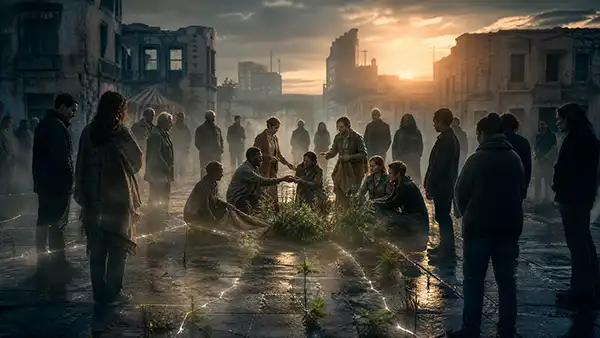
Trauma Heals: What Collective Pain Teaches Us About Ourselves
I recently watched Gabor Maté’s documentary “The Wisdom of Trauma.” It stayed with me longer than I expected.
Not because it told me something I didn’t know. Because it named something I’d been feeling but couldn’t articulate. Something about the way we carry pain. The way we run from it. The way it eventually finds us anyway.
The short answer to whether trauma can heal us is yes—but not in the way you might think. Trauma doesn’t heal us because it’s good. It heals us because it forces us to stop running. It forces us to look at what we’ve been avoiding. It forces us to reconnect with parts of ourselves we’ve abandoned.
What Trauma Actually Is
Most of us think of trauma as the bad things that happen to us. The accidents. The losses. The violations. The betrayals. The moments that broke something inside us.
That’s not wrong. But it’s incomplete.
Gabor Maté, a physician and trauma expert, defines trauma differently. He says trauma isn’t what happens to you. It’s what happens inside you as a result of what happens to you. It’s the disconnection from yourself that occurs when reality becomes too painful to bear.
When you can’t process what’s happening, you disconnect. You leave part of yourself behind. You numb. You distract. You find ways to not feel what you’re feeling. And over time, that disconnection becomes a habit. It becomes who you are.
That’s the real wound. Not the event itself. The separation from yourself that the event created.
The Two Needs We All Have
Maté talks about two fundamental needs that every human being has from birth: attachment and authenticity.
Attachment is the need to belong. To be connected. To feel safe with others. It’s the reason babies cry when they’re left alone. It’s the reason we crave intimacy. It’s the reason isolation is so painful.
Authenticity is the need to be yourself. To express who you really are. To feel your own feelings. To want what you truly want. To live in alignment with your own nature.
These two needs are both essential. But they often come into conflict. When being yourself threatens your attachments, you have to choose. And when you’re young and dependent, you almost always choose attachment.
You suppress your authenticity to stay connected. You hide parts of yourself. You learn to perform instead of being. You become who others need you to be instead of who you really are.
That’s the beginning of trauma. Not the event. The suppression. The disconnection. The slow, quiet process of leaving yourself behind.
A Question to Sit With
What parts of yourself did you hide to stay connected? What did you stop expressing because it wasn’t safe? What did you learn to suppress because it threatened your belonging?
The Disconnection We Don’t Notice
The disconnection from self happens gradually. You don’t notice it because it’s normal. It’s just how life is. It’s how you learned to survive.
You work too much, not because you love the work, but because it keeps you from feeling. You scroll through social media for hours, not because it’s interesting, but because it fills the space where feelings would be. You eat, drink, watch, consume—anything to avoid the silence.
Maté argues that addiction, in all its forms, is a response to trauma. It’s a way of managing the pain of disconnection. It’s a way of numbing the absence of self. The substance or behavior isn’t the problem. The disconnection is. The addiction is a symptom.
This is a hard truth. Because it means that the things we use to cope are actually evidence of a deeper wound. They’re not the problem. They’re the solution we found to a problem we couldn’t solve any other way.
What Collective Pain Teaches Us
We’re living through a time of collective trauma. The pandemic. The fires. The floods. The violence. The uncertainty. The endless stream of bad news that never seems to stop.
It’s tempting to see this as a burden. Something to endure. Something to get through. Something that’s happening to us.
But what if it’s also something else? What if it’s an invitation? What if the collective pain is trying to tell us something we’ve been refusing to hear?
The pain says: you’re not separate. What happens to others happens to you. The fires that burn forests burn something in you too. The losses that others experience are losses you feel. The disconnection you see in the world is a reflection of the disconnection inside you.
It also says: you can’t keep running. You can’t keep numbing. You can’t keep pretending that everything is fine when it’s not. The pain is too big to ignore. It’s too persistent to avoid. It’s forcing you to stop.
And stopping is the beginning of healing.
The Healing That Trauma Offers
The title of Maté’s film is “The Wisdom of Trauma.” At first, that sounds paradoxical. How can something so painful be wise? How can something so destructive contain wisdom?
The answer is that trauma forces you to face what you’ve been avoiding. It breaks through the defenses. It shatters the illusions. It brings you to the edge of yourself and asks: what are you going to do now?
Healing doesn’t come from the trauma itself. It comes from the response to the trauma. It comes from the decision to stop running. To stop numbing. To stop hiding. To turn toward the pain instead of away from it.
That turning is the healing. Not because the pain disappears. Because you stop being separate from it. You stop fighting it. You stop pretending it’s not there. You let it be part of you.
This is hard. It’s the hardest thing you’ll ever do. But it’s also the thing that brings you back to yourself.
A Question That Changes Everything
What would it mean to stop running? What would it mean to turn toward the pain instead of away from it? What would it mean to stop numbing and start feeling?
The Ancient Wisdom That Still Speaks
There’s a reason the ancient Greeks inscribed “Know Thyself” on the temple of Apollo at Delphi. It’s not a suggestion. It’s a requirement. Without self-knowledge, you can’t heal. You can’t connect. You can’t live authentically.
Knowing yourself means knowing your wounds. Not just the ones you can see. The ones you’ve buried. The ones you’ve hidden from yourself. The ones that have shaped you without your awareness.
It means knowing your patterns. The ways you avoid. The ways you cope. The ways you disconnect. It means seeing the strategies you developed to survive and asking: are they still serving me?
Knowing yourself also means knowing your strengths. Your resilience. Your capacity to endure. Your ability to heal. It means recognizing that you’ve already survived things you thought would kill you.
The wisdom of trauma is that it forces you into this knowledge. It takes away your illusions. It strips away your defenses. It leaves you with only what’s real.
What I’ve Learned About This Journey
I’ve watched people heal from deep wounds. Not because they forgot what happened. Because they stopped letting it define them. Because they learned to hold their pain without being consumed by it.
I’ve also watched people stay stuck. They’ve retold their stories a thousand times without ever seeing the deeper pattern. They’ve blamed others without ever looking inward. They’ve stayed in the role of victim because it felt safer than taking responsibility for their own healing.
The difference isn’t what happened to them. It’s what they did with what happened. It’s whether they used it as an excuse or as an invitation. It’s whether they stayed in the wound or used it as a doorway.
A Few Thoughts on the Path Forward
The path of healing is not linear. It’s not clean. It’s messy and uncertain and full of setbacks. You’ll think you’ve healed something, and then it will show up again in a different form. You’ll think you’ve moved on, and then something will trigger you back to where you started.
That’s not failure. That’s how it works. The wound is not a single event. It’s a pattern. And patterns have to be interrupted again and again before they finally change.
The key is to keep showing up. To keep turning toward the pain. To keep choosing connection over disconnection. To keep choosing authenticity over performance. To keep choosing yourself.
An Honest Reflection
I haven’t fully healed from everything. I still have patterns I can’t see. I still have wounds I haven’t faced. I still find myself running when I should be staying.
But I’m learning. I’m catching myself more quickly. I’m more willing to turn toward the discomfort. I’m more able to sit with what I’ve been avoiding.
That’s the progress. Not being healed. Being willing to heal. Being willing to face what needs to be faced. Being willing to stop running.
Where I Land on This
Trauma is not a gift. It’s not something to be grateful for. It’s damage. It’s pain. It’s loss.
But it can also be a teacher. It can show you what you’ve been ignoring. It can reconnect you to parts of yourself you’ve abandoned. It can bring you back to who you really are.
The question isn’t whether trauma will come. It will. The question is what you’ll do with it. Whether you’ll let it break you or let it open you. Whether you’ll stay in the wound or use it as a doorway.
The wisdom of trauma is that it gives you a choice. A choice you didn’t have before. A choice to reconnect. To heal. To become more yourself than you’ve ever been.
That’s not easy. But it’s worth it.