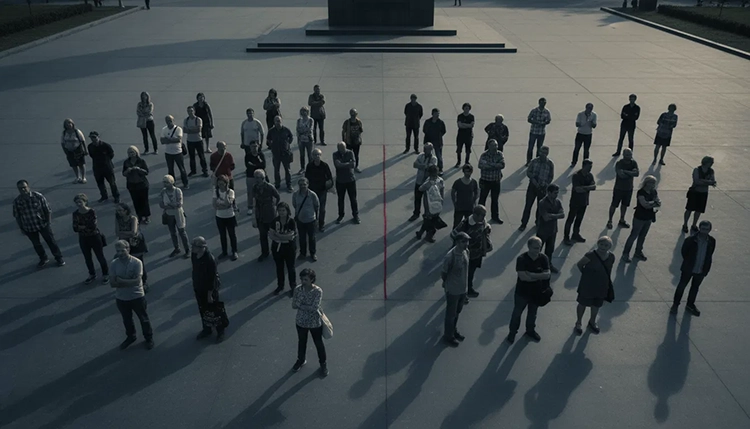
Why Does Collective Trauma Turn Us Against Each Other, and How Do We Heal?
Have you ever snapped at your family the moment you walked through the front door, just because someone cut you off in traffic? Or perhaps you found yourself taking out a frustrating day at work on a coworker, or letting the weight of the news cycle turn you sharp and irritable with a neighbor?
If so, you are far from alone. When our anger or distress has no clear, safe target—or when the real source of our pain is entirely outside our control—we have an involuntary, reflexive habit of redirecting that pressure downward. We leak our stress onto the nearest unsuspecting person.
Yet, this displacement becomes infinitely more destructive when the invisible pressure is not just a bad day, but an entire society grappling with shared devastation. Why does large-scale trauma make us instantly defensive, hostile, and reactive, and how do we reclaim our collective humanity when the ground beneath us feels like it has given way?
What Is Collective Trauma?
At its core, collective trauma is the psychological and emotional shockwave that ripples through an entire society following catastrophic events—such as natural disasters, wars, systemic violence, or collective loss. Unlike a personal crisis, which touches an individual or a single family, collective trauma envelops an entire culture.
When a society absorbs that level of cumulative shock, the psychological fallout rarely looks like quiet grief. Instead, it manifests as a pervasive, low-grade panic: hair-trigger irritability, digital hostility in comment sections, a collapse of social trust, and an underlying sense that we are all walking around like live wires waiting to short-circuit.
[The Displacement Cascade]
Unprocessed Societal Grief ──► Misdirected Anger & Hostility ──► Fractured Social Bonds ──► Deepened Collective Exhaustion
Because the threat feels omnipresent and unmanageable, our nervous systems stay locked in chronic fight-or-flight. We stop seeing each other as fellow human beings navigating the same storm and start viewing differing opinions or minor frictions as existential threats. The result is a toxic loop of misdirected anger that deepens our isolation precisely when we need each other most.
How Does Social Stress Distort Our Inner Reality?
When we are caught in the grip of a collective wound, our emotional boundaries fray. We become hyper-vigilant, scanning our environments for danger. But because our brains cannot fight an abstract societal crisis or a catastrophic weather event, that raw biological energy has to go somewhere.
We displace it onto social media debates, customer service workers, family members, or strangers on the street. We demand perfection from a broken world, lashing out because the sheer unpredictability of life feels intolerable.
“Collective healing does not begin when the world finally becomes safe and predictable; it begins the moment we stop punishing each other for the fact that it isn’t.”
This realization brings us to a vital turning point. Societal recovery is not an abstract political project or a distant milestone—it is an accumulation of micro-choices made by individuals refusing to let systemic exhaustion destroy their capacity for grace.
How Can We Repair the Social Fabric Without Burning Out?
Healing from collective trauma requires a deliberate shift from reactivity to stewardship. You cannot outrun a cultural nervous system overload by sheer willpower, nor can you scroll your way to peace.
A Practical Experiment for Today
The next time you feel a surge of unprovoked anger, digital hostility, or defensive tension rising in your chest, try this three-step grounding practice:
- Locate the Displacement: Pause mid-reaction and ask yourself: Is my current fury actually about the person in front of me, or am I leaking unspent fear from a heavier, unmanageable weight?
- Step Off the Doom Scroll: Intentionally unplug from the constant churn of crisis updates for a defined window. Give your nervous system a chance to realize that, in this exact room, at this exact second, you are safe.
- Offer an Unearned Kindness: Do one small, tangible act of cooperation or patience for someone else—not because they earned it, but because restoring a microscopic unit of trust is the only real antidote to collective despair.