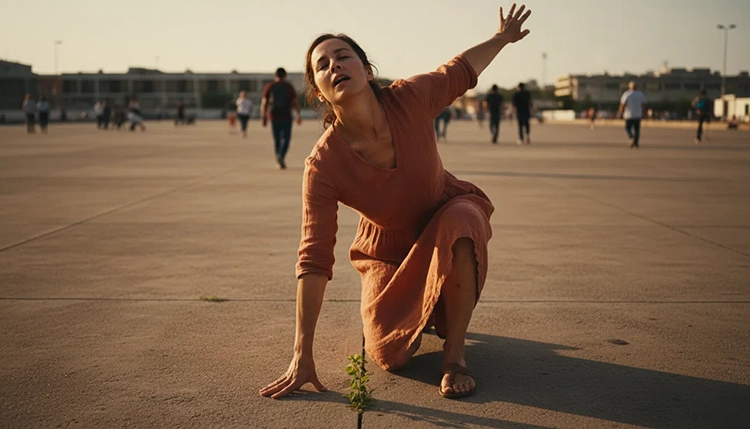
Can You Stand Back Up with Grace After Falling? The True Architecture of Strength
The city moves at a pace that leaves us breathless, demanding that we hold onto everything all at once. In a world this fast and this exhausting, many of us spend our days moving through life wearing a quiet mask—smiling when we are shattered, pretending everything is fine while behind closed doors, we quietly fall apart. (I have done this more times than I can count.)
When life shatters around us, our cultural conditioning tells us that strength is about defiance. We feel pressured to push back against the hardness of the world, fighting tooth and nail because everyone around us makes it look like we are supposed to be unbreakable.
When we hear the word “strength,” we often picture someone invincible, someone who never bends and never breaks. We assume true power comes from sheer effort, so we spend our energy forcing doors open, dragging ourselves through unworkable jobs, and trying to sustain relationships that have long since expired. Even on a yoga mat, the illusion persists: we try to force a posture through brute effort, confusing tension with capability.
Yet, real power does not come from locking horns with life. So, what does true resilience actually look like when everything collapses, and can we really rise with grace after a fall?
Why Does True Strength Require Softening?
In our lived experience, true strength is directly proportional to our capacity to soften in the face of life’s harshest waves. And let be clear: this is not easy. When heavy, turbulent tides rush over you, choosing grace instead of defensiveness feels entirely counterintuitive.
We think we need to fight the current. But true power is found in the willingness to open up to softness rather than stubbornly digging in our heels. It is the conscious intention to separate what is within our control from what is not, instead of forcing things to go our way through sheer exhaustion. Strength lives precisely in that quiet pause.
“True power is not the armor that blocks the blow; it is the flexible spine that bends with the wind and refuses to snap.”
Think of the moments that quietly break the heart:
- Receiving a sudden piece of devastating news,
- Facing a long, grueling road ahead,
- Losing someone you love,
- Navigating an unexpected health crisis,
- Experiencing rejection, professional displacement, or public humiliation.
In those exact moments, when you have no idea what to do next, allowing yourself to feel is your most real and unshakeable power.
What Happens When We Stop Fighting Our Falls?
We heal through permission, not persistence. We heal when we let ourselves feel the weight of our grief, rather than white-knuckling our way through it out of pride.
As psychological research and deep human experience continue to show, true resilience is an adaptive process. It is the capacity for self-organization in the face of chaos. When we try to out-stubborn our losses, we only create internal friction.
The quiet framework we call The Graceful Pivot describes this exact shift: it is the moment you stop treating your vulnerability as a failure and start recognizing it as the exact mechanism through which recovery happens.
Real strength means knowing when to cry, when to run, when to stand completely still, and when to take a step back. It means having the courage to fall apart without looking for someone to blame.
How Do You Learn to Rise Again Without Blame?
We all fall on different stages of life. The question is never whether we will stumble—it is whether we can find a way back to our feet without accumulating bitterness along the way.
The strength of a leaf drifting gently from a branch is found entirely in its willingness to move with the wind rather than fight it. We learn how not to fall by experiencing the reality of falling.
A Practical Experiment for Today
The next time you stumble—whether in a relationship, a career transition, or a moment of deep personal doubt—try this three-step reset:
- Drop the Defensive Armor: Notice the exact moment your mind starts scrambling for someone to blame for the fall. Gently let go of the need to find a culprit.
- Honor the Collapse: Allow yourself to sit in the mess of the moment for sixty seconds without demanding an immediate solution or a silver lining.
- Rise with Open Hands: When you decide to stand back up, do it without grasping backward at what was lost. Ask yourself not “How do I pretend this didn’t happen?” but “How do I move forward with honesty and grace?”