The Happiness Advantage: Why Positive Employees Perform Better (And When They Don’t)
What is the happiness advantage?
The number arrives in every leadership seminar, every productivity podcast, every LinkedIn post that wants to sound evidence-based. Thirty-one percent. That is how much more productive a positive brain is than a negative, neutral, or stressed one. The figure is repeated so often that it has acquired the status of scripture.
The number comes from Shawn Achor, a Harvard-trained researcher whose 2011 Harvard Business Review article “The Happiness Dividend” laid out the case with unusual precision. A decade of research, Achor wrote, proves that happiness raises nearly every business and educational outcome: sales by 37 percent, productivity by 31 percent, accuracy on tasks by 19 percent. The finding was not a minor adjustment to the conventional wisdom. It was an inversion. The conventional wisdom says work hard, achieve, and then you will be happy. Achor says be happy first, and the achievement follows.
The mechanism is neurochemical. Positive emotions flood the brain with dopamine, which enhances focus, reduces cortisol, and increases the cognitive flexibility required for creative problem-solving. The brain in a positive state is not just happier. It is measurably better at the things that produce success.
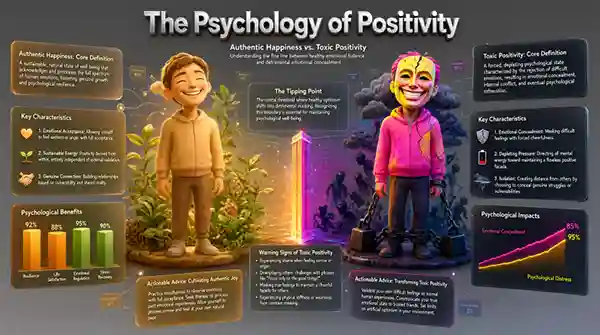
But the portrait has a second face. The same research that produced the 31 percent number also produced a warning about what happens when the pursuit of positivity becomes a demand. The warning is less quoted than the number. It is also more important.
The research behind the 31 percent productivity claim
The 31 percent figure has a specific origin, and the origin is more interesting than the headline.
Achor’s research was not a single study. It was a synthesis of decades of work on positive psychology, neuroscience, and workplace performance. The synthesis was tested in a field experiment at KPMG, the auditing and tax firm, during the most stressful tax season in decades following the 2008 banking crisis. Half of the managers in the New Jersey and New York offices received a three-hour introduction to positive psychology research. The other half did not. The trained group was evaluated before the training, a week after, and four months later.
The results were not a honeymoon effect. The positive metrics improved significantly after the training, and they held for the entire four months. Life satisfaction scores, perceived stress, social support, and work optimism were all significantly higher in the trained group than in the control group. The effect was not massive. It was reliable. And the reliability was the point.
A 2025 systematic review and meta-analysis published in MDPI examined 24 studies of positive psychology interventions in workplace settings. The finding was that these interventions produced significant and sustained improvements in psychological well-being, subjective well-being, and job performance. The effect size for performance was moderate, with a Hedges’ g of 0.42. The effect for subjective well-being was larger, at 0.50. The meta-analysis concluded that the interventions were relevant for promoting well-being and sustaining performance.
The word “moderate” is doing important work in these findings. The effect is real. It is not magic. A positive psychology intervention will not turn a mediocre employee into a star performer. It will, on average, produce a measurable improvement in the conditions that allow performance to occur.
Why suppressing negative emotions backfires
The counter-argument to the positivity movement is not that positivity is bad. It is that the suppression of negativity is bad.
A 2025 paper published in the Academy of Management journals examined what the authors called “toxic positivity” in the workplace. The definition was precise: the pressure or expectation to focus on positive emotions and experiences, which comes with a suppression and denial of negative emotions and experiences. The paper found that the suppression produced shame, which in turn produced either withdrawal or guilt-driven rumination.
The mechanism is not mysterious. The brain does not have a delete function for emotions. When a negative emotion is suppressed, it does not disappear. It is displaced. It surfaces elsewhere, often in the form of disengagement, cynicism, or the kind of quiet burnout that looks like compliance but feels like depletion.
A 2025 scoping review on the conceptualization of toxic positivity described it as “a socially enforced, overgeneralized norm that compels performance of happiness, biases appraisals toward positivity and inhibits authentic negative emotional expression.” The review identified four core dimensions, including emotional suppression and the dismissal or minimization of negative experience.
The portrait is not of a person who is too positive. It is of a person who has been told that the negative is not allowed. The telling is the problem.
The 2.9-to-1 positivity ratio explained
The question is not whether positivity matters. It is how much.
Barbara Fredrickson at the University of North Carolina at Chapel Hill spent decades developing the broaden-and-build theory of positive emotions. The theory proposes that positive emotions broaden an individual’s momentary thought-action repertoire—joy sparks the urge to play, interest sparks the urge to explore—and that these broadened repertoires build enduring personal resources over time.
The theory led to a specific prediction. Fredrickson and Marcial Losada, a mathematician, calculated that the ratio of positive to negative emotions that characterized individuals in flourishing mental health was approximately 2.9 to 1. A ratio at or above 2.9 was associated with flourishing. A ratio below 2.9 was associated with languishing. A ratio below 1.0 was a marker of depression.
The number is often quoted as three to one. The precision is misleading. The research does not say that every three positive thoughts must be followed by one negative. It says that the balance matters, and that the balance is tilted. The person who is flourishing is not the person who has eliminated the negative. It is the person whose experience contains enough positive to absorb the negative without being overwhelmed by it.
The ratio has been criticized in subsequent research for the mathematical assumptions that produced it. The criticism is fair. The broader finding—that the balance matters, and that extremes in either direction are less adaptive than a tilt toward the positive—has held up.
What negative emotions do for decision-making
The portrait of the flourishing person is not the portrait of the person who is always happy. It is the portrait of the person who can move between states.
Carol Gohm at the University of Queensland spent years studying individual differences in emotional experience. Her research distinguished between people who experience their emotions with clarity and those who experience them as overwhelming and confusing. The distinction matters for decision-making. The person who can read the negative emotion—who can name it, understand its source, and use it as information—is the person who can act on it. The person who is overwhelmed by it is the person who is controlled by it.
The research on negative emotions and decision-making is more nuanced than the positivity literature suggests. Negative emotions narrow attention. They focus the mind on the specific threat or problem. This narrowing is adaptive in some contexts. The person who is anxious about a deadline is the person who prioritizes the deadline. The person who is frustrated with a process is the person who identifies the flaw in the process.
The problem is not the negative emotion. The problem is the negative emotion that has become chronic and generalized—the anxiety that is no longer about the deadline but about everything, the frustration that is no longer about the process but about the job, the person, the life.
The portrait is not of the person who feels no negative emotions. It is of the person whose negative emotions are proportionate, temporary, and informative.
Building a sustainable positivity practice
The research on positive psychology interventions offers a set of practices, and the practices are not complicated. They are just hard to sustain.
The first practice is the gratitude journal. Achor’s research at KPMG suggested writing down three things you are grateful for each day. The practice is not a cure for depression. It is a training exercise for attention. The brain is a negativity detector by default. The journal retrains it to notice what is going well.
The second practice is the social investment. The research on workplace relationships is unambiguous. A 2025 study in ScienceDirect found that positive emotional states, both personal and job-related, partially mediated the relationship between HR practices and contextual performance. The positive emotions were not a byproduct of the work. They were a mechanism through which the work produced its results.
The third practice is the deliberate cultivation of psychological safety. Amy Edmondson’s 1999 paper in Administrative Science Quarterly introduced the construct and demonstrated that teams with higher psychological safety engaged in more learning behaviors, which in turn led to better performance—even more so than confidence or expertise alone. The safety is not a feeling. It is a condition. The condition is created by the leader, and it is the foundation on which the other practices rest.
When positivity becomes a mental health risk
The line between the happiness advantage and toxic positivity is the line between acknowledging reality and denying it.
If the pressure to be positive is producing persistent anxiety, if the inability to feel happy is creating a sense of shame, if the performance of positivity is depleting you rather than sustaining you, that is not a failure of the happiness advantage. It is a signal that the advantage has been distorted into a demand.
The research on emotional labor and burnout is robust. The 2025 Academy of Management paper found that the suppression of negative emotions in the service of mandatory cheerfulness produced shame and withdrawal. The shame is not a character flaw. It is a response to an impossible instruction. The instruction is impossible because it asks the person to deny a part of their experience that is real.
The same applies to the other side. If you are the person who cannot stop being positive because the negative feels too dangerous to acknowledge, if the cheerfulness is a defense against the grief or the fear or the anger, that is also a signal. A therapist can help separate the healthy practice of positive reframing from the compulsive performance of mandatory cheerfulness. That is not weakness. That is wisdom.
The portrait is not of the person who is always happy. It is of the person who is free to be unhappy when the situation calls for it, and who has the resources to return to the positive when the situation allows. The freedom is the thing. The freedom is the advantage.
The KPMG managers who received the three-hour training did not become different people. They became people with a different relationship to their own attention. The training did not eliminate the stress of tax season. It changed what they did with the stress. The change was small. The change was measurable. The change was the point.
The office is still there. The deadlines are still there. The negativity is still there. But the portrait has a second face now. The face is not the face of denial. It is the face of balance. The balance is not a destination. It is a practice.