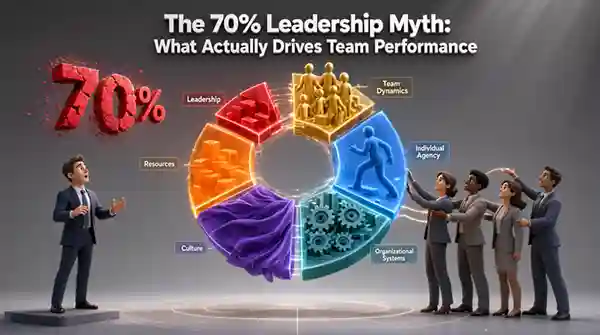
What Percentage of Team Performance Is Driven by the Leader?
The 70 percent claim
The number arrives in every leadership seminar, every management podcast, every LinkedIn post that wants to sound authoritative. Seventy percent of team performance variance is attributable to the leader. Not the market. Not the strategy. The leader. The claim is repeated so often that it has acquired the status of a fact.
The number comes from Gallup, and the original wording is more careful than the popular version. Gallup’s research found that managers account for approximately 70 percent of the variance in employee engagement—not performance, engagement. The distinction matters. Engagement is a leading indicator. Performance is a downstream outcome. The popular version collapses the two, and the collapse is convenient for anyone selling leadership training.
I have been on both sides of this number. I have used it in presentations to justify leadership development budgets. I have also been the leader whose team underperformed for reasons that had nothing to do with my engagement scores and everything to do with a supply chain that collapsed three weeks before launch. The number is real. The number is also a story we tell to make the complexity manageable.
The paradox is that the number is both true and misleading. Leaders do matter enormously. And leaders matter less than the story suggests. The resolution is not a compromise. It is a distinction.
What Google’s Project Aristotle actually found
The second number is more useful. Google spent two years studying 180 teams, trying to answer a question that every organization asks: what separates the best teams from the rest? They analyzed team composition, individual IQ, skill diversity, leadership styles, meeting frequency. The hypothesis was that the best teams were the ones with the smartest people.
The hypothesis was wrong. The factor that predicted team effectiveness more strongly than any other was psychological safety—the shared belief that you can speak up, ask questions, admit mistakes, and challenge ideas without being punished or humiliated. Teams with high psychological safety had half the turnover, significantly more revenue, and were rated as effective twice as often by management. Talented teams with low psychological safety underperformed mixed-ability teams where people felt safe taking risks.
Amy Edmondson, the Harvard Business School professor who coined the term in 1999, described psychological safety as an environmental condition created by leaders. The leader does not have to be the smartest person in the room. The leader has to be the person who makes it safe for the smartest person in the room to speak.
The paradox is that the leader’s most important contribution is often invisible. It is not the decision they make. It is the condition they create. The condition is the thing that allows the decisions to be good.
What Colin Powell learned in tank simulations
The third story is older and more specific. General Colin Powell, the former chairman of the Joint Chiefs of Staff, told a story about a military exercise designed to determine how much ammunition was optimal for tank battalions. The technicians ran simulations. One battalion was given unlimited ammunition. Another was given more time. The expectation was that the resources would determine the outcome.
The result was different. “The best-performing battalions were those with the best commanders,” Powell said. “A good commander knows how to motivate his soldiers to excel under any conditions.”
The story is usually told as proof that leadership trumps resources. It is that. But it is also something else. The commanders who performed best were not the ones with the most experience or the best tactical knowledge. They were the ones who had built the kind of unit climate where soldiers felt responsible for the outcome. The climate was the mechanism. The climate was the thing the commander created.
A 2003 U.S. Army War College paper described command climate as “an increasingly significant prerequisite for unit effectiveness and combat readiness”. The paper noted that “too many” units do not have a positive command climate, and that the problem had persisted for nearly thirty years because “the officer culture emphasizes short-term mission accomplishment more than long-term organizational growth”. The climate is not a soft variable. It is the variable that determines whether the hard variables work.
How Captain Abrashoff turned around the worst ship in the Navy
The fourth story is the one I return to when I am tempted to believe that leadership is about charisma. Mike Abrashoff took command of the USS Benfold, the worst-performing ship in the Pacific Fleet. The ship had the lowest morale, the highest turnover, and the worst inspection scores. Abrashoff did not fire anyone. He did not restructure the org chart. He did not give a stirring speech.
He changed the conditions. He asked his sailors what was broken and then he fixed it. He gave them authority over their own work. He made it safe to report problems. Within a year, the Benfold won the Spokane Trophy for the most combat-ready ship in the Pacific Fleet. The ship that had been the worst became the best.
The story is usually told as a testament to Abrashoff’s personal leadership. It is that. It is also a testament to the power of the conditions he created. He did not motivate the sailors. He removed the obstacles that had been demotivating them. The removal was the leadership. The leadership was the removal.
Does transformational leadership actually work?
The research on transformational leadership is the largest body of evidence we have. A 2024 meta-analysis in the Academy of Management examined 232 papers, 246 independent samples, and 98,769 participants. The finding was that positive leadership styles were significantly positively correlated with team creativity, while negative leadership styles were significantly negatively correlated. The strongest relationship was between strategic leadership and team creativity.
A separate 2024 meta-analysis examined the relative impact of emotional intelligence, transformational leadership, and leader-member exchange on project outcomes. The finding was that all three had a positive influence, but the strength of the influence increased in the order of emotional intelligence, transformational leadership, and leader-member exchange. The quality of the relationship between the leader and the team member was the strongest predictor.
The paradox is that the leadership style matters less than the relationship. The relationship matters less than the safety. The safety is the foundation. The style is the decoration.
When leadership pressure becomes a mental health issue
There is a note that the leadership literature usually omits. The note is about the leader.
If the pressure to perform is producing persistent anxiety, if the sense of responsibility is interfering with sleep, if the isolation of the role is bleeding into the rest of life, that is not a leadership development problem. That is a health problem. The research on executive burnout, loneliness, and depression is robust. A therapist can help separate the normal weight of the role from a clinical condition that requires care. That is not weakness. That is maintenance.
The same applies to the team. If the psychological safety is absent, if the voice is punished, if the climate is toxic, the damage is not limited to the bottom line. The research on workplace trauma and burnout is clear. A therapist can help the person who is in the environment, and a consultant can help the leader who is creating it. The two interventions are not the same. The two interventions are both necessary.
The ship that is not the captain
I have been writing about leaders as if they were the answer. They are not. The leader is the condition. The condition is the thing that allows the team to become the answer.
The 70 percent number is a story we tell to make the leader feel important. The story is not false. It is incomplete. The leader matters because the leader creates the climate. The climate matters because the climate determines whether the talent can work. The talent matters because the talent is the thing that produces the output.
The chain is not a hierarchy. It is a loop. The leader creates the climate. The climate shapes the behavior. The behavior produces the result. The result reinforces the climate. The loop is the thing that compounds. The loop is the thing that the leader can influence. The loop is the thing that the leader cannot control.
The ship is not the captain. The ship is what the captain made possible. The making is the leadership. The leadership is the making.