Breakfast and Work Productivity
What does breakfast skipping do to office productivity?
The office kitchen at 8:47 a.m. is a portrait of a decision. On the counter: a box of stale pastries, a bowl of apples nobody touches, a coffee machine that has been running since 7. The people who walk past it fall into two categories. The first grabs a pastry and eats it standing up, phone in the other hand. The second grabs nothing, pours coffee, and tells themselves they will eat later. Later never comes. By 11 a.m., both groups are running on fumes, but only one of them knows why.
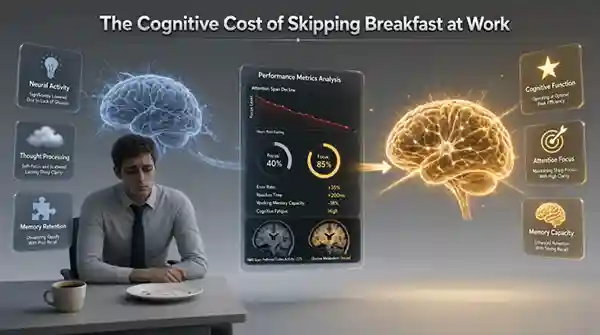
The research on this morning routine is more precise than the anecdote. A 2025 cross-sectional study published in DIET FACTOR surveyed 540 full-time office workers with standard 9-to-5 hours. The prevalence of habitual breakfast skipping was 39 percent. The most common reasons were lack of time (63 percent) and absence of morning hunger (41 percent). The skippers reported significantly lower morning productivity—a mean score of 6.2 versus 7.4—and higher rates of presenteeism, the phenomenon of being physically at work but mentally absent. The objective data confirmed the self-report. On a psychomotor vigilance task, the skippers had slower reaction times: a median of 345 milliseconds versus 310 for regular breakfast eaters.
The portrait is not a moral judgment. It is a description of a metabolic state. The brain is an expensive organ. It consumes roughly 20 percent of the body’s resting energy, and it has no reserve tank. Unlike muscle tissue, which can draw on stored glycogen during exertion, the brain depends on a continuous supply of glucose from the bloodstream. When that supply is interrupted—when the overnight fast extends into the working morning—the prefrontal cortex, the region responsible for planning, prioritization, and impulse control, is the first to feel the deficit.
I call this cognitive breakfast debt: the accumulated cognitive cost of extending the overnight fast into the hours when the brain is expected to perform at its peak. The debt is not paid in a single moment. It is paid in the small errors, the slower decisions, the meetings that take twenty minutes longer than they should. The person who skips breakfast does not feel impaired. They feel normal. The normal is the problem.
How does breakfast affect cortisol and stress?
The second portrait is hormonal. Cortisol follows a daily rhythm. It rises sharply within the first thirty to forty-five minutes after waking—a phenomenon known as the cortisol awakening response—and then declines gradually over the day. This pattern is not incidental. It is how the body mobilizes energy, regulates blood pressure, and prepares the brain for the demands of waking life.
When breakfast is eaten, the post-meal rise in blood glucose signals the hypothalamus to moderate the stress response. When breakfast is skipped, that signal is absent. A 2015 study published in Physiology & Behavior examined thirty women who were habitual breakfast skippers and thirty-five who were regular breakfast eaters. The skippers displayed a disrupted cortisol rhythm, with elevated circulating cortisol throughout the morning. They also had elevated blood pressure, both systolic and diastolic, even after controlling for body weight and composition. The researchers concluded that the chronic elevation of cortisol might explain the higher blood pressure and other cardiometabolic dysfunction observed in habitual breakfast skippers.
The mechanism is the hypothalamic-pituitary-adrenal axis, the system that governs the stress response. Missing the first major meal of the day appears to prolong the period during which cortisol remains elevated, creating a state of low-grade physiological stress that the body cannot easily resolve. The person who skips breakfast is not just hungry. They are, in a measurable sense, stressed.
The portrait widens. The elevated cortisol is associated with impaired working memory, reduced cognitive flexibility, and increased anxiety. The person operating under these conditions may not feel obviously stressed. They may simply feel slightly foggy, slightly irritable, slightly less able to hold multiple threads of a problem in mind. The deficit is subtle enough to escape conscious notice but large enough to affect the quality of the decisions made in the morning meeting, the patience required to mentor a junior colleague, the creativity needed to solve an unexpected problem.
What is the glycemic load connection to memory?
The third portrait is about composition. Not all breakfasts are equal. The research on glycemic load—the measure of how much a food raises blood glucose—has produced a finding that is more specific than the general advice to eat breakfast.
A 2022 meta-analysis published in Neuroscience & Biobehavioral Reviews synthesized fifteen studies involving adults aged twenty to eighty. The finding was that the effect of breakfast on cognition depended on when the measurement was taken. In the first two hours after eating, there was no significant difference between high-glycemic and low-glycemic breakfasts. But after 120 minutes, immediate episodic memory was significantly better following a low-glycemic breakfast compared to a high-glycemic one. The effect was stronger in younger adults and those with better glucose tolerance.
The practical translation is that the type of carbohydrate matters for sustained cognitive performance. A breakfast heavy in refined sugar and white flour—the pastry from the office kitchen, the sugary cereal, the glass of orange juice—produces a rapid spike in blood glucose followed by a compensatory drop. The brain, which depends on steady glucose delivery, experiences this as a brief period of abundance followed by scarcity. The symptoms of that scarcity—difficulty concentrating, irritability, and a sudden urge to snack—are often misattributed to stress or workload rather than to the meal eaten three hours earlier.
The low-glycemic breakfast is not a luxury. It is a design choice. The pairing of carbohydrate with protein and fat slows gastric emptying and moderates the rate at which glucose enters the bloodstream. The result is a slower, more sustained energy curve. The person who eats eggs and whole-grain toast is not morally superior to the person who eats a pastry. They are metabolically better provisioned for the morning.
Do corporate nutrition programs pay for themselves?
The fourth portrait is institutional. The research on workplace nutrition programs has moved beyond the question of whether they are a nice perk. The question is whether they produce a return.
A 2026 systematic review published in the Journal of Human Nutrition and Dietetics evaluated 168 studies of workplace interventions with a dietary component. Return on investment was evaluated in twenty-eight studies, and of those, 89.3 percent reported a positive effect. The range of ROI was wide—from negative 3.9 to positive 15.6—but the direction was consistent. The review also found that healthcare cost reductions were reported in 41.5 percent of the studies that examined them. The evidence was heterogeneous and largely based on interventions in the United States, but the pattern was difficult to dismiss.
The portrait narrows to a single cafeteria tray. The question is not whether the company should provide free breakfast. The question is whether the food that is provided is designed for the people who are eating it. A 2025 study in Frontiers in Public Health noted that workplace nutrition programs have shown promising health benefits, but that the evidence on their business impact remains scarce, particularly in low- and middle-income countries. The review identified two pathways through which improved nutrition benefits employers. The first is that healthier diets improve workers’ concentration and energy, reducing absenteeism and saving costs. The second is that improved nutrition enhances motivation, productivity, and work quality, which may increase sales and revenue.
The practical implication is not complicated. The cheapest catering contract may be the most expensive decision in the long run, not because it causes immediate harm, but because it fails to provide the nutritional substrate that sustained cognitive work requires. The relationship is not linear or immediate. It operates through the accumulation of small effects: a slightly more focused morning, a slightly better decision in the afternoon, a slightly lower rate of the errors that come from fatigue.
What did early 1900s school feeding studies find?
The fifth portrait is historical. The question of whether breakfast affects cognitive performance is not new. It was being studied before the term “cognitive performance” existed.
A 1900s report on the feeding of school children in England collected testimony from headteachers across the country. At Hull, out of 165 headteachers asked for their opinions, 76 declared that there had been a considerable or distinct improvement in mental capability after regular meals were provided, 53 reported a slight improvement, and 36 saw no visible difference. At Bradford, 134 teachers reported considerable improvement, 35 slight improvement, and 35 no difference. One headmistress wrote: “The girls receiving regular meals have become more alert, less apathetic, and consequently far more ready to respond to the teachers’ efforts to gain their undivided attention. The interest thus aroused has led the girls to look upon all branches of their work with more favour than heretofore”.
The language is Victorian, but the observation is modern. The mechanism the teachers were describing is the same mechanism the contemporary research measures. The underfed child is not a slow child. The underfed child is a child whose cognitive resources are being diverted to the management of a metabolic deficit. The same is true of the underfed adult. The office worker who skips breakfast is not less intelligent or less motivated. They are metabolically under-provisioned. The provisioning is the variable.
When should you seek help for fatigue and poor concentration?
The final portrait is clinical. The research in this article is about the normal relationship between breakfast and cognitive performance. It is not a diagnostic tool.
If you are eating breakfast regularly and still experiencing persistent fatigue, difficulty concentrating, or changes in mood that interfere with your work or daily life, the appropriate response is not to experiment with different breakfast foods. It is to speak with a physician or a registered dietitian who can assess whether there is an underlying issue that requires attention. Nutritional strategies can support cognitive function, but they are not a substitute for clinical evaluation when something feels consistently wrong. That is not a disclaimer appended to the end of an article. It is part of the same clear-eyed reasoning that makes breakfast worth taking seriously in the first place.
The portrait is complete. The office kitchen at 8:47 a.m. is still there. The pastries are still stale. The coffee machine is still running. The people are still making the same decision. But the decision is not a mystery anymore. It is a choice between two metabolic states, and the research has mapped the difference. The map is not a command. It is a description. The description is available to anyone who wants to read it.