The puzzle book I bought at O’Hare
January 4. I bought a book of logic puzzles at the Hudson News in Terminal 2. It was an impulse purchase. The cover promised to “sharpen your mind” and “boost cognitive performance.” I was flying to Denver for a conference I did not want to attend. I needed something to do with my hands. I paid $12.99 and stuffed it into my carry-on.
I solved three puzzles on the plane. They were the kind with grids and clues about who owns the dog and who drinks tea. I felt a small, clean satisfaction each time the grid locked into place. The feeling was not unlike finishing a workout. My brain felt stretched. I believed, without evidence, that I was becoming smarter.
Two weeks later, I could not remember where I parked my car at the grocery store.
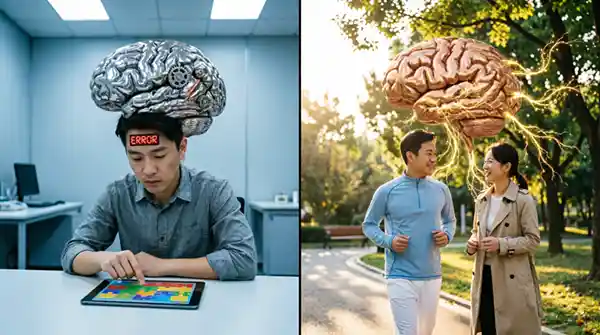
The feeling of getting smarter is not the same as getting smarter. I know this now. I did not know it then. The puzzle book was not making me smarter. It was making me better at the puzzle book. And the gap between those two things is where an entire industry has built its cathedral.
What the Stanford review found
I started reading the research because I am the kind of person who cannot leave a question alone. The Stanford Center on Longevity published a review in 2016 that examined the claims made by the brain-training industry. The companies claimed their products would improve memory, attention, and even IQ. The evidence showed that people got better at the specific tasks they practiced. They did not get better at anything else.
Ian McDonough, an associate professor of psychology at Binghamton University, put it in terms that are hard to misunderstand. “If I do Tetris a lot, I’m going to get better at Tetris,” he said. “Does that mean I’ll be better able to remember my groceries?” The answer, most of the time, is no.
Elizabeth Stine-Morrow, a professor emerita at the University of Illinois Urbana-Champaign, was even more direct. “It sounds like a magic bullet,” she told Health. “There’s just no magic. They’re just these decontextualized laboratory tasks. Everyday life offers much more stimulation than these brain-training games.”
The puzzle does not transfer. The skill you build is the skill of solving that puzzle. The brain is not a muscle that gets stronger in general when you lift a specific weight. It is a collection of specialized systems, and training one system does not automatically train the others.
I read this and felt a small, specific disappointment. I had been duped. Not by a company. By my own intuition. The intuition said effort equals improvement. The research said effort equals effort. The improvement is a separate thing, and it has to be designed.
The transfer problem
The reason puzzles feel like they should work is that they violate a principle of learning without ever announcing the violation. The principle is called transfer. Transfer is what happens when learning in one context improves performance in another. It is the holy grail of education, and it is surprisingly rare.
The brain encodes information in highly context-specific ways. When you learn to solve a Sudoku puzzle, you are learning a set of rules and patterns that apply to Sudoku grids. The patterns are not abstract logical principles that can be applied to any problem. They are Sudoku patterns. The brain stores them as such.
A 2025 study published in the Journal of Intelligence examined the relationship between practical intelligence and life outcomes across 1,200 adults. The findings showed that practical intelligence predicted career success, relationship satisfaction, and well-being, even after controlling for academic intelligence. The two were not correlated. The skills that matter in life are not the skills that matter in a puzzle.
I call this the transfer illusion: the mistaken belief that solving a specific puzzle produces general cognitive improvement, when in fact it produces a specific skill that rarely leaves the page. The illusion is reinforced by the feeling of effort. The brain interprets effort as a signal of importance. If something is hard, it must be valuable. If it is valuable, it must be making us better. The logic is intuitive. It is also wrong.
Difficulty is a necessary condition for learning. It is not a sufficient one. The learning has to be of the right kind.
February 14: what actually helps
If puzzles do not make you smarter, what does? The research on cognitive aging has produced a consistent answer, and it is not a product you can buy.
Physical exercise is the most reliable intervention. A 2025 study published in Nature Reviews Neuroscience synthesized decades of research and concluded that exercise is one of the most effective interventions for maintaining cognitive health across the lifespan. Aerobic exercise increases blood flow to the brain, stimulates the release of growth factors including BDNF, and promotes the formation of new neurons in the hippocampus. The brain and the heart are not separate systems. They are connected.
Social connection is the second driver. The Harvard Study of Adult Development, which has followed participants for more than eighty years, found that the quality of relationships at midlife predicted physical health and happiness at eighty more reliably than cholesterol levels. Loneliness is associated with an increased risk of dementia, independent of other risk factors.
Novelty is the third driver. The research on cognitive reserve, developed by Yaakov Stern at Columbia University, has shown that the brain can withstand age-related changes by building redundant connections. The people with the highest cognitive reserve are not necessarily those with the most education or the highest IQ. They are the people who have continued to challenge their brains throughout their lives. Learning a new language, taking up a musical instrument, traveling to unfamiliar places, having conversations with people who disagree with you.
A 2025 study published in Nature Neuroscience examined the effects of learning new skills on brain structure in adults aged sixty to eighty. The participants who learned a new language, a new instrument, or a new sport showed measurable increases in gray matter density in regions associated with memory and executive function. The participants who engaged in familiar activities did not.
The puzzle is not new. It is familiar. It is the same thing you have done a hundred times, dressed in a slightly different grid. The brain does not respond to the familiar with growth. It responds to the novel.
March 1: the same book, six weeks later
I finished the puzzle book last week. I solved every puzzle. I got faster. I got more accurate. I did not get smarter. I know this because I still forget where I park my car. I still lose my train of thought in the middle of a sentence. I still walk into a room and cannot remember why.
But I enjoyed the puzzles. That matters. The research on positive emotion, developed by Barbara Fredrickson at the University of North Carolina at Chapel Hill, has shown that positive emotions broaden attention, increase creativity, and build psychological resources. The person who enjoys solving puzzles is not wasting time. They are experiencing pleasure, and pleasure has value.
Puzzles also build specific skills. If you want to be better at Sudoku, do Sudoku. If you want to be better at crossword puzzles, do crossword puzzles. The research on deliberate practice, pioneered by Anders Ericsson at Florida State University, has shown that focused, repetitive practice on specific tasks produces specific improvements. The improvement is real. It is just narrow.
Puzzles also provide a sense of accomplishment. The research on self-determination theory, developed by Edward Deci and Richard Ryan at the University of Rochester, has identified competence as one of three basic psychological needs. The feeling of competence is not the same as competence itself. But it is still a feeling, and feelings matter.
A 2025 study published in the International Journal of Instruction examined the cognitive benefits of regular logic game play. The researchers compared 30 experienced logic game players with 30 people from the general population. The logic game players showed significantly better long-term memory performance. The study did not find differences in self-efficacy. The memory benefit was real. The self-efficacy benefit was not.
The puzzle is not a waste. It is just not what the marketing claims it is.
What the puzzle is actually good for
I am not saying puzzles are worthless. They are not. They are enjoyable. Enjoyment is not a trivial thing. The person who enjoys solving puzzles is not wasting time. They are experiencing pleasure, and pleasure has value.
But if you are spending hours a day on brain-training apps because you are terrified of cognitive decline, if the puzzles have become a compulsion rather than a pleasure, if the anxiety about your memory is interfering with sleep, appetite, work, or relationships, the appropriate response is not to try harder to solve the puzzle. It is to speak with a mental health professional who can help you understand what is happening and develop strategies for moving forward.
The research on health anxiety and obsessive behavior is robust. The puzzle is not the problem. The fear is the problem. And fear does not respond to Sudoku.
The book on the shelf
The puzzle book is on my shelf now. I have not opened it in three weeks. I am thinking about buying another one. Not because I believe it will make me smarter. Because I enjoy the feeling of solving something. The feeling is enough. The feeling is the point.
I still do the puzzles. I still enjoy them. I no longer believe they are making me smarter. I believe they are making me happy. That is enough. That is the only honest thing a puzzle can offer. The rest is marketing.
The transfer illusion is not a puzzle. It is a mirror. It reflects our culture’s deepest anxieties about intelligence, aging, and worth. We want to believe that the mind is a muscle, that effort produces improvement, that the things we enjoy are also the things that are good for us. The puzzle promises all of this. It delivers a fraction.
The fraction is not nothing. The pleasure is real. The specific skill is real. The sense of accomplishment is real. But the transfer is not. The general cognitive enhancement is not. The promise is not.
You can solve puzzles. You can enjoy them. You can get very good at them. Just do not confuse the thing you are good at with the thing you want to be. The puzzle is a grid. The life is not. And the skills that matter in the life are not the skills that matter in the grid.
I am going to buy another puzzle book tomorrow. I am going to enjoy it. I am not going to believe it is making me smarter. That is the difference between a hobby and a lie.