The light you are not getting: a documentary look at seasonal depression
Seasonal affective disorder is not a mood. It is a diagnosis. Up to 9 percent of American adults experience it, and another 25 percent experience a milder form of seasonal mood change. The condition repeats. It arrives in late fall. It lingers through winter. It lifts in spring. The pattern is so reliable that researchers can predict it. The cause is not weakness. It is light. Or rather, the lack of it. The body’s internal clock needs bright morning light to stay synchronized. When the light fades, the clock drifts. Melatonin, serotonin, and cortisol shift. The result is a body that feels like it is living in the wrong time zone. I call this photoperiod debt: the accumulated deficit of bright morning light that disrupts the circadian system and produces the sleep, energy, and mood symptoms of seasonal depression.
A waiting room in Rochester, New York
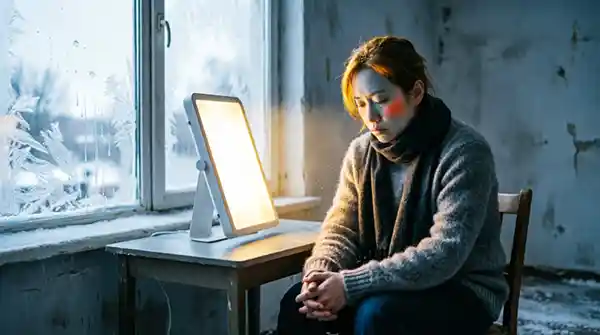
Fluorescent lights. Beige chairs. A woman in her sixties sits with her hands folded. She has done this every morning for six winters. She is not waiting for a doctor. She is waiting for a box.
Inside the light box
It is white. It is bright. It is 10,000 lux, roughly the intensity of sunlight on a clear day, compressed into a rectangle the size of a tablet. She sits in front of it for thirty minutes. She does not stare. She reads. She eats. The light enters her eyes and travels a path most people never think about.
What the research actually shows
The American Psychiatric Association estimates that up to 9 percent of American adults experience seasonal affective disorder, and another 25 percent experience a milder form of seasonal mood change. The condition repeats. It arrives in late fall. It lingers through winter. It lifts in spring. The pattern is so reliable that researchers can predict it.
How light sets the body clock
The suprachiasmatic nucleus is a cluster of about 20,000 neurons in the hypothalamus. It is the body’s master clock. It uses light to set the timing of almost everything: sleep, hunger, hormone release, body temperature. When the days get shorter, the clock gets less signal. It drifts. Melatonin, the sleep hormone, gets produced at the wrong time. Serotonin, the mood regulator, drops. Cortisol, the stress hormone, shifts. The result is a body that feels like it is living in the wrong time zone.
The debt you accumulate in the dark
One dark morning is a small withdrawal. One dark month is a significant balance. The debt is not metaphorical. It is measurable in hormone levels, sleep architecture, and reaction time. And it compounds. The person who starts the winter with a small deficit ends the winter with a large one.
What the research says about light therapy
A 2025 systematic review and meta-analysis published in Medicine examined seventeen randomized controlled trials. The finding was not subtle. Light therapy significantly reduced SAD symptoms by week two. White light was the most effective. The effect was comparable to antidepressant medication for many people, with fewer side effects. A separate 2025 meta-analysis in The Cognitive Behaviour Therapist found that group cognitive behavioral therapy for SAD was equivalent to light therapy immediately after treatment and more effective at one- and two-year follow-up.
Why exercise multiplies the effect
Dr. James McDeavitt, a professor of physical medicine and rehabilitation at Baylor College of Medicine, explained the exercise connection in a release from Northwestern Medicine. “You experience low serotonin and dopamine levels in SAD, depression or other conditions,” he said. “But there is a benefit to boosting neurotransmitter levels through exercise.” The exercise does not replace the light. It multiplies it. A thirty-minute walk in the morning combines both.
The patient who did not want to exercise
She told me she hated exercise. She hated the cold. She hated the dark. Her therapist gave her a single instruction: walk to the end of the driveway and back. That was it. Five minutes. She did it for a week. Then she walked to the corner. Then around the block. By February, she was walking thirty minutes a day. She did not become a runner. She became a person who moved. The movement changed her mood. The mood changed her motivation. The cycle started with a driveway.
The sleep trap that deepens the blues
Winter SAD is not just low mood. It is oversleeping. The person sleeps ten hours and wakes exhausted. The sleep does not restore. The sleep makes it worse. The research on sleep and mood has shown that excessive sleep disrupts the circadian rhythm further, creating a feedback loop. The solution is not more sleep. It is better sleep. Same bedtime. Same wake time. Light in the eyes within the first hour. No screens for an hour before bed. The Mayo Clinic recommends keeping the bedroom dark, cool, and quiet. The bed is for sleep. Not for scrolling.
The food trap that makes it worse
The craving is for carbohydrates. The body wants quick energy. The quick energy produces a spike and a crash. The crash produces more craving. The cycle ends in weight gain and regret. The research on blood sugar and mood has shown that the crash deepens fatigue and irritability. The fix is not a diet. It is a shift. Protein in the morning. Fiber. Fat. The kind of breakfast that does not spike and crash.
A scene from a support group
I sat in on a virtual support group for people with SAD. A man in his forties said he had tried everything: light, exercise, therapy, medication. He said the only thing that worked was moving to Arizona. The group laughed. He did not. He said the move saved his life. He was not joking. He was describing the difference between a body that gets light and a body that does not.
What the research says about moving
A 2025 study in Nature Reviews Neuroscience synthesized decades of research and concluded that exercise is one of the most effective interventions for maintaining cognitive health across the lifespan. Aerobic exercise increases blood flow to the brain, stimulates BDNF, and promotes new neurons in the hippocampus. The brain and the heart are not separate systems. What is good for one is good for the other. The man who moved to Arizona did not just change his latitude. He changed his light. He changed his movement. He changed his life.
When the blues become something more
The Mayo Clinic lists the symptoms that should trigger a conversation with a doctor: feeling down for days at a time, losing interest in activities you once enjoyed, changes in sleep and appetite, turning to alcohol for comfort, feeling hopeless, or thinking about suicide. The presence of any of these symptoms is not a reason to try harder on your own. It is a reason to seek professional help.
A note on asking for help
If you are experiencing persistent sadness, anxiety, or distress that interferes with sleep, appetite, work, or relationships, the appropriate response is not to try harder to manage it alone. It is to speak with a mental health professional who can assess what is happening and recommend an appropriate course of care. The research on seasonal affective disorder is robust. Effective treatments exist. Support is not a sign that you have failed to handle the winter. It is a recognition that some seasons are heavier than others.
What the light does
The light does not fix everything. It does not erase the winter. It does not make the gray sky blue. It does one thing. It tells the clock that the day has begun. The clock listens. The body follows. The mood follows. The light is not a cure. It is a signal. The signal is available. The signal is free. The signal is the thing you are not getting, and the thing you can reclaim.
The morning you can reclaim
You do not need a prescription to get light. You need a window. You need a walk. You need a box that costs less than a month of coffee. The research is clear. The treatment is available. The darkness is not permanent. The light is there. You just have to let it in.