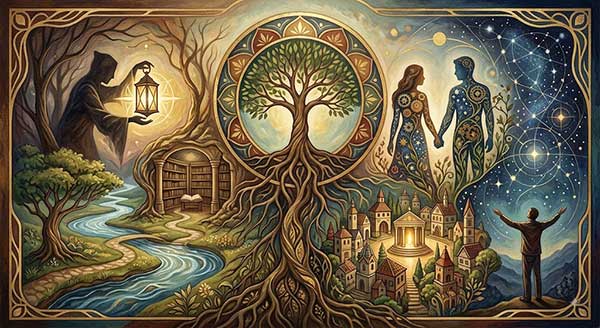
ARCHITECTURES OF THE SOUL: CARL JUNG’S 5 PILLARS OF HUMAN FULFILLMENT
Few psychological thinkers have illuminated the cavernous depths of the human psyche as profoundly as Carl Gustav Jung. While modern discourse often reduces happiness to fleeting sensory pleasures or relentless optimization, Jung viewed true fulfillment as a harmonious integration of the self—a quiet alignment between our physical vessel, our interpersonal bonds, and our search for cosmic resonance.
THE ARCHETYPAL PILLARS OF JUNGian WELL-BEING
  [ SOMATIC & MENTAL HEALTH ] ──► [ DEEP RELATIONAL BONDS ] ──► [ SLOW PERCEPTION OF BEAUTY ]
│
▼
[ MEANING-MAKING & TRANSCENDENCE ]
1. Somatic & Psychological Equilibrium
Modern wellness culture routinely fetishizes physical vitality—dietary restrictions, gym metrics, and biohacking—while entirely neglecting psychological hygiene. Jung asserted that true well-being requires protecting your internal peace with intentionality. Honoring your needs and setting boundaries against toxic dynamics is not self-indulgence; it is a fundamental act of psychological preservation.
2. Relational Reciprocity & Social Belonging
As inherently relational beings, our emotional stability relies heavily on mutual support. Jung observed that absolute isolation erodes the spirit, a sentiment echoed historically by Epicurus, who identified warm community as the bedrock of joy. Cultivating empathy and healthy compromise builds a safe harbor where our nervous system can exhale.
3. The Art of Deceleration & Interiority
When we rush blindly through life, we become blind to the quiet beauty around us. Jung famously wrote, “Who looks outside, dreams; who looks inside, awakes.” By slowing down our internal tempo, we shift from frantic reactivity to deep presence, allowing external beauty to nourish our interior world.
4. The Teleological Pursuit of Meaning
Not all of us have the privilege of deriving deep existential purpose from our daily breadwinning. Yet, Jung emphasized that humanity’s ultimate purpose is “to kindle a light in the darkness of mere being.” Whether through creative expression, advocacy, or community service, discovering an avenue to contribute meaning transforms routine existence into a sacred narrative.
5. Transcendence & Spiritual Alignment
Perhaps the most controversial pillar in a secular age, Jung maintained that belief in something greater—be it the divine, universal energy, or a continuation of consciousness—anchors the psyche. He noted that individuals who embrace a sense of spiritual continuity navigate mortality with greater resilience and live more generative, fear-free lives.
SCIENTIFIC & THEORETICAL FOOTPRINTS
To understand how Jung’s intuitive frameworks intersect with empirical science, consider these foundational research perspectives:
- Social Isolation & Mortality: Holt-Lunstad, J., Smith, T. B., & Layton, J. B. (2010). Social Relationships and Mortality Risk: A Meta-analytic Review.PLOS Medicine, 7(7), e1000316.
- Insight: Validates Jung’s second pillar by proving that strong social ties increase survival probability by 50%, whereas isolation carries health risks comparable to smoking.
- Meaning-Making & Psychological Resilience: Steger, M. F., Frazier, P., Oishi, S., & Kaler, M. (2006). The Meaning in Life Questionnaire: Assessing the presence of and search for meaning in life.Journal of Counseling Psychology, 53(1), 80–93.
- Insight: Demonstrates that individuals with a clear sense of meaning (Pillar 4) experience significantly higher life satisfaction and lower rates of depressive distress.
- Neurobiology of Mindfulness & Deceleration: Tang, Y. Y., Hölzel, B. K., & Posner, M. I. (2015). The neuroscience of mindfulness meditation.Nature Reviews Neuroscience, 16(4), 213–225.
- Insight: Confirms Jung’s third pillar, showing that turning attention inward deactivates stress pathways and restores emotional balance.
Jung’s insights remind us that joy is not a trophy to be captured, but a garden to be tended. By nurturing your body, deepening your relationships, slowing your stride, pursuing purpose, and remaining open to the mysterious, you construct a sanctuary capable of holding both life’s storms and its quiet wonder.