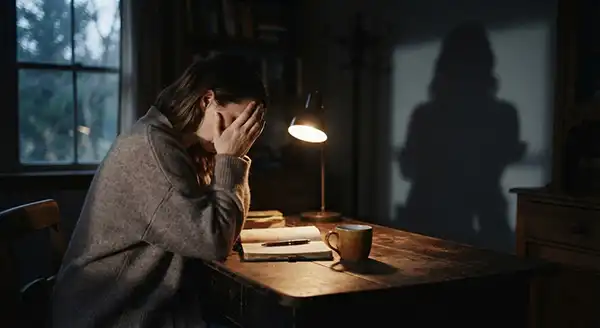
Why the Dark Parts of You Are Not the Enemy: Finding Light in What You Avoid
I was forty-one years old when I found myself sitting in a cramped therapist’s office in Minneapolis, trying to explain why I had just screamed at my son over a spilled glass of milk. Not a raised voice. A scream. The kind that comes from somewhere deeper than the moment, somewhere old and feral. My son was eight. He had been carrying the glass with two hands, concentrating hard, and it had slipped. The milk spread across the kitchen floor like a white flag. And I came apart.
The therapist, a calm woman named Ruth, listened without flinching. Then she asked me a question I had never been asked before: “What were you afraid of in that moment?”
I opened my mouth to say I was not afraid. I was angry. The milk was everywhere. The floor was a mess. It was a normal thing to be angry about.
But even as I said it, I knew it was not the whole truth. The anger was real, but it was not about the milk. It was about control. About the terror of watching something slip out of my hands—literally, a glass; metaphorically, everything else—and being unable to stop it. The milk was just the trigger. The fear underneath was ancient.
That was the beginning of a long, unglamorous journey into what I can only call the dark. Not evil. Not sin. Just dark. The parts of myself I had spent forty-one years avoiding, judging, pushing into the shadows.
The Swiss psychiatrist Carl Jung called this the shadow. He believed that every person carries within them the parts they cannot bear to see—the anger, the envy, the neediness, the fear—and that these parts do not disappear when we ignore them. They go underground. They gather power. And then, in moments like a spilled glass of milk, they come roaring back.
Why We Run From the Dark
We are taught early that some feelings are acceptable and others are not. Anger, especially in women, is dangerous. Sadness is inconvenient. Need is a burden. Fear is weakness. We learn to hide these things, first from our parents, then from our friends, then—most completely—from ourselves.
The psychologist and researcher Brené Brown, at the University of Houston, has spent her career studying what happens when we try to suppress the parts of ourselves we are ashamed of. Her research shows that you cannot selectively numb emotions. When you numb the dark, you also numb the light. The joy, the love, the sense of aliveness—all of it gets buried with the fear.
I did not know that then. I thought I was managing. I thought the anger that leaked out in small, sharp comments was just a personality flaw. I thought the anxiety that kept me up at night was just how I was wired. It never occurred to me that these things were messages. Signals. Signs pointing toward something I had been running from for years.
The poet and philosopher Rumi tells a story about this. Rumi was a respected scholar, a man of learning and reputation. Then he met Shams of Tabriz—Shams means “sun”—and everything he had built began to crumble. Shams did not give Rumi new knowledge. He took away the old. He pushed Rumi into the place he had been avoiding, the place where everything he thought he knew stopped being useful. And in that place, Rumi found something real.
The story is not about losing yourself. It is about losing the self you have been performing, so the self you actually are can finally breathe.
The Cave You Refuse to Enter
I have a friend in Portland, a man named David, who is one of the kindest people I know. He is also one of the most secretly angry. For years, his anger lived in his jaw, his shoulders, his stomach. It showed up as back pain, as insomnia, as a low-grade irritability that made him snap at cashiers and tailgate slow drivers. He had no idea he was angry. He thought he was just stressed.
When he finally started therapy—dragged there by a wife who was tired of walking on eggshells—he discovered that his anger was not the problem. The problem was that he had been swallowing it for thirty years. Every slight he had absorbed. Every boundary he had failed to set. Every time he had said “it’s fine” when it was not fine. The anger had not gone away. It had simply moved into his body and taken up residence.
The Jungian analyst Robert Johnson, in his book “Owning Your Own Shadow,” writes that the shadow is not something to be conquered or eliminated. It is something to be befriended. The qualities we have banished to the dark are not our enemies. They are our lost powers. The anger that scares us is actually the energy we need to set boundaries. The sadness we avoid is actually the depth that lets us feel joy. The fear we run from is actually the wisdom that keeps us safe.
The cave is not a prison. It is a treasury. But you cannot access the treasure until you are willing to enter.
What Happens When You Stop Running
The first time I let myself really feel my anger—not act on it, not suppress it, just feel it in my body—I thought I might die. The heat in my chest. The shaking in my hands. The terrible, unfamiliar sensation of something long buried finally rising to the surface.
It did not kill me. It passed. And on the other side of it, something strange happened. I felt lighter. Not fixed. Not cured. But lighter, as if I had been carrying a stone I did not know was there, and someone had finally helped me set it down.
The teacher and author Tara Brach calls this “radical acceptance.” It is the practice of allowing whatever is present to be present, without fighting it. Not because the feeling is good. Because the fighting is what makes it worse. The darkness loses its power when you stop running from it. Not because it disappears. Because you finally turn around and look at it.
The milk on the kitchen floor was not the problem. The spilled glass was not the problem. Even the scream was not the problem. The problem was the years of pretending I was someone who never got scared, never lost control, never felt the ancient terror of watching things slip away.
The darkness was not my enemy. It was the part of me that had been trying to tell me something for years. The anger was not a flaw. It was a signal. The fear was not a weakness. It was a message.
The message was simple: You are not the person you have been pretending to be. And the pretending is exhausting you.
The Ordinary Courage of Going Inward
This work is not glamorous. It does not happen in a single breakthrough or a single retreat or a single journal entry. It happens in the small, repeated choices to stop hiding. To stop performing. To stop pretending that the parts you are ashamed of do not exist.
It looks like saying the true thing instead of the pleasant thing. It looks like feeling the anger in your body instead of swallowing it. It looks like admitting, to yourself and to someone you trust, that you are scared. It looks like letting the tears come when they need to come, instead of blinking them back.
The poet Mary Oliver wrote: “Someone I loved once gave me a box full of darkness. It took me years to understand that this too, was a gift.” The gift is not the darkness itself. The gift is what the darkness makes possible. The depth. The honesty. The capacity for real, unperformed connection with other human beings.
The people who have walked through their own dark places are different from those who have not. They are softer. They are less afraid. They can sit with another person’s pain without flinching, because they have sat with their own. They are, in some quiet way, more alive.
A Note for When the Dark Feels Too Heavy
I want to be careful here, because I know that not all darkness is the same. There is the ordinary darkness I have been describing—the suppressed emotions, the hidden fears, the parts of ourselves we would rather not see. And then there is the heavier kind. The kind that comes with depression, with trauma, with a pain so deep it feels like it will swallow you.
If you are in that kind of darkness—if the heaviness has been there for weeks, if the days feel gray and meaningless, if the thought of getting out of bed feels impossible—please do not try to navigate it alone. The shadow work I am describing is not a substitute for professional care. A therapist can help you carry what you are carrying. The National Alliance on Mental Illness offers resources. The Suicide and Crisis Lifeline is available by calling or texting 988.
Reaching out is not weakness. It is the bravest thing you can do.
What I Am Still Learning
I still spill milk. I still get scared. I still catch myself falling into the old patterns, the old performances, the old pretending. The difference is that I catch it sooner now. And when I catch it, I do not punish myself. I just come back. To the body. To the breath. To the truth of what I am actually feeling.
The darkness is still there. It will always be there. But I am no longer at war with it. We have reached something like a truce, the darkness and I. And in the truce, there is more room for light.
The sun is out today. It is the middle of the afternoon, and the light is coming through the window in a way that makes everything look ordinary and beautiful. I am sitting here, in the middle of my ordinary, beautiful life, and I am not pretending to be anything I am not.
The anger is here. The fear is here. The love is here. The grief is here. All of it, in one room, in one body, in one moment.
And for the first time in a long time, I am not running from any of it.
That is the whole thing, I think. Not the absence of darkness. The willingness to be with it. Not the perfect light. The courage to be real.
The cave is still there. It will always be there. But now I know what is inside it. And I am not afraid to enter.