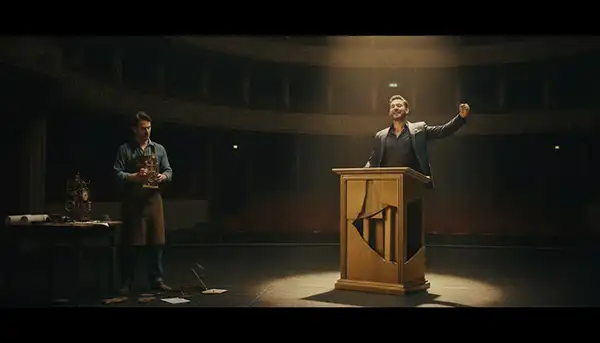
The ignorance premium: why confidence outperforms competence
The most successful people in many organizations are not the ones who know the most. They are the ones who are most comfortable not knowing—and most skilled at hiding it. The admission of ignorance, once a virtue in childhood, becomes a liability in adult professional life. The person who says “I don’t know” is marked as weak, unprepared, or unfit for advancement. The person who pretends to know, who projects certainty regardless of evidence, is rewarded with trust, authority, and promotion. I call this the ignorance premium: the professional and social advantage that accrues to those who display confidence in their own knowledge, even when that knowledge is thin, incomplete, or wrong. The premium is not a moral failure of individuals. It is a structural feature of workplaces that have confused certainty with competence.
This is not a new observation. It is an old one that each generation rediscovers and then forgets. What makes it urgent now is the cost. Organizations that reward the appearance of knowledge over the pursuit of it make worse decisions, miss better options, and silence the people who could correct them. The ignorance premium is not just unfair. It is expensive.
The child who asked too many questions
Every human being begins as a question machine. The infant points, grunts, and stares. The toddler asks why the sky is blue, why dogs have tails, why grandma is sad. The questions are not strategic. They are not designed to impress. They are the raw output of a brain that has not yet learned what it is supposed to ignore. The child asks because not knowing is uncomfortable and asking is the only relief.
Then something changes. The child learns that some questions are welcome and others are not. The parent who is tired, distracted, or threatened by their own ignorance responds with irritation. The teacher who has a curriculum to cover responds with impatience. The peer who is insecure responds with mockery. The child learns, quickly and thoroughly, that asking too many questions is a social liability. The lesson is not taught explicitly. It is absorbed through a thousand small signals: the sigh, the eye roll, the change of subject, the silence that follows a question that was not supposed to be asked.
By adolescence, the question machine has been mostly silenced. The student who does not understand stays quiet. The employee who needs clarification pretends to understand. The adult who is lost refuses to ask for directions. The fear of looking stupid becomes stronger than the desire to learn. And the ignorance premium begins to do its work, rewarding those who perform certainty and punishing those who admit confusion.
What thirty years in the workplace taught me about not knowing
I spent three decades in full-time professional life. I met thousands of people. I sat in hundreds of meetings. I watched decisions being made at every level, from entry-level teams to executive committees. And in all that time, I almost never heard anyone say, “I don’t know. Let’s find someone who does.” I almost never saw anyone raise a hand and admit that the question being discussed was beyond their competence. I almost never witnessed a leader turn to their team and say, “I am not sure. Help me understand.”
What I saw instead was a performance. People spoke with confidence about topics they had not studied. They offered opinions on data they had not examined. They made predictions about outcomes they could not control. They used jargon to disguise uncertainty. They repeated what they had heard someone else say. The performance was not always conscious. Many of them believed they knew what they were talking about. But the effect was the same: the room moved forward on a foundation of unexamined assumptions, and the people who could have corrected the course stayed silent.
The research on this phenomenon has a name. David Dunning and Justin Kruger at Cornell University published a study in 1999 showing that people with low ability in a domain tend to overestimate their competence. The reason is not stupidity. It is that the skills required to perform well are often the same skills required to recognize that you are performing poorly. If you lack the expertise, you lack the ability to see your own lack. The Dunning-Kruger effect is not a joke about stupid people. It is a description of a cognitive blind spot that affects everyone, especially in domains where feedback is delayed or ambiguous.
The meeting where no one said “I don’t know”
I remember a meeting in which a major strategic decision was being made. The company was considering entering a new market. The presentation was polished. The financial projections were detailed. The competitive analysis was thorough. Everyone in the room nodded. The leader asked if there were any questions. There were none. The decision was approved.
Six months later, the market entry failed. The assumptions behind the projections turned out to be wrong. The competitive analysis had missed a key player. The financial model had underestimated the cost of customer acquisition. In the post-mortem, it emerged that several people in the room had harbored doubts. One had questioned the market data but had not spoken because the presenter was senior and respected. Another had known about the missing competitor but had assumed someone else would mention it. A third had felt the projections were too optimistic but had not wanted to be the negative voice.
None of them had said, “I don’t know enough to evaluate this.” None of them had said, “I have a doubt.” The silence was not malicious. It was social. The cost was enormous.
Amy Edmondson at Harvard Business School has spent decades studying this dynamic. She calls it psychological safety: the belief that one can speak up with questions, concerns, or mistakes without being punished or humiliated. Her research has consistently found that psychological safety is the strongest predictor of team learning and performance. Teams with high psychological safety ask more questions, challenge more assumptions, and catch more errors. Teams with low psychological safety perform a kind of collective certainty that feels efficient but is dangerously fragile.
How uncertainty became a career liability
The ignorance premium is not an accident. It is produced by specific incentives. In most organizations, promotions are not given to the person who asks the most questions. They are given to the person who appears to have the most answers. The person who admits uncertainty is seen as lacking confidence. The person who projects certainty is seen as leadership material. The signal that gets rewarded is not accuracy. It is conviction.
This creates a selection effect. The people who rise to the top are often the ones who are most comfortable performing certainty, regardless of their actual knowledge. They are not necessarily the most competent. They are the most confident. And confidence, unlike competence, is easy to fake. You cannot fake knowing how to perform surgery. You can fake the demeanor of someone who knows how to perform surgery. In domains where outcomes are delayed, complex, or difficult to measure, the fake often wins.
Philip Tetlock at the University of Pennsylvania spent two decades studying expert judgment. His research, published in Expert Political Judgment, found that the experts who were most confident in their predictions were not the most accurate. The most accurate forecasters were the ones who were comfortable with uncertainty, who updated their views in response to new evidence, and who acknowledged the limits of their knowledge. Tetlock called them foxes. The confident, single-theory experts he called hedgehogs. The hedgehogs were more likely to be invited on television. The foxes were more likely to be right.
The paradox of the confident incompetent
The ignorance premium produces a paradox. The people who are most aware of their ignorance are the least likely to speak. The people who are least aware of their ignorance are the most likely to speak. The result is that the loudest voices in the room are often the least informed. The quietest voices are often the most informed.
This is not a new problem. It is a problem that has been observed in medicine, law, finance, and politics. In medicine, it is called diagnostic momentum: once a diagnosis is made, subsequent evidence is interpreted to fit it. In finance, it is called overconfidence bias: traders who believe they are better than average take excessive risks. In law, it is called advocacy: the lawyer who argues a case becomes convinced of their client’s innocence. In each domain, the person who is most certain is not the most reliable. The person who is most uncertain is often the most trustworthy.
The research on intellectual humility has begun to map this territory. Mark Leary at Duke University and his colleagues have developed scales to measure intellectual humility, defined as the recognition that one’s beliefs and opinions might be wrong. Their research has found that people who score high on intellectual humility are more likely to seek out new information, more likely to change their minds, and more likely to be trusted by others. They are also less likely to be perceived as arrogant. The humility is not weakness. It is a form of strength.
Why the honest are punished
Honesty in the workplace is often not rewarded. It is punished. This claim deserves careful examination. The person who admits they do not know is seen as less competent. The person who admits a mistake is seen as less reliable. The person who says “I was wrong” is seen as less credible. The punishment is not always formal. It is often subtle. The person is passed over for a promotion. The person is excluded from important meetings. The person is not invited to the next project.
The research on blame and accountability has documented this pattern. When something goes wrong, organizations often look for a person to blame rather than a process to fix. The person who admits fault becomes the scapegoat. The person who deflects blame survives. The incentive is clear: do not admit uncertainty. Do not admit error. Perform confidence. Perform certainty. Perform competence. The performance is rewarded even when it is false.
This is not to say that honesty is never rewarded. It is to say that honesty is risky. The risk is real. The person who tells the truth about their ignorance may be punished. The person who hides it may be promoted. That is the ignorance premium. It is a structural feature of many organizations, and it is corrosive.
A different kind of intelligence
There is another way to think about intelligence. It is not the ability to have answers. It is the ability to ask good questions. It is not the confidence to speak. It is the curiosity to listen. It is not the performance of knowing. It is the willingness to learn.
The psychologist Carol Dweck at Stanford University has shown that people who believe their abilities are fixed avoid challenges because failure would be a verdict. People who believe their abilities can be developed seek challenges because failure is information. The fixed mindset protects the ego. The growth mindset protects the learning. The person who can say “I don’t know” is not admitting defeat. They are opening a door.
The research on curiosity has shown that it is associated with higher levels of well-being, better relationships, and greater creativity. Curiosity is not a luxury. It is a form of engagement with the world. The person who stops being curious stops growing. The person who stops asking questions stops learning. The person who stops learning becomes obsolete.
When the cost of not knowing becomes a clinical problem
There is a difference between the ordinary difficulty of admitting uncertainty and the persistent, distressing fear of being exposed as a fraud. The research on impostor syndrome has shown that it is common, especially among high achievers. But when the fear becomes chronic, when it interferes with sleep, appetite, work, or relationships, when it prevents a person from speaking, applying, or risking, the appropriate response is not to try harder to perform confidence. It is to speak with a mental health professional who can help assess what is happening and develop strategies for moving forward. The research on anxiety disorders and perfectionism is robust. Effective treatments exist. Support is not a sign that you have failed to be confident enough. It is a recognition that some fears are not rational and cannot be reasoned away alone.
What remains when certainty is stripped away
There is a note of regret that runs through many careers. After thirty years, the lesson learned is often that honesty about ignorance is punished and that the performance of certainty is rewarded. The lesson feels like it has been learned too late. The young person who might ask for advice is told: look at me and do the opposite.
That advice is incomplete. The opposite of the ignorance premium is not a simple inversion. It is not the rejection of confidence. It is the cultivation of a different kind of confidence: the confidence to admit what you do not know. The confidence to ask the question that makes you look foolish. The confidence to change your mind when the evidence changes. The confidence to say “I was wrong.”
This kind of confidence is rare. It is also the only kind that produces learning. The person who is never wrong is not learning. The person who is always right is not listening. The person who never asks is not growing.
The ignorance premium is real. It shapes careers. It damages organizations. It silences the people who could help. But it is not invincible. It can be interrupted. It can be named. It can be resisted. The resistance begins with a single sentence: “I don’t know.” The sentence is not an ending. It is a beginning. And the beginning is available to anyone who is willing to speak it.