Andy Warhol’s afterlife economics: why his market keeps growing after death
Andy Warhol died in 1987 with an estate valued at roughly $220 million. By 2022, a single painting of his—*Shot Sage Blue Marilyn*—sold for $195 million. The math is not a contradiction. It is a business model. The artist was not the product. The estate was. The estate is still producing. I call this afterlife economics: the economic and cultural value generated by an artist’s estate after death, driven by scarcity, myth, and the institutional machinery that preserves and monetizes the work. Warhol is the purest case study in American art history.
What Andy Warhol’s net worth was when he died
Warhol left behind thousands of artworks, a magazine, a film archive, a foundation, and a mountain of personal possessions that filled a five-story townhouse on the Upper East Side. The estate was valued at $220 million in 1987. That number has been revised upward by every subsequent auction. The foundation he established became one of the largest grant-making organizations in the art world. The foundation also became the gatekeeper of authenticity. The gatekeeping was lucrative. The gatekeeping was also contentious. When the foundation dissolved its authentication board in 2012, the decision was praised by some and mourned by others. The board had been sued repeatedly. The lawsuits cost millions. The authentication of Warhol’s work had become a business of its own, a business built on the premise that the dead artist’s hand could still be verified, that his intentions could still be known, that his signature could still be trusted. The hand was gone. The intentions were reconstructed. The signature was often a stamp.
How the Andy Warhol Foundation makes money
The foundation sells art. It has sold thousands of works since 1987. The sales fund grants. The grants fund museums, artists, and scholars. The cycle is self-reinforcing. The foundation also licenses Warhol’s image, name, and trademarks. The licensing generates revenue. The revenue funds more grants. The grants generate more goodwill. The goodwill generates more value. The value generates more licensing. The machine is elegant. The machine is also controversial. Critics argue that the foundation has flooded the market with Warhols, depressing prices for some works while inflating prices for others. The foundation argues that it is fulfilling Warhol’s wishes. The wishes were not specific. The wishes were general. The general wishes have been interpreted by lawyers and accountants. The interpretation has been profitable.
Why Shot Sage Blue Marilyn sold for $195 million
The painting was created in 1964. It was one of five Marilyn portraits in different color combinations. The series is called Shot Marilyns because a performance artist named Dorothy Podber walked into the Factory in 1964, asked if she could shoot a stack of canvases, and fired a bullet through the forehead of one of the Marilyns. The bullet did not destroy the painting. It made it more famous. The bullet became part of the story. The story became part of the value. The value became part of the price. The price became part of the myth. The myth became part of the market. The market became part of the culture. The culture became part of the algorithm. The algorithm is still producing.
Inside the Factory: Warhol’s production model
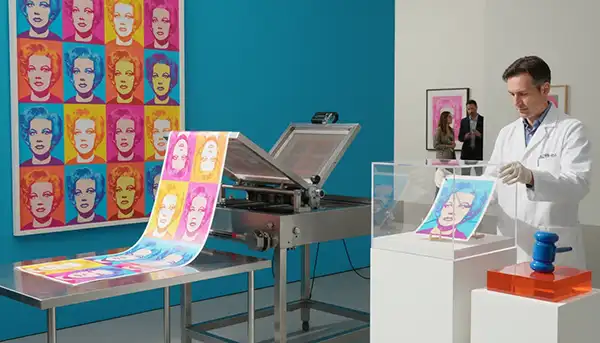
The Factory was not a studio. It was a factory. The name was literal. Warhol had worked in advertising. He understood mass production. He understood that the artist’s hand was not the source of value. The concept was. The repetition was. The brand was. The Factory produced paintings the way a factory produces widgets. The Campbell’s Soup Cans were not paintings of soup cans. They were paintings of the idea of soup cans, repeated until the idea became the image and the image became the brand. The brand became the product. The product became the art. The art became the business. The business became the best art. Warhol said that. He meant it.
The 1968 shooting that changed his art and his brand
Valerie Solanas shot Warhol on June 3, 1968. She was a feminist writer. She had given him a script. He had lost it. She believed he had stolen it. She believed he was trying to steal her work. She was wrong. She was also mentally ill. She was arrested. She was diagnosed with paranoid schizophrenia. She was institutionalized. She was released. She continued to write. She died in 1988. Warhol was pronounced dead on the operating table. He was revived by heart massage. He spent two months in the hospital. He never fully recovered. The shooting was the end of the 1960s for Warhol. It was also the beginning of the myth. The myth was that he had been killed and resurrected. The myth was that he had seen death and returned. The myth was that he was invincible. The myth was not true. But the myth was useful. The myth generated value.
Interview magazine and Warhol’s media empire
Warhol founded Interview in 1969. The magazine was a product. It was also a platform. It featured celebrities interviewing celebrities. It featured artists interviewing artists. It featured people who wanted to be famous interviewing people who were already famous. The magazine was distributed by hand in the early days. It was sold at newsstands and galleries. It became a fixture of the downtown scene. It outlived Warhol by more than a decade. It was relaunched in 2008. The magazine was not a vanity project. It was a brand extension. It extended the name. It kept the name in circulation. It created a platform for the portraits that Warhol was producing for the rich and famous. The portraits paid the bills. The bills funded the foundation. The foundation funds the art world. The art world funds the myth. The myth funds the market.
Warhol’s portrait business and the celebrity economy
Warhol painted the wealthy. He painted the famous. He painted the aspirational. He painted them in multiples. He painted them in colors that were designed to match the sofa. He painted them because they paid. He was not ashamed. “Being good in business is the most fascinating kind of art,” he said. “Making money is art and working is art and good business is the best art.” The portraits were not the most critically acclaimed works. They were the most commercially successful. They funded the experimental work. They funded the films. They funded the magazine. They funded the foundation. The portraits were the engine. The experimental work was the exhaust. The exhaust was what the critics loved. The engine was what kept the car running.
Screen Tests, Sleep, and Empire: the films that built the myth
Warhol made films that no one wanted to watch. Sleep was eight hours of a man sleeping. Empire was eight hours of the Empire State Building. Screen Tests were three-minute portraits of Factory regulars staring at the camera. The films were not entertainment. They were endurance tests. They were also commercial products. The Chelsea Girls cost $3,000 to make and grossed $130,000. The margins were better than Hollywood’s. The films were not about narrative. They were about time. They were about attention. They were about the viewer’s willingness to sit with the image. The image was the product. The product was the brand. The brand was the myth. The myth was the market.
What the authentication board controversy reveals
The Warhol Authentication Board was established in 1987. It was dissolved in 2012. The board was responsible for determining which works were authentic Warhols. The board was sued repeatedly. The lawsuits cost millions. The lawsuits also generated headlines. The headlines generated interest. The interest generated value. The value generated more lawsuits. The cycle was not sustainable. The foundation dissolved the board. The dissolution created a new problem. Without the board, there is no official arbiter of authenticity. Without an official arbiter, the market relies on provenance, expertise, and consensus. The consensus is not always reliable. The market is not always rational. The rational market is a myth. The myth is a product. The product is the art. The art is the business.
How Warhol predicted the algorithm economy
Warhol said that in the future, everyone would be world-famous for fifteen minutes. The line was a joke. The line was also a prediction. The algorithm economy has made the prediction literal. The feed produces fame in fifteen-second increments. The feed produces repetition. The feed produces the same images over and over until they become the culture. The culture becomes the brand. The brand becomes the product. The product becomes the art. The art becomes the business. Warhol would have understood the algorithm. He would have used it. He would have manipulated it. He would have made money from it. He would have called it art. He would have been right.
The legacy: museums, markets, and the myth machine
The Warhol Museum in Pittsburgh opened in 1994. It is the largest museum in North America dedicated to a single artist. The museum houses thousands of works, thousands of documents, thousands of films. The museum is a monument. The monument is a brand. The brand is a product. The product is the myth. The myth is the market. The market is the machine. The machine is still running. The running is the point. The point is the product. The product is the art. The art is the business. The business is the best art. Warhol said that. He said it and he meant it and he built it and he left it behind. The factory is still running. The product is still moving. The myth is still growing. The man is still dead. The brand is not.