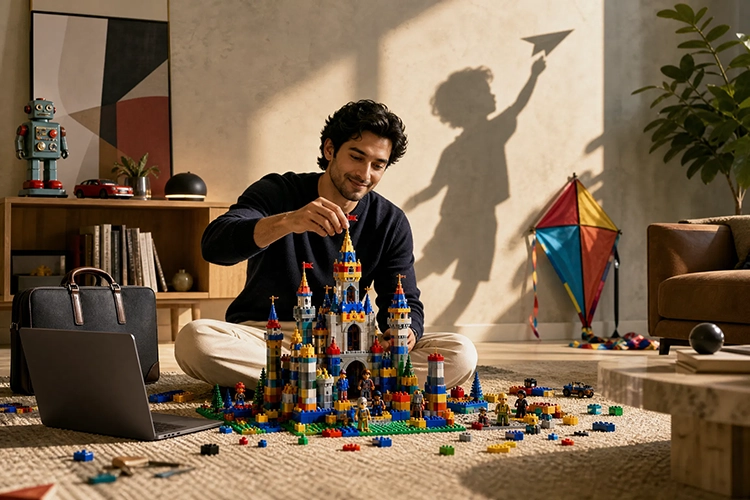
The Sanctuary of the Inner Child: Why Modern Adults Are Embracing “Kidulting”
There is a distinct kind of exhaustion that belongs exclusively to modern adulthood. It lives in the unyielding ping of a work email late at night, the invisible mental load of household logistics, and the quiet, crushing realization that the bills never stop coming. In the middle of this relentless friction, most of us have experienced a sudden, visceral longing for a simpler era—a flash of memory featuring Saturday morning cartoons, plastic building blocks, or the simple comfort of a favorite childhood snack.
For generations, society treated this longing as a guilty secret, a childish weakness to be ironed out by the time one acquired a mortgage and a professional title. But a profound cultural shift is underway. Adults are no longer hiding their affection for the past; they are actively curating it.
Welcome to the world of kidulting.
Redefining the Refuge
At its core, kidulting is the conscious choice by adults to re-engage with the playful experiences, objects, and media of their youth. It is a portmanteau of kid and adulting—a linguistic bridge connecting the structural demands of maturity with the unburdened emotional freedom of early life.
When a thirty-five-year-old spends a rainy Sunday afternoon assembling a complex Lego architecture set, lines up to buy a special-edition toy from a fast-food chain, or gathers friends for a nostalgic board game night, they are not acting confused about their age. They are engaging in emotional self-care.
Yet, cultural critics often rush to pathologize this behavior, conflating it with the infamous Peter Pan Syndrome. Coined by psychologist Dr. Dan Kiley in the 1980s, Peter Pan Syndrome describes a genuine developmental stall—an avoidance of responsibility, a refusal to make adult decisions, and a chronic fear of commitment.
Kidulting is the exact opposite. It is practiced by fully functional, tax-paying adults who hold down jobs, manage relationships, and navigate heavy responsibilities. They do not use play to escape their duties permanently; they use it as an emotional decompression chamber to survive them.
The Billion-Dollar Economy of Play
The cultural footprint of kidulting is no longer a fringe subculture; it is a multi-billion-dollar economic force. Market research from outlets like Bloomberg reveals that adult consumers spend tens of billions of dollars annually on collectibles, board games, video games, and nostalgia-driven merchandise.
Adult fans drive the multi-billion-dollar box offices of superhero cinematic universes, pack theme parks without children in tow, and clear out shelves of sophisticated building kits designed explicitly for mature builders. This spending represents a collective rebellion against the gray, utilitarian expectations of contemporary life. It is an assertion that joy, wonder, and imagination should not have an expiration date.
The Neurobiology of Nostalgia
Why does holding a vintage trading card or watching a retro animated film evoke such an instantaneous wave of calm? Psychology and neuroscience offer clear answers.
As author and researcher Nicole Booz notes, nostalgia acts as a powerful psychological anchor. When adults revisit the touchstones of their youth, their minds briefly travel back to a time when the world felt expansive, secure, and full of unwritten possibility. It is a tactical retreat to a mental territory where the future was a promise rather than a list of deadlines.
Furthermore, play has a profound physical effect on our neurology. As play expert Meredith Sinclair points out, when we dedicate time to activities pursued purely for fun, the brain’s prefrontal cortex—the region responsible for emotional regulation and social processing—lights up with activity.
Dr. Krystine Batcho, a professor of psychology specializing in nostalgia, explains that play allows us to temporarily suspend the rigid boundaries of reality.
“First, play may serve as an escape from the burdens, frustrations, or worries of responsibilities,” Dr. Batcho observes, “but given a chance, play also revives a sense of wonder, because ordinary things are looked at with curious eyes from a new perspective.”
This shift in perspective triggers a natural rise in serotonin, dampens the somatic markers of anxiety, and restores cognitive flexibility.
Giving Yourself Permission to Play
If you find yourself secretly scrolling through listings of vintage toys, smiling at the opening theme song of a childhood television show, or feeling an inexplicable urge to color outside the lines, stop fighting the impulse.
You do not need to justify your need for play to anyone. Giving yourself permission to engage in a little kidulting is not a regression; it is a vital psychological reset. Pull out an old game, watch a comfort movie from your youth, or spend an afternoon building something simply for the sheer delight of creating it. Your inner child carried you this far through a demanding world—it is more than time to return the favor.