The Holiday You Don’t Need to Travel For
Your toes in the sand, a turquoise sea stretching ahead, a cool drink in your hand. Even the daydream feels good, doesn’t it? The anticipation of escape, of stepping out of routine, of permission to simply be. For most of us, that feeling is the closest we get to genuine restoration—until the holiday itself arrives, and then vanishes, leaving us back at our desks, wondering where the peace went.
The pandemic taught us something about deprivation. When travel became restricted, when weekends blurred into weekdays, when the boundaries between work and rest dissolved, we felt the absence of holiday more acutely than ever. We craved the shift, the novelty, the liberation from sameness. And yet, even now, with borders open and planes flying, the fundamental problem remains. A holiday is a temporary fix. It treats the symptom—exhaustion—but not the underlying condition. The condition is a life that demands restoration, but a schedule that rarely permits it.
What if you didn’t need to leave home to find what the holiday promises? What if the escape you seek is not a destination, but a way of being?
The Post-Holiday Letdown
There is a pattern that plays out in millions of lives each year. Anticipation builds. The holiday arrives. For a week or two, there is joy, relaxation, a sense of freedom. Then the return. The inbox. The laundry. The ordinary pressures of daily existence. Within a fortnight, the glow has faded. You are back where you started, maybe with a tan and some photographs, but essentially unchanged.
Research confirms what most of us have experienced firsthand. Studies by Fritz and Sonnentag, and later by Strauss-Blasche and colleagues, found that people report fewer health complaints and higher life satisfaction immediately after a holiday. But within one to two weeks of returning to work, the positive effects begin to dissipate. The restoration is real, but it is short-lived.
The question is not whether holidays are valuable—they are. The question is whether we are relying on them to do a job they were never designed to do. A holiday cannot fix a life that is chronically out of balance. It cannot compensate for months of burnout, for a job that drains you, for relationships that need attention, for the quiet erosion of your sense of self. A holiday is a pause, not a reset. And if you need a reset every year, the problem is not the absence of holiday; it is the presence of a life that requires escaping from.
Holiday infusion is the term I use to describe the alternative. It is the practice of bringing the quality of the holiday—the openness, the curiosity, the permission to enjoy—into your ordinary days. Not as a substitute for travel, but as a complement. Not as a way to avoid the grind, but as a way to transform your relationship to it.
What Research Says About Restoration
The science of recovery offers a useful framework. Psychologists distinguish between four types of recovery experiences: psychological detachment from work, relaxation, mastery, and control. Detachment means mentally switching off. Relaxation means low-effort activities that replenish energy. Mastery means learning something new, which builds confidence and competence. Control means having autonomy over how you spend your time.
A holiday typically delivers all four. But the same experiences are available in your daily life—if you design for them.
Consider mastery. You do not need a beach to learn a new skill. A cooking class, a language app, a creative project—all of these provide the same sense of growth and achievement that a holiday offers through novel experiences. Consider relaxation. You do not need a resort to rest. A quiet evening with a book, a walk in a park, a bath without interruption—these are accessible, often overlooked, but deeply restorative.
The psychologist Mihaly Csikszentmihalyi found that people experience the most satisfaction not during passive leisure, but during activities that require engagement and skill. The holiday that feels most meaningful is often the one that includes some kind of challenge—learning to surf, hiking a difficult trail, cooking a new cuisine. That challenge is not a distraction from restoration; it is a core component of it.
The implication is clear. You can build restoration into your daily life, not by waiting for the annual break, but by intentionally creating moments of mastery, relaxation, detachment, and control. It does not require a change of scenery. It requires a change of intention.
Bringing Holiday into Your Everyday
The most concrete step is to act like a tourist in your own city. Tourists are curious. They notice details that locals overlook. They try things they have never tried. They give themselves permission to explore without a fixed agenda. You can do the same.
Take a different route to work. Visit a neighborhood you have never explored. Go to a museum you have been meaning to see. Sit in a café and watch people without checking your phone. These are not massive undertakings. They are small acts of discovery, and they can produce the same shift in perspective that a holiday provides.
The same principle applies to your routines. If you always wear the same colors, try something different. If you always read the same genre, pick up a book by an author you have never heard of. If you always listen to the same music, let a streaming service choose for you. These are not life-changing decisions. They are invitations to novelty, and novelty is one of the key ingredients of psychological restoration.
There is also the question of social connection. On holiday, you are more open to new people, more willing to strike up conversations, more tolerant of differences. You can bring that openness home. Join a class, a club, a meetup. Talk to the person next to you on the bus. Attend an event alone and see what happens. The goal is not to make friends—though that may happen—but to break the isolation that routine can create.
The Daily Vacation Practice
Here is the shift that makes the difference. Instead of treating your year as a long stretch of work punctuated by a brief holiday, treat every day as a container for a small holiday experience. This is not about productivity. It is about presence.
The practice is simple. Each day, choose one small act that would be normal on holiday but feels indulgent on a Tuesday. It could be taking a lunch break away from your desk. It could be leaving work on time. It could be cooking a meal with care instead of rushing through it. It could be calling someone you love just to talk, not to coordinate logistics.
The resistance you feel to these acts is the voice of conditioning. It tells you that you should be working, that you are wasting time, that you will fall behind. But that voice is not your friend. It is the voice that keeps you trapped in a cycle of exhaustion, waiting for a holiday to save you.
Psychologist Martin Seligman’s research on well-being highlights the importance of savoring—the act of attending to positive experiences and allowing them to linger. On holiday, you savor naturally. You stop to appreciate the view. You take a moment to enjoy the taste of a meal. You notice the warmth of the sun. You can do the same in your daily life. Savoring transforms ordinary moments into extraordinary ones.
The Shift from Escape to Inclusion
The deeper change is one of orientation. When you view holiday as an escape, you are implying that your ordinary life is something to escape from. This is a subtle but corrosive belief. It frames your daily existence as a burden to be endured until you can find relief.
Holiday infusion inverts this. It says that the qualities you seek on holiday—rest, joy, connection, novelty—are not external luxuries to be acquired. They are internal states to be cultivated. They are available in any moment, if you know how to access them.
This is not about denying the reality of stress or difficulty. There are times when life is genuinely hard, and a change of scenery is exactly what you need. But even in those times, the recovery does not depend on the destination. It depends on your capacity to shift your attention, to break your patterns, to find moments of restoration within the chaos.
The pandemic showed us that we can adapt. We learned to work from home, to socialize remotely, to find meaning in small acts of connection. That adaptability is a resource. You can use it now, not just to survive difficult circumstances, but to thrive in ordinary ones.
A Quiet Observation
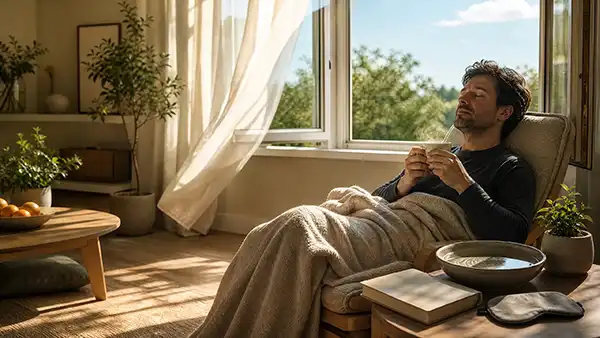
There is a woman I once met who had a small ritual. Every Friday evening, she would close her laptop, put her phone in a drawer, and make a cup of tea. She would sit by the window and watch the light change. She called it her “mini-holiday.” It lasted twenty minutes, sometimes less. But it was sacred. It was hers. And she told me that it transformed her weeks—not because it fixed anything, but because it reminded her that she was not just a worker. She was a person with a life.
That ritual is available to all of us. It does not require travel. It does not require money. It does not require time off. It requires only the permission to pause, to attend, to treat your own experience as worthy of attention.
The holiday you need is not a place. It is a permission. Permission to enjoy without guilt. Permission to be curious without a purpose. Permission to rest without earning it. And that permission is not something you receive from your boss or your calendar. It is something you give yourself, every single day, in every small act of presence.
So this week, try one thing. Just one. Take a different route. Cook something new. Call someone you miss. Sit and do nothing for ten minutes. Notice what happens. Notice if the world feels different, if you feel different, if the ordinary day has suddenly acquired a hint of the extraordinary.
That hint is the gift. Not the holiday you wait for. The holiday you create. And it is always available.