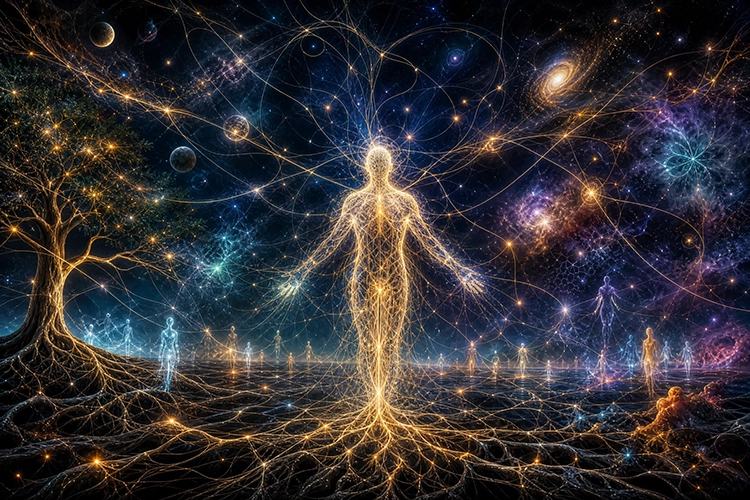
We spent centuries trying to stop the universe from shaking. We inherited a Newtonian blueprint that insisted reality was a vast, mechanical clockwork—a predictable engine of linear cause and effect where every variable could, in theory, be measured, isolated, and controlled.
The trouble is, human beings refused to tick quietly.
When psychotherapist Daniel Stern began his sessions with a deceptively simple question—“What did you experience at breakfast this morning?”—he wasn’t engaging in casual small talk. He was hunting for fractal footprints. The velocity with which a coffee mug meets a wooden table, the hesitation in a sigh, the subtle cadence of a morning routine—these micro-behaviors are not random noise. They are the micro-cosmic blueprints of an entire internal architecture.
The Hidden Geometry of Chaos
In chaos theory, we learn that systems once dismissed as erratic or disordered actually possess a hidden, underlying harmony. What looks like wild unpredictability on the surface is often governed by attractors—deep systemic loops that pull experience toward specific patterns.
Yet, as dynamic as these loops are, they are intensely sensitive to initial conditions. A microscopic shift in the present can cascade outward into a profound butterfly effect. Human life does not unfold along a neat, arithmetic straight line; it is a web of complex, non-linear interactions. To understand a person, you cannot look at them in a vacuum of abstract statistics. You have to look at the immediate, breathing context of here and now.
When the Observer Becomes the Canvas
The rigid objectivity demanded by classical science began to fracture in the early twentieth century, giving way to quantum mechanics and relativity. Albert Einstein captured the profound shift of this new paradigm with characteristic wit when he remarked to Carl Jung:
“Put your hand on a hot stove for a minute, and it seems like an hour. Sit with a pretty girl for an hour, and it seems like a minute. That’s relativity.”
When human experience is subjective and fluid, absolute neutrality becomes impossible. At the quantum level, the very act of observing a particle alters its reality.
Jung recognized the exact same limitation in psychic life, leading him to formulate the concept of synchronicity. Rejecting strict linear causality, Jung suggested that the universe occasionally coordinates events through shared symbolic meaning rather than mechanical force. A sudden life crisis, an uncanny coincidence, or an unexpected encounter arrives not by random accident, but as a resonant signal from the deeper architecture of the psyche, pointing toward transformation.
The Intersubjective Web
If subatomic particles exist in a state of continuous, probabilistic deviance—and if no two observations of the universe are ever identical—then the traditional illusion of an isolated, measurable human ego collapses entirely.
Enter intersubjectivity.
When two human consciousnesses meet, they do not function as two computers exchanging static data packets. Instead, they generate a shared, mutually organized field of subjective experience. The meaning derived from an interaction cannot be ripped away from its context.
To force human complexity into rigid, standardized diagnostic boxes is to misunderstand the very nature of reality. Every relationship, every emotional exchange, and every therapeutic encounter is a singular ecosystem governed by its own unrepeatable dynamics.
The universe is in constant, chaotic, magnificent motion, and you are not a spectator standing safely outside of it. You are woven directly into the canvas.
Given that everything you feel, think, and experience is part of an infinite, ever-shifting web of context, can any single snapshot of who you are right this second ever capture the entirety of your truth?