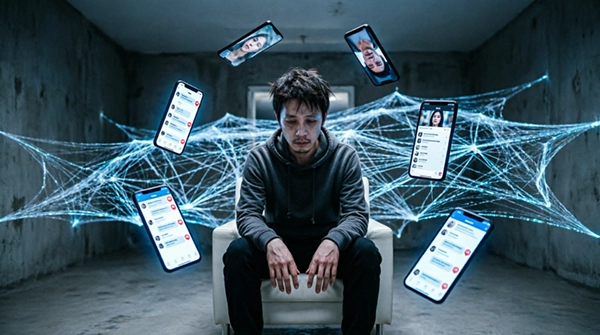
How We Stopped Talking: A Documentary About Communication
LOGLINE: A filmmaker interviews people across five generations about how they communicate, and discovers that the tools meant to connect us have changed the very nature of connection itself.
FORMAT: Documentary feature. 75 minutes. Interview-driven. Archival footage. No narrator. The subjects speak for themselves.
OPENING
EXT. SUBURBAN BACKYARD — DAY
A woman in her seventies sits on a porch swing. She holds a smartphone in her lap like it is a foreign object. She does not look at it. She looks at the camera.
DOROTHY, 74: My granddaughter taught me how to use this thing. She said, Grandma, you have to text. You have to be on Facebook. You have to see what everyone is doing. So I learned. But I do not know what everyone is doing. I know what everyone is posting. That is not the same thing.
She laughs. It is not a happy laugh.
DOROTHY: I remember when I got my first telephone. I was nineteen. My father had it installed as a surprise. We shared a party line with three other families. You had to wait for them to finish their calls before you could make yours. And when someone called you, the whole house knew. The phone rang and everyone ran to answer it. It was an event.
She pauses.
DOROTHY: Now the phone is always ringing. But nobody runs.
CUT TO:
INT. COFFEE SHOP — DAY
A man in his late forties sits across from the camera. He is a project manager. He is tired.
DAVID, 48: I manage a team of twelve people. Half of them are in the same building. Half of them are remote. I have never met the remote ones in person. Not once. I have seen their faces on Zoom. I have heard their voices on conference calls. But I have never shaken their hands. I have never had lunch with them. I have never seen what they do when they are nervous or excited or bored.
He shrugs.
DAVID: And they are fine employees. They do their work. But I do not know them. And they do not know me. And that is the part that keeps me up at night.
TITLE CARD: HOW WE STOPPED TALKING
ACT ONE: THE TOOLS
EXT. CITY STREET — DAY
Archival footage. Black and white. A man on a bicycle delivers a letter. The footage is from the 1940s.
VOICE (DOROTHY): When I was a girl, you wrote letters. That was how you told someone you loved them. You wrote it down. You mailed it. You waited. And waiting was part of it. The waiting made the words mean more.
CUT TO:
INT. LIVING ROOM — DAY
A man in his fifties sits on a couch. He is a retired teacher.
ROBERT, 55: I remember pagers. You had a code. You had to find a payphone to call back. It was terrible. But it was also kind of exciting. You had to decide if the message was important enough to stop what you were doing and find a phone.
He smiles.
ROBERT: Now I get thirty emails a day. And none of them feel important. Because none of them required effort. Effort was the filter. And we lost the filter.
CUT TO:
INT. OFFICE — DAY
A woman in her thirties sits at a desk. She is a marketing manager.
SARAH, 34: My first phone was a flip phone. I got it when I was sixteen. I could call. I could text. That was it. And I remember feeling so connected. Like I could reach anyone, anywhere.
She looks at her current phone on the desk.
SARAH: Now I have a phone that can do everything. And I feel more disconnected than ever. I have three hundred friends on Facebook. I have four hundred followers on Instagram. But I have maybe four people I could call if something went wrong.
CUT TO:
EXT. UNIVERSITY CAMPUS — DAY
A young man walks across a quad. He is nineteen. He is looking at his phone.
MARCUS, 19: I do not really call people. Nobody my age does. We text. We DM. We send memes. Calling is weird. Calling feels like an invasion.
He stops walking.
MARCUS: I have never actually heard some of my friends’ voices. Like, I know their texts. I know their emojis. I know their Instagram stories. But I do not know what they sound like when they laugh.
ACT TWO: THE LOSS
INT. THERAPIST’S OFFICE — DAY
A therapist sits in a chair. She is in her sixties. She has been practicing for thirty years.
DR. ELAINE, 62: The research is clear. Face-to-face communication does something that digital communication cannot replicate. A 2025 study in Scientific Reports found that brain synchronization is significantly higher in face-to-face interactions than online ones. The right temporoparietal region, the area associated with empathy and social cognition, showed greater coherence when people were in the same room.
She leans forward.
DR. ELAINE: That is not a small thing. That is the neural signature of connection. And we are replacing it with something that does not produce the same signature.
CUT TO:
INT. LIVING ROOM — NIGHT
A family sits at a dinner table. Four people. All on their phones. The camera holds. Nobody speaks.
VOICEOVER (DAVID, 48): I used to think it was just my family. That we were the problem. Then I started noticing other families. At restaurants. At ballgames. At school pickup. Everyone is together. And everyone is alone.
CUT TO:
INT. UNIVERSITY OFFICE — DAY
A researcher sits at a desk. He is in his forties. He studies social media and communication.
DR. CHEN, 44: A 2025 study in Zenodo found that social media has transformed communication by making it faster and more convenient, but it has also weakened the depth and quality of human connections. The findings included reduced face-to-face interactions, superficial relationships, and increased misunderstandings due to lack of non-verbal cues.
He pauses.
DR. CHEN: The non-verbal cues are the key. When you text someone, you lose the tone. You lose the face. You lose the body. You lose the context. And the brain has to work harder to fill in the gaps. And sometimes it fills them in wrong.
CUT TO:
INT. BEDROOM — NIGHT
A young woman, twenty-two, sits on her bed. She is crying. She is looking at her phone.
JESSICA, 22: My boyfriend and I had a fight over text. He said something and I read it wrong. I thought he was angry. He was not angry. He was tired. But I did not know that. I could not hear his voice. I could not see his face. So I assumed the worst. And I said things I regret. And he said things he regrets. And now we are not together anymore.
She wipes her eyes.
JESSICA: Over text. We broke up over text. That is not how it is supposed to work.
ACT THREE: THE GENERATIONS
INT. OFFICE — DAY
A woman in her sixties sits at a conference table. She is a senior executive.
PATRICIA, 61: I manage people from four different generations. The Traditionalists. The Boomers. Gen X. Millennials. Gen Z. And they all communicate differently.
She counts on her fingers.
PATRICIA: The Traditionalists want a memo. The Boomers want a meeting. Gen X wants an email. Millennials want a text. Gen Z wants a DM. And I am supposed to speak all five languages.
She laughs.
PATRICIA: A 2023 study from Kennesaw State University called intergenerational communication a form of intercultural communication. That is exactly right. We are not just different ages. We are different cultures.
CUT TO:
INT. COWORKING SPACE — DAY
A young man, twenty-four, sits at a table with a laptop.
TYLER, 24: My boss is fifty. He sends me emails. Long emails. With paragraphs. And I am like, just text me. Just send me a Slack message. I will respond in two seconds. But he does not. He writes these emails that take me ten minutes to read and then I have to write a response that takes me another ten minutes. And I am thinking, this could have been a text. This could have been two sentences.
He shrugs.
TYLER: But I do not say that. Because that would be rude. So I write the email. And I waste the time.
CUT TO:
INT. CONFERENCE ROOM — DAY
A woman in her late fifties sits across from a man in his late twenties. They are in a meeting. They are both on their phones. They are not talking.
VOICEOVER (PATRICIA, 61): The research from Kennesaw State found that organizations need to adopt generation-specific social media apps for two-way communication. But that is not a solution. That is a workaround. The solution is not more apps. The solution is more effort. And effort is the thing we are running out of.
ACT FOUR: THE HOPE
INT. SCHOOL CLASSROOM — DAY
A teacher stands in front of a class of middle schoolers. She is in her forties. She has a rule.
MS. RIVERA, 42: No phones in my classroom. Not even in your backpacks. Not even turned off. They stay in the locker. And the first week, the kids were angry. They said they felt naked. They said they felt disconnected. They said they could not breathe.
She smiles.
MS. RIVERA: By the third week, they were talking to each other. Actually talking. Looking at each other. Laughing at things that were not on a screen. And they told me they liked it. They said it felt like a break. They said it felt like being on vacation.
CUT TO:
INT. LIVING ROOM — DAY
A family sits at a dinner table. Four people. The phones are in a basket by the door. They are talking. They are laughing. The camera holds.
VOICEOVER (DAVID, 48): We started doing this six months ago. No phones at dinner. It was hard at first. We did not know what to say. We had forgotten how to talk to each other. But we relearned. And now it is the best part of my day.
CUT TO:
INT. THERAPIST’S OFFICE — DAY
Dr. Elaine again.
DR. ELAINE, 62: The research on digital communication is not all negative. A 2025 study in the Journal of Computer-Mediated Communication found that phone calls were rated higher in quality than face-to-face interactions in some contexts. Video calls at home were perceived as higher quality than face-to-face. The situation matters.
She pauses.
DR. ELAINE: But the overall pattern is clear. Face-to-face communication produces something that digital communication cannot replicate. And when we replace face-to-face with digital, we lose something essential. We lose the brain synchronization. We lose the non-verbal cues. We lose the depth.
ACT FIVE: THE CLOSING
EXT. PARK — DUSK
Dorothy sits on a bench. She is holding her phone. She is not looking at it.
DOROTHY, 74: I am not against technology. I am not one of those people who says everything was better in the old days. It was not. The old days had their own problems.
She looks at the camera.
DOROTHY: But I do think we lost something. When I was young, you could not reach someone instantly. You had to wait. And waiting made you think about what you wanted to say. It made you choose your words. It made the words matter.
She puts the phone in her pocket.
DOROTHY: Now you can reach anyone, anytime, anywhere. And we do. We reach each other constantly. But we do not say anything. We just send noise. And the noise is drowning out the signal.
CUT TO:
INT. EDITING SUITE — NIGHT
The filmmaker sits in front of a monitor. On the screen: footage from all the interviews. Faces. Voices. Confessions. The camera holds.
VOICEOVER (FILMMAKER): I started this project because I wanted to understand what happened to us. How we went from writing letters to sending texts. How we went from waiting for a phone call to ignoring a thousand notifications. How we went from talking to each other to talking past each other.
The filmmaker pauses.
VOICEOVER (FILMMAKER): I did not find an answer. I found a question. What do we want from communication? Do we want speed? Do we want convenience? Or do we want connection? Because we cannot have all three. And we have been choosing speed and convenience. And we have been losing connection.
TITLE CARD: The research is clear. Face-to-face communication produces brain synchronization that digital communication cannot replicate. The non-verbal cues matter. The effort matters. The presence matters.
TITLE CARD: If you are struggling with loneliness, if the digital connections feel hollow, if you have forgotten how to talk to the people you love, that is not a failure. That is a signal. And the research on loneliness and social connection is clear. Professional support helps. A therapist can help you rebuild the skills that the digital world has eroded.
TITLE CARD: The phone is not the enemy. The choice is.
FADE TO BLACK.